Designing For The Small Grey Screen

With the huge popularity of retrocomputing and of cyberdecks, we have seen a variety of projects that use a modern computer such as a Raspberry Pi bathed in the glorious glow of a CRT being used as a monitor. The right aesthetic is easily achieved this way, but there’s more to using a CRT display than simply thinking about its resolution. Particularly a black-and-white CRT or a vintage TV has some limitations due to its operation, that call for attention to the design of what is displayed upon it. [Jordan “Ploogle” Carroll] has taken a look at this subject, using a 1975 Zenith portable TV as an example.

The first difference between a flat panel and a CRT is that except in a few cases it has a curved surface and corners, and the edges of the scanned area protrude outside the edges of the screen. Thus the usable display area is less than the total display area, meaning that the action has to be concentrated away from the edges. Then there is the effect of a monochrome display on colour choice, in other words the luminance contrast between adjacent colours must be considered alongside the colour contrast. And finally there’s the restricted bandwidth of a CRT display, particularly when it fed via an RF antenna socket, which affects how much detail it can reasonably convey. The examples used are games, and it’s noticeable how Nintendo’s design language works well with this display. We can’t imagine Nintendo games being tested on black-and-white TV sets in 2022, so perhaps this is indicative of attention paid to design for accessibility.

While they require a bit of respect due to the presence of dangerous voltages, there’s a lot of fun to be had bringing a CRT into 2022. Get one while you still can, and maybe you could have a go at a retro cyberdeck.

Ask Hackaday: Repair Café Or Not?

A huge part of the work our community does, aside from making things and doing a lot of talking about the things we’d like to make, involves repair. We have the skills to fix our own stuff when it breaks, we can fix broken stuff that other people throw out when it breaks, and we can fix broken stuff belonging to other people. As our consumer society has evolved around products designed to frustrate repairs and facilitate instead the sale of new replacements for broken items this is an essential skill to keep alive; both to escape having to incessantly replace our possessions at the whim of corporate overlords, and to fight the never-ending tide of waste.

Repair Cafés: A Good Thing

A German repair cafe
A German repair café. , Redaktion NdW, CC BY 2.0

So we repair things that are broken, for example on my bench in front of me is a formerly-broken camera I’ve given a new life, on the wall in one of my hackerspaces is a large screen TV saved from a dumpster where it lay with a broken PSU, and in another hackerspace a capsule coffee machine serves drinks through a plastic manifold held together with cable ties.

We do it for ourselves, we do it within our communities, and increasingly, we do it for the wider community at large. The Repair Café movement is one of local groups who host sessions at which they repair broken items brought in by members of the public, for free. Their work encompasses almost anything you’d find in a home, from textiles and furniture to electronics, and they are an extremely good cause that should be encouraged at all costs.

For all my admiration for the Repair Café movement though, I have chosen not to involve myself in my local one. Not because they aren’t a fine bunch of people or because they don’t do an exceptionally good job, but for a different reason. And it symbolically comes back to an afternoon over thirty years ago, when sitting in a university lab in Hull, I was taught how to wire a British mains plug. Continue reading “Ask Hackaday: Repair Café Or Not?”

Wearable Electronics Takes The 3D Printing Route

There was a time when a cheap 3D printer was almost certain to mean an awful kit of parts, usually a so-called “Prusa i3”, which was of course as far away in quality from the machines supplied by [Josef Průša] himself as it’s possible to get. But as Chinese manufacturers such as Creality have brought machines with some quality and relaibility into the budget space these abominations have largely been crowded out. There are still cheap 3D printers to be found though, and it’s one of these that [3D Printing Professor] has mounted on his wrist (Nitter) for the ultimate in portable manufacturing.

The Easythreed K7 is a novel take on a 3D printer that positions the device more as a child’s toy than a desktop manufacturing solution. It’s somewhat limited in its capabilities by its tiny size but by all accounts it’s a usable machine, and at around $100 USD it’s about the cheapest 3D printer for sale on the likes of AliExpress. The wearable mount is probably best described as a forearm mount rather than a wrist mount, but has provision for a battery pack and a small roll of filament. And this contraption is claimed to work, but we maybe would think before committing to a day-long print with it.

This may be the smallest wearable 3D printer we’ve shown you so far, but it’s not the first. That achievement goes to Shenzhen maker [Naomi Wu], who strapped one on her back way back in 2017.

Thanks [J. Peterson] for the tip!

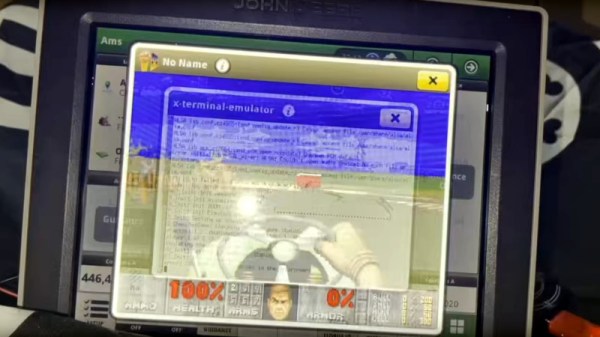
For Once, The Long Arm Of John Deere Presses The Right Button

Over many years now we’ve covered right-to-repair stories, and among them has been a constant bête noire. The American farm machinery manufacturer John Deere whose instantly recognisable green and yellow tractors have reliably tilled the soil for over a century, have become the poster child for inappropriate use of DRM. It’s enough to make any farmer see red, but there’s a story from CNN which shows another side to manufacturer control. A Deere dealership in Melitopol, Ukraine, was looted by invading Russian forces, who took away an estimated $5m worth of farm machinery. The perfect crime perhaps, save for the Deere computer system being used to remotely disable them leaving the crooks with combine harvesters they can’t even start.

It makes for a good news story showing the Ukranians getting one over on the looters, and since on-farm thefts are a hot topic anywhere in the world it’s not entirely unexpected that Deere would have incorporated a kill-switch in their products. Recently we covered a look at how the relationship between motor vehicle owner and manufacturer is changing from one of product ownership to software licence, and this is evidently an example of the same thing in the world of machinery. It’s reported that the looters are seeking the help of tractor hackers, which may be unfortunate for them since the world’s go-to source for hacked Deere software is Ukraine. Perhaps they would be better remembering that Russia has legendary tractors of its own.

Thanks [Robert Piston] for the tip.

From Car To Device: How Software Is Changing Vehicle Ownership

For much of the last century, the ownership, loving care, and maintenance of an aged and decrepit automobile has been a rite of passage among the mechanically inclined. Sure, the battle against rust and worn-out parts may eventually be lost, but through that bond between hacker and machine are the formative experiences of motoring forged. In middle-age we wouldn’t think of setting off across the continent on a wing and a prayer in a decades-old vehicle, but somehow in our twenties we managed it. The Drive have a piece that explores how technological shifts in motor vehicle design  are changing our relationship with cars such that what we’ve just described may become a thing of the past. Titled “The Era of ‘the Car You Own Forever’ Is Coming to an End“, it’s well worth a read.

At the crux of their argument is that carmakers are moving from a model in which they produce motor vehicles that are simply machines, into one where the vehicles are more like receptacles for their software. In much the same way as a smartphone is obsolete not necessarily through its hardware becoming useless but through its software becoming unmaintained, so will the cars of the future. Behind this is a commercial shift as the manufacturers chase profits and shareholder valuations, and a legal change in the relationship between customer and manufacturer that moves from ownership of a machine into being subject to the terms of a software license.

This last should be particularly concerning to all of us, after all if we’re expected to pay tens of thousands of dollars for a car it’s not unreasonable to expect that it will continue to serve us at our convenience rather than at that of its manufacturer.

If you’re a long-time Hackaday reader, you may remember that we’ve touched on this topic before.

Header image: Carolyn Williams, CC BY 2.0.

Track Those Leftovers With This Little Timer

We’ve all at some point in our lives opened the fridge door and immediately wished we hadn’t. A miasma of stench envelops us as we discover that last Saturday’s leftovers have been forgotten, and have gone off. If only we had some way to keep track of such things, to avoid such a stench-laden moment. Step forward [ThinkLearnDo], with a little timer designed for exactly that purpose.

The operation is simple enough, press the button and place the unit on top of the container with the leftovers in it. If you haven’t eaten the leftovers within a week, the LED will start blinking. The blink is a subtle reminder to deal with the old food before it becomes a problem.

Onboard is a Holtek HT68F001 microcontroller with a coin cell for power, not much else is needed. The Holtek is an unusual choice, one of several brands of super-inexpensive Chinese microcontrollers we see less commonly than ATmegas and STM32s. This is exactly the place where such a minimal computer fits perfectly:  a way to add a little bit of smarts to a very cheap item with minimal strain on the BoM.

If these chips interest you, a while back we covered a run-down of the different families including the Holtek and the famous 3-cent Padauk chips.

How To Hide A Photo In A Photo

If you’ve ever read up on the basics of cryptography, you’ll be aware of steganography, the practice of hiding something inside something else. It’s a process that works with digital photographs and is the subject of an article by [Aryan Ebrahimpour]. It describes the process at a high level that’s easy to understand for non-maths-wizards. We’re sure Hackaday readers have plenty of their own ideas after reading it.

The process relies on the eye’s inability to see small changes at the LSB level to each pixel. In short, small changes in colour or brightness across an image are imperceptible to the naked eye but readable from the raw file with no problems. Thus the bits of a smaller bitmap can be placed in the LSB of each byte in a larger one, and the viewer is none the wiser.

We’re guessing that the increased noise in the image data would be detectable through mathematical analysis, but this should be enough to provide some fun. If you’d like a closer look, there’s even some code to play with. Meanwhile as we’re on the topic, this isn’t the first time Hackaday have touched on steganography.