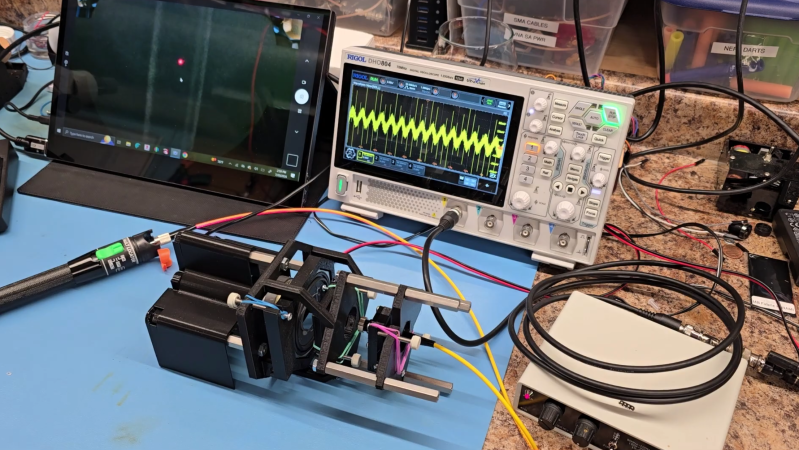
A plastic device sits on a desk, with a computer display and an oscilloscope behind it. A fiber-optic cable runs from the device to a laser diode source.

2026 Frikkin Lasers Challenge: Measuring Nanometer-Scale Displacements With An Optical Cavity

Optical cavities – two mirrors arranged to reflect light multiple times between them – form the basis of lasers and certain optical filters. Since any angle between the two mirrors results in light being scattered away, parallel alignment is essential, yet difficult to maintain. Nevertheless, [Timothy Giles] managed to 3D-print and align such an optical cavity, and used it to detect minute shifts in space and wavelength.

The cavity has two semi-transparent mirrors facing towards each other. One mirror is held in a 3D-printed mount, and the other is attached to the diaphragm of a speaker with a hole drilled through the center. The hole avoids the speaker coil, and allows light exiting the optical cavity through the semi-transparent mirror to appear on a paper target, which is monitored by a webcam. On the other side of the optical cavity, a laser diode coupled to a single-mode fiber shines in through the other mirror. Alignment is challenging, but the webcam makes it easier; as the mirrors tilt relative to each other, the pattern seen on the paper target changes, providing feedback for more precise adjustment.

Light reflected within the cavity can interfere constructively or destructively with incoming light, changing the brightness of the emitted beam. [Tim] used the speaker as a linear actuator to vary the cavity’s length, which, by counting the peaks in brightness, allowed him to measure the diaphragm’s displacement. This also demonstrated a laser diode’s wavelength instability: when the cavity was set to a constant length and the laser started up, the output brightness would cycle a few times. As the diode was warming up, its output wavelength was shifting, creating the same changing interference pattern.

To get a Gaussian beam distribution, [Tim] used a fiber-coupled laser; if you’d like to build one, we’ve seen a coupling mechanism built before. Most lasers are built around an internal optical cavity, but some instead use an external cavity.

Lowering Your Noise Floor, The Easy Way

If there’s anything more annoying to an amateur radio operator than noise, we’re not sure what it could be. We’re talking about radio frequency noise, of course, the random broadband emissions that threaten to make it almost impossible to work the bands and pick out weak signals. This man-made interference is known as “QRM” in ham parlance, and it has become almost intolerable of late, as poorly engineered switch-mode power supplies have become more common.

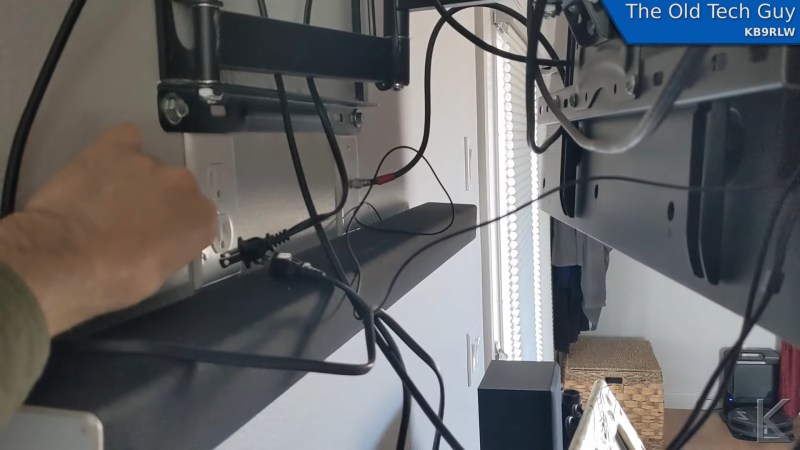
But hams love a technical challenge, so when a nasty case of QRM raised its ugly head, [Kevin Loughlin (KB9RLW)] fought back. With an unacceptable noise floor of S8, he went on a search for the guilty party, and in the simplest way possible — he started flipping circuit breakers. Sure, he could have pulled out something fancier like a TinySA spectrum analyzer, but with his HF rig on and blasting white noise, it was far easier to just work through the circuits one by one to narrow the source down. His noise problem went away with the living room breaker, which led to pulling plugs one by one until he located the culprit: a Roomba vacuum’s charging station.

Yes, this is a simple trick, but one that’s worth remembering as at least a first pass when QRM problems creep up. It probably won’t help if the source is coming from a neighbor’s house, but it’s a least worth a shot before going to more involved steps. As for remediation, [Kevin] opts to just unplug the Roomba when he wants to work the bands, but if you find that something like an Ethernet cable is causing your QRM issue, you might have to try different measures.

Continue reading “Lowering Your Noise Floor, The Easy Way”

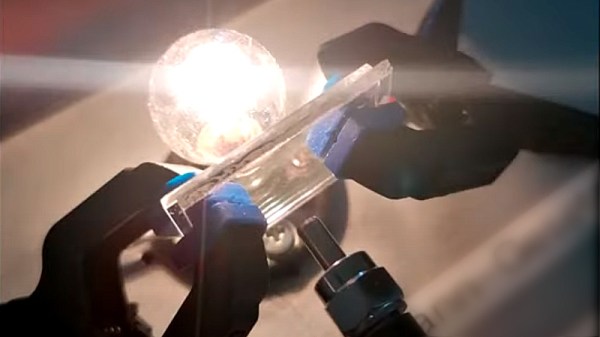
Setup of a small lightbulb passing light through a thin film

Experimenting With Interference On Thin Layers

[Stoppi] has taken on a fascinating project involving the interference of thin layers, a phenomenon often observed in everyday life but rarely explored in such depth. This project delves into the principles of interference, particularly focusing on how light waves interact with very thin films, like those seen in soap bubbles or oil slicks. The post is in German, but you can easily translate it using online tools.

Interference occurs when waves overlap, either reinforcing each other (constructive interference) or canceling each other out (destructive interference). In this project, [Stoppi] specifically examines how light behaves when passing through thin layers of air trapped between semi-transparent mirrors. When light waves reflect off these mirrors, the difference in path length leads to interference patterns that depend on the layer’s thickness and the wavelength of the light.

To visualize this, [Stoppi] used an interferometer made from semi-transparent mirrors and illuminated it with a bulb to ensure a continuous spectrum of light. By analyzing the transmitted light spectrum with a homemade spectrometer, he observed clear peaks corresponding to specific wavelengths that could pass through the interferometer. These experimental results align well with theoretical predictions, confirming the effectiveness of the setup.

If you like pretty patterns, soap bubbles are definitely good for several experiments. Don’t forget: pictures or it didn’t happen.

Continue reading “Experimenting With Interference On Thin Layers”

Reggaeton-Be-Gone Disconnects Obnoxious Bluetooth Speakers

If you’re currently living outside of a Spanish-speaking country, it’s possible you’ve only heard of the music genre Reggaeton in passing, if at all. In places with large Spanish populations, though, it would be more surprising if you hadn’t heard it. It’s so popular especially in the Carribean and Latin America that it’s gotten on the nerves of some, most notably [Roni] whose neighbor might not do anything else but listen to this style of music, which can be heard through the walls. To solve the problem [Roni] is now introducing the Reggaeton-Be-Gone. (Google Translate from Spanish)

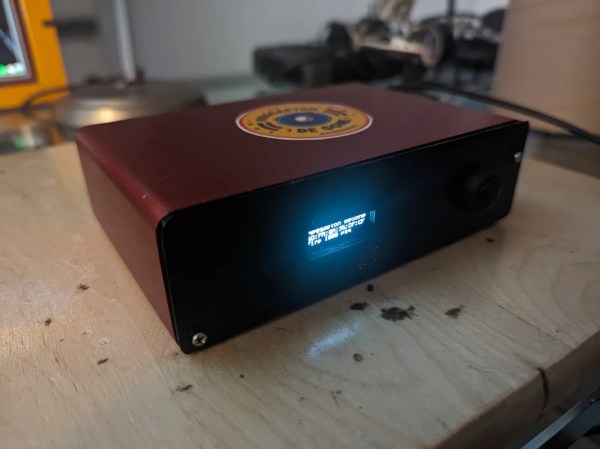
Inspired by the TV-B-Gone devices which purported to be able to turn off annoying TVs in bars, restaurants, and other places, this device can listen to music being played in the surrounding area and identify whether or not it is hearing Reggaeton. It does this using machine learning, taking samples of the audio it hears and making decisions based on a trained model. When the software, running on a Raspberry Pi, makes a positive identification of one of these songs, it looks for Bluetooth devices in the area and attempts to communicate with them in a number of ways, hopefully rapidly enough to disrupt their intended connections.

In testing with [Roni]’s neighbor, the device seems to show promise although it doesn’t completely disconnect the speaker from its host, instead only interfering with it enough for the neighbor to change locations. Clearly it merits further testing, and possibly other models trained for people who use Bluetooth speakers when skiing, hiking, or working out. Eventually the code will be posted to this GitHub page, but until then it’s not the only way to interfere with your neighbor’s annoying stereo.

Thanks to [BaldPower] and [Alfredo] for the tips!

Hackaday Links Column Banner

Hackaday Links: June 4, 2023

A report released this week suggests that 50 flights into its five-flight schedule, the Mars helicopter might be starting to show its age. The report details a protracted communications outage Ingenuity’s flight controllers struggled with for six sols after flight 49 back in April. At first attributed to a “communications shadow” caused by the helicopter’s robotic buddy, Perseverance, moving behind a rocky outcrop and denying line of sight, things got a little dicey once the rover repositioned and there was still no joy. Since the helicopter has now graduated from “technology demonstration” to a full-fledged member of the team tasked with scouting locations for the rover while respecting the no-fly zone around it, it was essential to get it flying again. Several attempts to upload a flight plan failed with nothing but an acknowledgment signal from the helicopter, but a final attempt got the program uploaded and flight 50 was a complete if belated success. So that’s good, but the worrying news is that since Sol 685, the helicopter has been switching in and out of nighttime survival mode. What that portends is unclear, but no matter how amazing the engineering is, there’s only so much that can be asked on Ingenuity before something finally gives.

Continue reading “Hackaday Links: June 4, 2023”

Mon Dieu! French Parent Kills Cell Service For An Entire Town To Stop Kids Surfing

It used to be that having technical skills meant that fixing the computer problems of elderly relatives was a regular occurrence. Over the last few years this has been joined by another request on our time; friends with teenage children requesting help configuring their routers such that Internet access is curtailed when the kids should sleeping. In France a desperate parent took more extreme measures, buying a wideband frequency jammer to ensure les petits anges can’t waste the night away on social media sites through their cellular connections. It had the intended effect, but sadly it also interrupted cellular coverage over a wide area The French spectrum regulator ANFR sent in their investigators (French, Google Translate link), and now the unfortunate parent faces the prospect of up to 6 months imprisonment and €30,000 fine for owning and using a device that’s illegal in France.

A cursory search of everybody’s favourite online electronics bazaars will find plenty of these devices, so perhaps what’s surprising is that we don’t see more of these devices even if it’s not the first tale of interference tracking that we’ve seen. Judging by the strategies our friends with kids take, we’d suggest meanwhile to the unfortunate French person, that they simply equip their kids with restricted data plans.

Interference Patterns Harnessed For Optical Logic Gates

The basics of digital logic are pretty easy to master, and figuring out how the ones and zeroes flow through various kinds of gates is often an interesting exercise. Taking things down a level and breaking the component AND, OR, and NOR gates down to their underlying analog circuits adds some complexity, but the flow of electrons is still pretty understandable. Substitute all that for photons, though, and you’ll enter a strange world indeed.

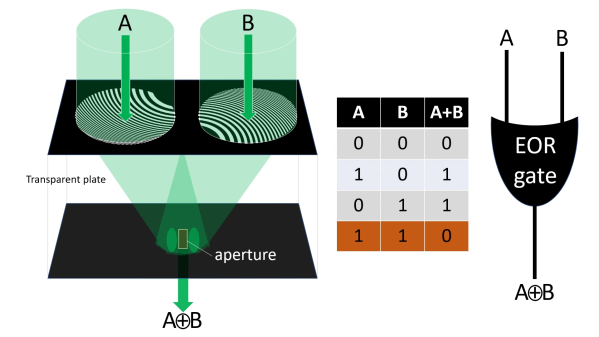
At least that’s our take on [Jeroen Vleggaar]’s latest project, which is making logic gates from purely optical components. As he himself admits in the video below, this isn’t exactly unexplored territory, but his method, which uses constructive and destructive interference, seems not to have been used before. The basic “circuit” consists of a generator, a pair of diffraction patterns etched into a quartz plate, and an evaluator, which is basically a pinhole in another plate positioned to coincide with the common focal point of the generator patterns. An OR gate is formed when the two generators are hit with in-phase monochromatic light. Making the two inputs out of phase by 180° results in an XOR gate, as destructive interference between the two inputs prevents any light from making it out of the evaluator.

Continue reading “Interference Patterns Harnessed For Optical Logic Gates”