What’s In A Raspberry Pi Processor Update?

Those of us who have followed the Raspberry Pi over the years will be familiar with the various revisions of the little board, with their consequent new processors. What may be less obvious is that within the lifetime of any chip there will often be minor version changes, usually to fix bugs or to fine-tune production processes. They’re the same chip, but sometimes with a few extra capabilities. [Jeff Geerling] didn’t miss this when the Raspberry Pi 400 had a BCM2711 with a newer version number than that on the Pi 4, and now he’s notices the same chip on Pi 4 boards.

Why might they run two different revisions of the chip in parallel? It seems that the update changes the amount of memory addressable by the eMMC and the PCIe bus, the former could only see the first 1GB and the latter the first 3Gb. For the lower-spec Pi 4 boards this doesn’t present a problem, but for those with 8 gigabytes of memory it could clearly be an issue. Thus the Pi 400 and the top spec Pi 4 now have a newer BCM2711 version. This will almost certainly pass unnoticed for the average Raspberry Pi OS user, but the extra memory addressing space should be of interest for hardware experimenters wishing to expose that PCIe bus and talk to peripherals such as a GPU. That said, though he suggests the Compute Module 4  has the newer revision, his own experiments were unsuccessful.

[Editor’s Note: our own overclocking experiments show the C-version SOCs to run cooler/faster than their B counterparts, so it’s nice to have the better chips in the “normal” Pi form factor and not just the Pi 400 and compute modules.]
A Coolant Leak The Likely Culprit For Aussie Tesla Battery Bank Fire

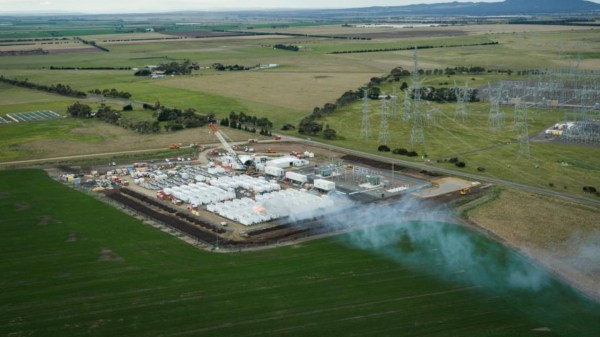
Followers of alternative energy technology will remember how earlier in the year a battery container at Tesla’s Megapack Australian battery grid storage plant caught fire. Lithium ion batteries are not the easiest to extinguish once aflame, but fortunately the fire was contained to only two of the many battery containers on the site.

The regulator Energy Safe Victoria have completed their investigation into the incident, and concluded that it was caused by a coolant leak in a container which caused an electrical component failure that led to the fire. It seems that the container was in a service mode at the time so its protection systems weren’t active, and that also its alarm system was not being monitored. They have required that cooling systems should henceforth be pressure tested and inspected for leaks, and that alarm procedures should be changed for the site.

When a new technology such as large-scale battery storage is brought on-line, it is inevitable that their teething troubles will include catastrophic failures such as this one. The key comes in how those involved handle them, and for that we must give Tesla and the site’s operators credit for their co-operation with the regulators. The site’s modular design and the work of the firefighters in cooling the surrounding packs ensured that a far worse outcome was averted. Given these new procedures, it’s hoped that future installations will be safer still.

You can read our original coverage of the fire here, if you’re interested in more information.

[Main image source: CFA]

E3D On Patents And Not Being Evil About Them

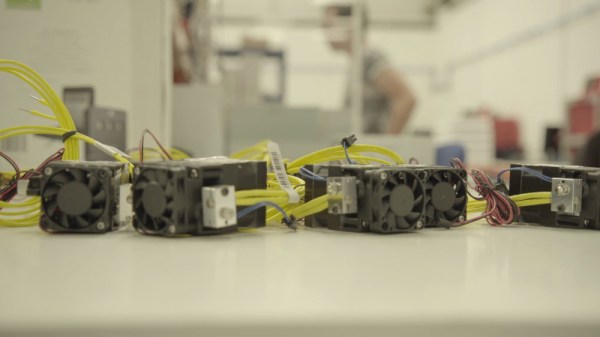
In our community it’s certain that there will be many people with very strong views about patents. It’s fair to say that the patents system is at times not fit for purpose, with such phenomena as patent trolls, submarine patents, and patent war chests doing nothing but leading it into disrepute. So it’s interesting to read the words of 3D printer hotend manufacturer E3D, as they talk about why they feel the need to patent some of their inventions, and how they intend to proceed with them.

The result is a no-nonsense explanation of why their work being reproduced by overseas competitors has brought them to this point, and in short: they’re patenting very specific inventions rather than broad catch-alls, they are making what they call a legally binding promise not to enforce the patents against non-commercial or academic experimenters, and they will continue to open-source as much as they can.

Will it work for them, or is it the start of a slippery slope? We can see why the E3D folks have taken this step, and we hope that they will continue to act in a responsible manner. If not, as those who have followed the maker-oriented 3D printing business for a long time will know: treading the line between open-source and closed-source can be fraught with danger.

How To Get Into Computer Game Development In 1982

If you are a follower of retrocomputing, perhaps you caught the interactive Black Mirror episode Bandersnatch when it came out on Netflix. Its portrayal of a young British bedroom coder finding his way into the home computer games industry of the early 1980s was of course fictional and dramatised, but for those interested in a real-life parallel without the protagonist succumbing to an obsession with supernatural book there’s a recent epic Twitter thread charting an industry veteran’s path into the business.

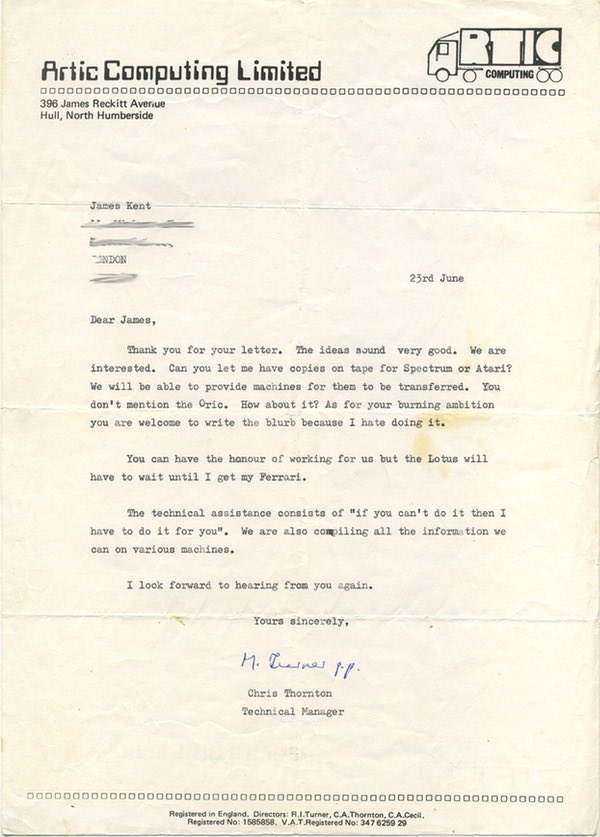
An acceptance letter like this from Artic Software would have been the wildest dream of any early-80s bedroom coder.

[Shahid Kamal Ahmad] now has an impressive portfolio spanning his his nearly four decades at the forefront of gaming, but his story starts in 1982 as a diabetic British Pakistani teenager from a not-privileged background in London writing in BASIC on his Atari 400. His BASIC games are good, but not good enough to gain acceptance from a publisher, so he sells his prized BMX bicycle to buy books on Atari 6502 assembler, a coffee percolator, and for curiosity’s sake, [Rodnay Zaks’] Programming the Z80. An obsessive three-month learning of 6502 programming and the Atari’s architecture ensues, and his game Storm in a Teacup sells to Artic Software.  He’s a professional game developer.

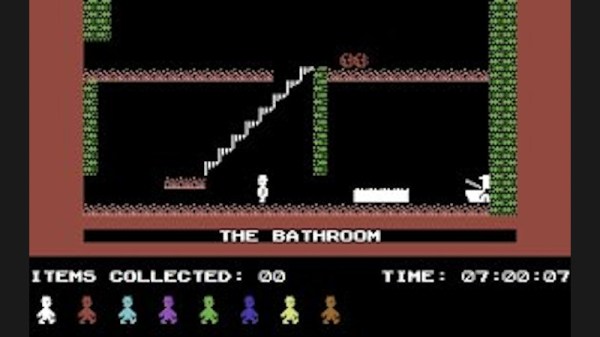
We follow him through a couple more projects until he arrives at Software Projects in Liverpool to try to sell his game Faces of Haarne, which he secures publishing for but also lands the opportunity of a lifetime. Jet Set Willy is the smash hit of the year on the ZX Spectrum, and they urgently need a Commodore 64 port. Can he do it in four weeks, with a bonus if he manages three? The subsequent descent into high-pressure assembly coding and learning the quirks between two completely different 8-bit architectures is an epic in itself, but he manages it in just a shade over the three weeks and they pay him the bonus anyway. His career in the computer game industry is cemented.

Through this tale the reminders of 1980s Britain are everywhere, far from bring a retro paradise it was a place hollowed out by industrial decline, with very little for those at the bottom of society to be optimistic about. His descriptions of casual racism are hard-hitting, but the group of computer-addicted friends at school is probably something that all teenagers of the era whose interests lay in that direction can relate to. The real hero of the story is probably his mother, who somehow found the resources for that Atari 400 and who provided him with much-needed support and encouragement.

This thread captures a unique and never-to-be repeated era in which a teenager could master an emerging technology and make a living in it without an expensive education. Like Bil Herd’s description of his career at Commodore in the same period, it’s well worth a read.

Reinforced Concrete: Versatile At Any Size?

In our community we’re no strangers to making things, and there are plenty among us who devote their efforts to modelmaking. It’s uncommon, though, for a scale model of something to be made using the exact same techniques as whatever it’s copying. Instead a model might be made from card, foam, glassfibre, or resin. [tiny WORLD] takes an opposite tack, building scale model civil engineering projects just as they would have been for real. (Video, embedded below.)

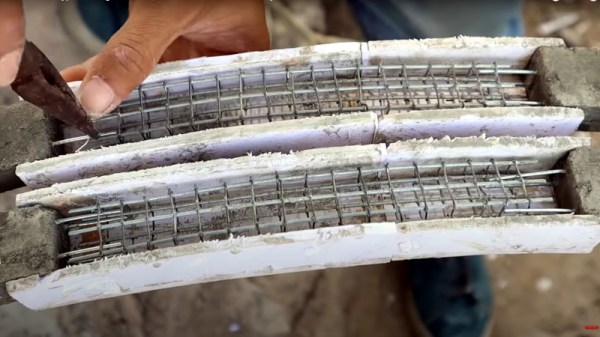
Here, a scale model of the Hoover Dam bypass bridge is made as the original, from reinforced concrete. In place of rebar is a wire grid in place of wooden shuttering is what looks like foam board, the concrete is a much smoother mortar, but otherwise it’s the real thing. We see the various bridge parts being cast in situ, with the result being as strong as you’d expect from the original.

We can see that this is a great technique for modelling concrete buildings and structures, but it’s also a material that we think might have other applications at this scale. How would the rigidity, strength, and mass of small-scale reinforced cement compare to 20-20 extrusion, 3D-printed plastic, or wood, for example? Regardless, it’s interesting to watch, as you can see from the video below the break.

Continue reading “Reinforced Concrete: Versatile At Any Size?”

The Simplest FT8 Transceiver You’ll Ever Build

Probably the most interesting facets of amateur radio in 2021 lie in the realm of digital modes. Using the limitless possibilities of software defined radios has freed digital radio communication from the limits of what could be done with analogue electronics alone, and as a result this is a rare field in which radio amateurs can still be ahead of the technological curve. On of these newer digital modes is FT8 created by the prolific [Joe Taylor K1JT].

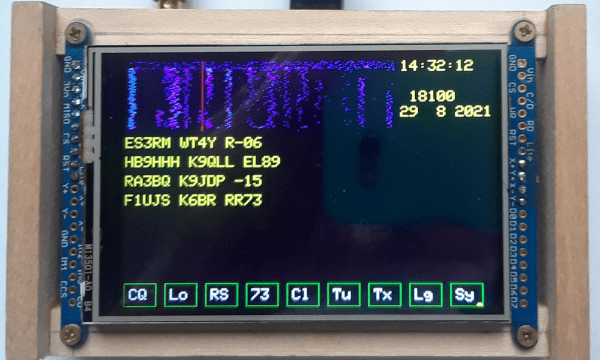
And it’s for this  mode that [Charles Hill] has created an easy-to-build transceiver. Its brains are aTeensy 3.6, while the receive side is a Si4735 receiver chip and the transmitter is a Si5351 programmable clock chip driving a Mini-Circuits GVA84 power amplifier with an appropriate filter. The interface is via a touchscreen display. It relies on existing work that applies a patch on-the-fly to the Si4735 receiver chip for SSB reception, and another project for the FT8 software.

The charm of this transceiver is that it can be assembled almost in its entirety from modules. Some radio amateurs might complain that homebrew radios should only use the most basic of components assembled from first principles, but the obvious answer to that should be that anything which makes radio construction easier is to be welcomed. If the 100 mW output power seems a bit low it’s worth remembering that FT8 is a weak signal mode, and given the right propagation conditions the world should be able to hear it despite the meagre output.

We’ve featured quite a few radios using the Si47XX series, which can be made into very tidy receivers indeed.

A Toy Jeep For After The Apocalypse

When your friends are off to the post-apocalyptic Wasteland Festival and present you with a defunct Power Wheels clone toy Jeep to make ready for the festivities, what are you to do? If you happen to be [Victor Frost], soup it up with new electrics and uprated steering, and send it forth into the hideous no-mans land.

These toys usually have one or two 12V high-speed motors driving plastic gear trains for the rear wheels. This one is a two-motor model and unexpectedly comes with a steering motor for parental remote control. All its electronics were dead, so rather than do a complete motor upgrade he instead doubled the voltage and installed decent motor controllers with an Arduino sending them instructions. Otherwise it received an upgrade and stiffening of its chassis and steering components, and the kids plastic steering wheel was replaced with a wooden one.

The result is not quite Mad Max as while it’s faster than the original there’s still something of the pedestrian about it. But it seems to be a load of fun, and we can’t help admitting we’d like a go in it. If you’re hungry for more, this isn’t the first such story we’ve covered.