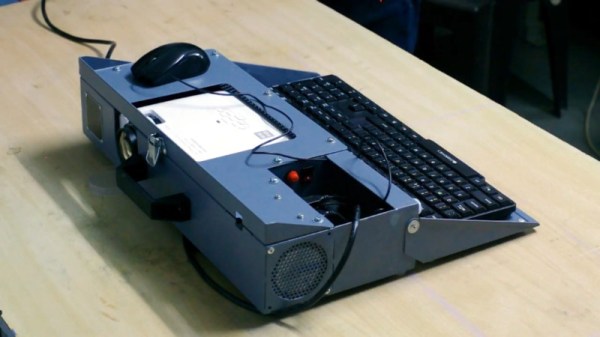
It Takes A Lot To Build A Hacker’s Laptop

An essential tool that nearly all of us will have is our laptop. For hardware and software people alike it’s our workplace, entertainment device, window on the world, and so much more. The relationship between hacker and laptop is one that lasts through thick and thin, so choosing a new one is an important task. Will it be a dependable second-hand ThinkPad, the latest object of desire from Apple, or whatever cast-off could be scrounged and given a GNU/Linux distro? On paper all laptops deliver substantially the same mix of performance and portability, but in reality there are so many variables that separate a star from a complete dog. Into this mix comes a newcomer that we’ve had an eye on for a while, the Framework. It’s a laptop that looks just like so many others on the market and comes with all the specs at a price you’d expect from any decent laptop, but it has a few tricks up its sleeve that make it worth a glance.

These USB-C based modules are a neat idea.

Probably the most obvious among them is that as well as the off-the-shelf models, it can be bought as a customised kit for self-assembly. Bring your own networking, memory, or storage, and configure your new laptop in a much more personal way than the norm from the big manufacturers. We like that all the parts are QR coded with a URL that delivers full information on them, but we’re surprised that for a laptop with this as its USP there’s no preinstalled open source OS as an option. Few readers will find installing a GNU/Linux distro a problem, but it’s an obvious hole in the line-up.

On the rear is the laptop’s other party trick, a system of expansion cards that are dockable modules with a USB-C interface. So far they provide USB, display, and storage interfaces with more to come including an Arduino module, and we like this idea a lot.

It’s all very well to exclaim at a few features and party tricks, but the qualities that define a hacker’s laptop are only earned through use. Does it have a keyboard that will last forever, can it survive being dropped, and will its electronics prove to be fragile, are all questions that can be answered only by word-of-mouth from users. It’s easy for a manufacturer to get those wrong — the temperamental and fragile Dell this is being typed on is a case in point — but if they survive the trials presented by their early adopters and match up to the competition they could be on to a winner.

Classroom Surplus Becomes Linux Powerhouse

The SMART Response XE is a handheld computer that was originally sold for use in the classroom as a terminal for pupils taking tests. It’s now cheap enough on the surplus market to have become a target for experimenters, and we’ve seen them with a variety of cool hacks. We particularly like what [chmod775] has done with it, putting a VT100 terminal emulator on the device and hiding a NanoPi Neo Air single board computer in the battery bay. Powered from a USB battery bank, it gives a fully-featured Linux terminal in the palm of the hand. We see it running an Ubuntu LTS  version, and it’s clear that it’s a functional and usable device.

This raises a more abstract question though: We’d guess comparatively few of us write software through an old-style dumb terminal, instead we’re more likely to get our terminal experience at a much more accomplished command line with all the conveniences of a modern desktop surrounding it. How many of us could comfortably return to the limited confines of a VT100 emulator on an odd-sized LCD display? We’d be interested to hear [chmod755]’s experiences using it, because if it retains usability it’s a device we wouldn’t mind having ourselves.

Hungry for more SMART Response XE hacks? Take a look at the BASIC computer, or the spectrum analyser.

If Society Is In Danger Of Collapse, Here’s How We Should Do Our Bit

If you’ve been following the news, you can’t have missed the series of floods, droughts, and wildfires that have occurred seemingly in all corners of the world. Coming on the heels of a Northern Hemisphere winter that had its own extreme weather events, it would be perhaps foolhardy not to by now take climate change seriously. You may also have seen the news about a return to a 1970s paper in which MIT crystal-ball-gazers predicted the collapse of our civilisation in the mid-21st century, and a review based upon the empirical data gathered since then which concluded that we could be right on track with that prediction set to happen in about 2040.

It’s sobering stuff, and something which could so easily form the basis of many a Hollywood apocalyptic disaster movie. But sitting here in 2021 amid extreme weather events and a global pandemic it’s certainly something to think about. It’s not as though we’re riding biogas-powered weapon cars through the post-apocalyptic desert just yet though, we still have a chance to do something to avert catastrophe and no doubt over the next decade a raft of changes will reduce our CO2 impact and make our infrastructure more resilient to stave off any coming crises.

Our mind was turned to the halcyon time before the pandemic, to the Danish BornHack hacker camp back in August 2019. One of the talks at the event came from [Igor Nicolic], whose day job as an academic with Delft University of Technology takes him into the study of ecology and sustainability. In it he looks at the current state of global sustainability, and identifies the roles which the hardware hacker community could play in an uncertain future. It’s a fascinating lecture from an expert in the field and it’s well worth a watch and taking note of his points, so we’ve placed it below the break. Continue reading “If Society Is In Danger Of Collapse, Here’s How We Should Do Our Bit”

Are Hackers Being Let Down In Education?

In my work for Hackaday over the years I have been privileged to interact with some of the most creative people I have ever met, I have travelled far more than I ever did when I toiled unseen in an office in Oxford, and I have been lucky enough to hang out in our community’s spaces, camps, and dives across Europe.

Among the huge diversity of skills and ideas though, it’s striking how many of us share similar experiences and histories that have caused us to find our people in rooms full of tools and 3D printers. One of these things I found surprising because I thought I was the only one; I never fit in with the other kids at school, I found much of the teaching incomprehensible and had to figure things out for myself. As an exercise recently I did a straw poll among some of my friends, and found that a significant majority had a similar experience. Clearly something must have gone badly wrong in the way we were being taught that so many of us could have been let down by our schooling, and maybe to understand the needs of our community it’s time to understand why.

Continue reading “Are Hackers Being Let Down In Education?”

Retrotechtacular: Nuvistor, Vacuum’s Last Gasp

In 2021 all our electronics are solid state, in that they exclusively use semiconductor devices as their active components. Some of us may experiment with vacuum tubes, but only for curiosity or aesthetic purposes. Semiconductors have overtaken vacuum devices in all but the rarest of niche applications due to their easier design requirements, greater reliability, lower cost, and increased performance.

It was not always this way though, and there was a period at the start of the semiconductor era when transistors and vacuum tubes existed together side-by-side and competed directly. Vacuum tube manufacturers continued to create new devices into the 1970s, and in doing so they pushed the boundaries of their art in unprecedented directions. [David W Knight] has a page dedicated to the Nuvistor, something his calls the “final evolution of the thermionic valve”. His comparison photo seen above shows a Nuvistor on the left — a miniature vacuum tube you’ve likely never seen before.

Continue reading “Retrotechtacular: Nuvistor, Vacuum’s Last Gasp”

It’s Linux – But On An ESP32

GNU/Linux is an open-source marvel that has over the past three decades given us an almost infinitely versatile and powerful UNIX-like operating system. But even it has its limitations, particularly at the lower end of the hardware scale where less fully-featured processors often lack the prerequisites such as a memory management unit. Thus [JuiceRV]’s feat of booting a Linux kernel on an ESP32 microcontroller seems impossible, what’s happening?

The ESP’s dual 32-bit Xtensa cores are no slouch in the processing power department, but without that MMU it’s not an obvious Linux candidate platform. The solution to this problem comes in the form of an emulated RISC-V virtual machine which provides just enough grunt for a Linux 5.0.0 kernel to boot.

By any measure this represents an impressive piece of work, but will this new-found ability to run Linux on a microcontroller take the world by storm? Of course not, unless your tastes run to the very slowest of computing experiences. It is however the essence of the hack, and for that we salute it.

It’s not the first time Linux has run on a microcontroller, in the past someone hooked up a 30 pin SIMM and an SD card to an 8-bit Atmel chip and did it in a similar way with an ARM emulator.

Via CNX Software.

Header image: Ubahnverleih, CC0.

The Gatwick Drone: Little By Little, The Story Continues To Unravel

If you remember the crazy events in the winter of 2018 as two airports were closed over reports of drone sightings, you might be interested to hear that there’s still a trickle of information about those happenings making it into the public domain as Freedom of Information responses.

Three Christmases ago the news media was gripped by a new menace, that of rogue drones terrorising aircraft. The UK’s Gatwick airport had been closed for several days following a spate of drone sightings, and authorities thundered about he dire punishments which would be visited upon the perpetrators when they were caught. A couple were arrested and later quietly released, and after a lot of fuss the story quietly disappeared.

Received Opinion had it that a drone had closed an airport, but drone enthusiasts, and Hackaday as a publication in their sphere, were asking awkward questions about why no tangible evidence of a drone ever having been present had appeared. Gradually the story unravelled with the police and aviation authorities quietly admitting that they had no evidence of a drone, and a dedicated band of drone enthusiasts has continues to pursue the truth about those few winter nights in 2018. The latest results chase up the possibility that the CAA might have received a description of the drone, and why when a fully functional drone detection system had been deployed and detected nothing they continued with the farce of closing the airport.

Perhaps the saddest thing about these and other revelations about the incident which have been teased from the authorities is that while they should fire up a scandal, it seems inevitable that they won’t. The police, the government, and the CAA have no desire to be reminded of their mishandling of the event, neither except for a rare bit of mild questioning do the media wish to be held to account for the execrable quality of their reporting. The couple who were wrongly arrested have not held back in their condemnation, but without the attention of any powerful vested interests it seems that some of the measures brought in as a response will never be questioned. All we can do is report any new developments in our little corner of the Internet, and of course keep you up to date with any fresh UK police drone paranoia.