That Elusive Valve Amp Sound, For Not A Lot! (There Has To Be A Catch)

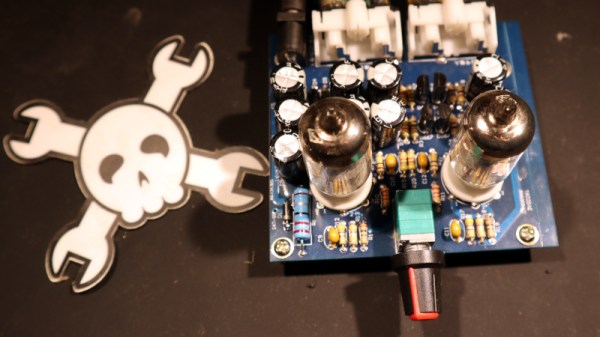
It was with considerable interest last month that I set out to track down where in the world there are still factories making tubes. My research found them in Slovakia, Russia, and China, and it’s fairly certain I didn’t find all the manufacturers by any means. There appeared to be a whole class of mundane tubes still in production that weren’t to be found on their glossy websites. A glance at any outlet through which Chinese modules can be bought will find this type of tube in small audio amplifier projects, and some of them can be astoundingly cheap. When faced with cheap electronics of course I’m tempted to buy some, so I parted with about £10 ($12.50) and bought myself a kit for a two-tube device described as a stereo preamplifier and headphone amplifier.

An Unusual Tube Choice For Audio
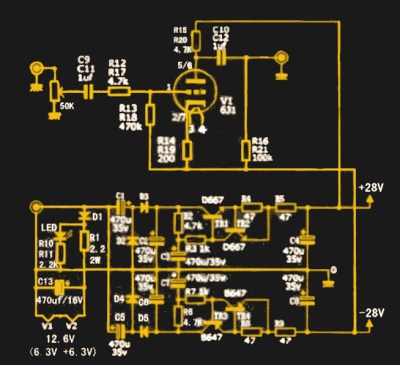
What I received for my tenner was a press-seal bag with a PCB and a pile of components, and not much else. No instructions, which would have been worrisome were the board not clearly marked with the value of each component. The circuit was on the vendor’s website and is so commonly used for these sort of kits that it can be found all over the web — a very conventional twin common-cathode amplifier using a pair of 6J1 miniature pentodes, and powered through a +25 V and -25 V supply derived from a 12 VAC input via a voltage multiplier and regulator circuit. It has a volume potentiometer, two sets of phono sockets for input and output, and the slightly naff addition of a blue LED beneath each tube socket to impart a blue glow. I think I’ll pass on that component.

The 6J1 seems to be ubiquitous throughout the Chinese kits, which is surprising when you understand that it’s not an audio tube at all. Instead it’s a small-signal VHF amplifier, a rough equivalent of the European EF95, and would be much more at home in an FM radio receiver or turret TV tuner from the 1950s. I can only assume that somewhere in China there’s a tube factory tooled up for radio tube production that is targeting this market, because another tube you will see in audio power amplifier kits is the FU32 or QQV03-20 in European parlance, a large power beam tetrode that might have been found in a 1950s military radio transmitter. Still just as if you were to use an RF transistor in an audio circuit it would give good account of itself, so it is with an RF tube. There is no reason a 6J1 won’t do an acceptable job in a circuit such as this one.

Continue reading “That Elusive Valve Amp Sound, For Not A Lot! (There Has To Be A Catch)”
Perfect Photographs For PCB Reverse Engineering

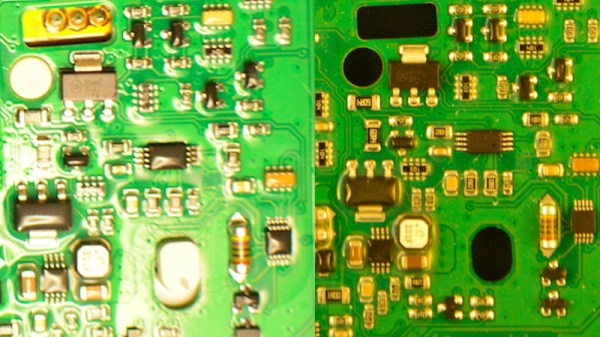
There’s an unexpected part of hacking that is very difficult to get right, namely photographing printed circuit boards. Everything seems to catch the light, making for a complex dance of manipulating light sources and camera angles. We were thus captured by [Roman Valls]’ budget rig for taking PCB photos that makes ingenious use of roadside trash to achieve a result.

It was inspired by a video featuring a much more accomplished rig, which he set out to emulate for much less outlay. Instead of an expensive lens, he’s using a Nikon camera with its kit lens. And instead of a tripod there’a a scrap drawer salvaged from the roadside and modified to become a camera holder. Lighting is diffused by baking paper, and the result is a rig that can photograph PCBs with neutral lighting and without annoying highlights.

We especially like work that takes junk and makes something useful from it, and though our purpose isn’t in reverse engineering it’s impressive to see how well the technique reveals the traces. We’ll definitely be experimenting with some of the techniques herein, and those lighting tips might also work with the Hackaday ear camera microscope.

Start Me Up: What Has The Windows 95 Desktop Given Us 25 Years Later?

We’ve had something of an anniversary of late, and it’s one that will no doubt elicit a variety of reactions from our community. It’s now 25 years ago that Windows 95 was launched, the operating system that gave the majority of 1990s PC users their first taste of a desktop-based GUI and a 32-bit operating system.

To the strains of the Rolling Stones’ Start me up, Microsoft execs including Bill Gates himself jubilantly danced on stage at the launch of what was probably to become the company’s defining product, perhaps oblivious to the line “You make a grown man cry” which maybe unwittingly strayed close to the user experience when faced with some of the software’s shortcomings.

Its security may seem laughable by the standards of today and the uneasy marriage of 16-bit DOS underpinning a 32-bit Windows operating system was clunky even in its heyday, but perhaps now is the best time to evaluate it unclouded by technical prejudice. What can we see of Windows 95 in the operating systems we use today, and thus from that can we ask the question: What did Windows 95 get right? Continue reading “Start Me Up: What Has The Windows 95 Desktop Given Us 25 Years Later?”

Something To Look Forward To: MCH2021 Call For Participation

As we stare dejectedly at our screens and consider what might have been during the 2020 summer that didn’t quite happen, here’s a little something to look forward to in a future where the COVID-19 pandemic will with any luck be much less of a threat. We have have had precious little in the way of events in 2020, but the call for participation has been announced for one of the largest planned for 2021. MCH2021 will be big European summer camp of next year, and is scheduled for the 6th to the 10th of August at Scoutinglandgoed Zeewolde in the Netherlands province of Flevoland. It will be the latest in a long line of such events going back to 1989, and with such a track record we know it’s going to be a good one.

We know that among our community are many people who’ll be interested in going to MCH, and that each and every one of you will have some fascinating insights that others would love to hear about. The challenge of the MCH orga is to bestow upon you the courage to stand up in front of your peers and talk about it, and from our experience here at Hackaday we’d say that an event such as this one makes for a very good place to give speaking a try. As always they’re interested in all the cool stuff that comes from our diverse community, but to help you along they’ve suggested a theme. Recent events have it’s fair to say presented a challenge to the world, and in that light they state that “we are especially looking for content that is about our ability to recover from extreme events of whatever nature”. We look forward to seeing you there.

Hands-On: BornHack 2020 Badge Has 9×32 Of Bling Fed By CircuitPython

Despite widespread pandemic cancellations, BornHack still happened this year and they even managed to once again bring an electronic badge to all attendees. If you missed it, I’ve already published an overview of the hacker camp itself. Today let’s dig into the 2020 BornHack badge!

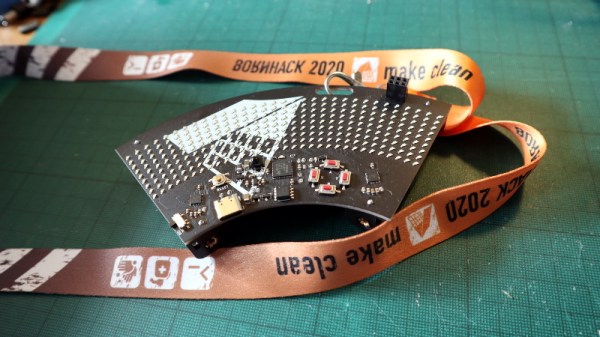
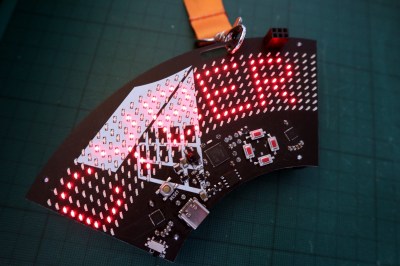
Designed by Thomas Flummer and manufactured in Denmark, it takes the form of a PCB in the shape of a roughly 60 degree circular arc with most of its top side taken up by a 9 by 32 array of SMD LEDs. There is the usual 4-way button array and space for an SAO connector on the rest of the front face, while on the rear are a set of GPIO pads and a pair of AA battery holders for power. Connectivity is via USB-C and infra-red, and usefully there is also a power on/off switch.

At the heart of its hardware is a SAMD21G18A ARM Cortex M0+ microcontroller which is perhaps not the most exciting of chips, but the hardware becomes more interesting with the LED drivers. A pair of the IS31FL3731 chips (you may recognise from Brian Benchoff’s Mr. Robot badge) each drive half of the Charliplexed LED array. These versatile chips take the bother of scanning the LED matrix away from the microcontroller with their own internal frame registers fed from an I2C interface. This choice both makes the best use of the relatively meagre microcontroller in this application, and opens the way for the software choice. This badge runs Adafruit’s CircuitPython, and can thus be programmed over the USB connection in the same way as any other CircuitPython board. To test this I put aside my GNU/Linux laptop, and picked up something considerably less versatile to test its ease of use: a Chromebook.


# configure I2C
i2c = busio.I2C(board.SCL, board.SDA)

# turn on LED drivers
sdb = DigitalInOut(board.SDB)
sdb.direction = Direction.OUTPUT
sdb.value = True

# set up the two LED drivers
display = adafruit_is31fl3731.Matrix(i2c, address=0x74)
display2 = adafruit_is31fl3731.Matrix(i2c, address=0x77)

text_to_show = "BornHack 2020 - make clean"

CircuitPython devices mount as a disk drive in which can be found a Python file that can be edited with the code of your choice. The BornHack badge ships with code to display a BornHack banner text, which serves as a quick introduction to the capabilities of its display. It’s noticeable that the text scrolling performance leaves something to be desired, but this microcontroller is hardly one of the more powerful supported by the CircuitPython platform. The Chromebook was happily able to edit the code, though viewing the Python serial console necessitated diving into its Linux virtual machine.

The BornHack badge then, an attractive design that fulfils the aim of being capable and easy to program through its use of the popular CircuitPython platform, and through its decent sized LED matrix and available GPIOs with the chance of seeing a use beyond the camp as a general purpose display/experimentation platform. It may not be the most powerful of badges, but it does its job well. In particular it has achieved the feat missed by so many others, of arriving at the camp fully assembled and with working hardware and software. You can see more about it in Thomas’ badge presentation at the camp (cut from a stream, talk begins at 5:27) which we’ve placed below the break.

We look forward to seeing its influence upon other similar badges. Meanwhile if you are interested, you can compare it with the 2019 BornHack badge which we reviewed last year.

Continue reading “Hands-On: BornHack 2020 Badge Has 9×32 Of Bling Fed By CircuitPython”

Running A Successful Hacker Camp In A Pandemic: BornHack 2020

You could say 2020 is The Year That Didn’t Happen, or perhaps even The Year That Everything Happened Online. All the international cons and camps have been cancelled, and we’ve spent our time instead seeing our friends in Jitsi, or Zoom.

But there was one camp that wasn’t cancelled. The yearly Danish hacker camp BornHack has gone ahead this year with significantly reduced numbers and amid social distancing, turning it from what is normally one of the smaller and more intimate events into the only real-world event of 2020.

I bought my ticket early in the year and long before COVID-19 became a global pandemic, so on a sunny day in August I found myself in my car with my friend Dani from FizzPop hackerspace in Birmingham taking the ferry for the long drive through the Netherlands and Germany to Denmark.

Continue reading “Running A Successful Hacker Camp In A Pandemic: BornHack 2020”

The Mostly Forgotten Story Of Atmospheric Railway

It doesn’t matter whether you know it as a railway, a railroad, a chemin de fer, or a 铁路, it’s a fair certainty that the trains near where you live are most likely to be powered either by diesel or electric locomotives. Over the years from the first horse-drawn tramways to the present day there haven’t been many other ways to power a train, and since steam locomotives are largely the preserve of museums in the 21st century, those two remain as the only two games in town.

But step back to the dawn of the railway age, and it was an entirely different matter. Think of those early-19th-century railway engineer-barons as the Elon Musks and Jeff Bezos’ of their day, and instead of space and hyperloop startups their playground was rail transport. Just as some wild and crazy ideas are spoken about in the world of tech startups today, so it was with the early railways. One of the best-known of these even made it to some real railways, I’m speaking of course about the atmospheric railway.

These trains were propelled not by a locomotive, but by air pressure pushing against a piston in a partially evacuated tube between the tracks.

Continue reading “The Mostly Forgotten Story Of Atmospheric Railway”