Aussies Find The True Meaning Of Drone Flight

Ah, stereotypes. Once they’ve solidified it’s surprisingly hard to shake them. When non-Australians think of a generic Aussie then, the chances are that a Crocodile Dundee type of character will spring to mind — a ‘Strine-speaking outdoorsman with a beer in hand. This group of Aussies aren’t helping the case, with a video posted by Australian drone retailer UAVme and featured by ABC News where a large multirotor lifts a guy in a lawn chair, beer in hand, over a lake to do some fishing.

Antics aside, having enough capacity to lift a person is pretty impressive. The drone in question appears to be a large hexacopter frame with rotors both below and above the boom, achieving an unusual dodecacopter configuration.

Of course we’re entertained by the sight, who wouldn’t envy them a spin under a drone in the relative safety of an environment where an unscheduled landing merely means getting wet? It seems Austrailia’s Civil Aviation Safety Authority isn’t quite so happy though, as ABC reports the usual chorus of condemnation. Entertainingly though it’s unclear whether or not our plucky adventurer — named as [Sam Foreman] — has in fact broken any laws given that he’s not flown in restricted airspace, over people or habitation, or above the legal altitude.

This isn’t the first such story we’ve brought you from Down Under, back in 2016 an Aussie landed in hot water for picking up a Bunnings sausage in a bun with his drone.

Continue reading “Aussies Find The True Meaning Of Drone Flight”
The Numberwang Badge Brought Cheer To CCCamp 2019

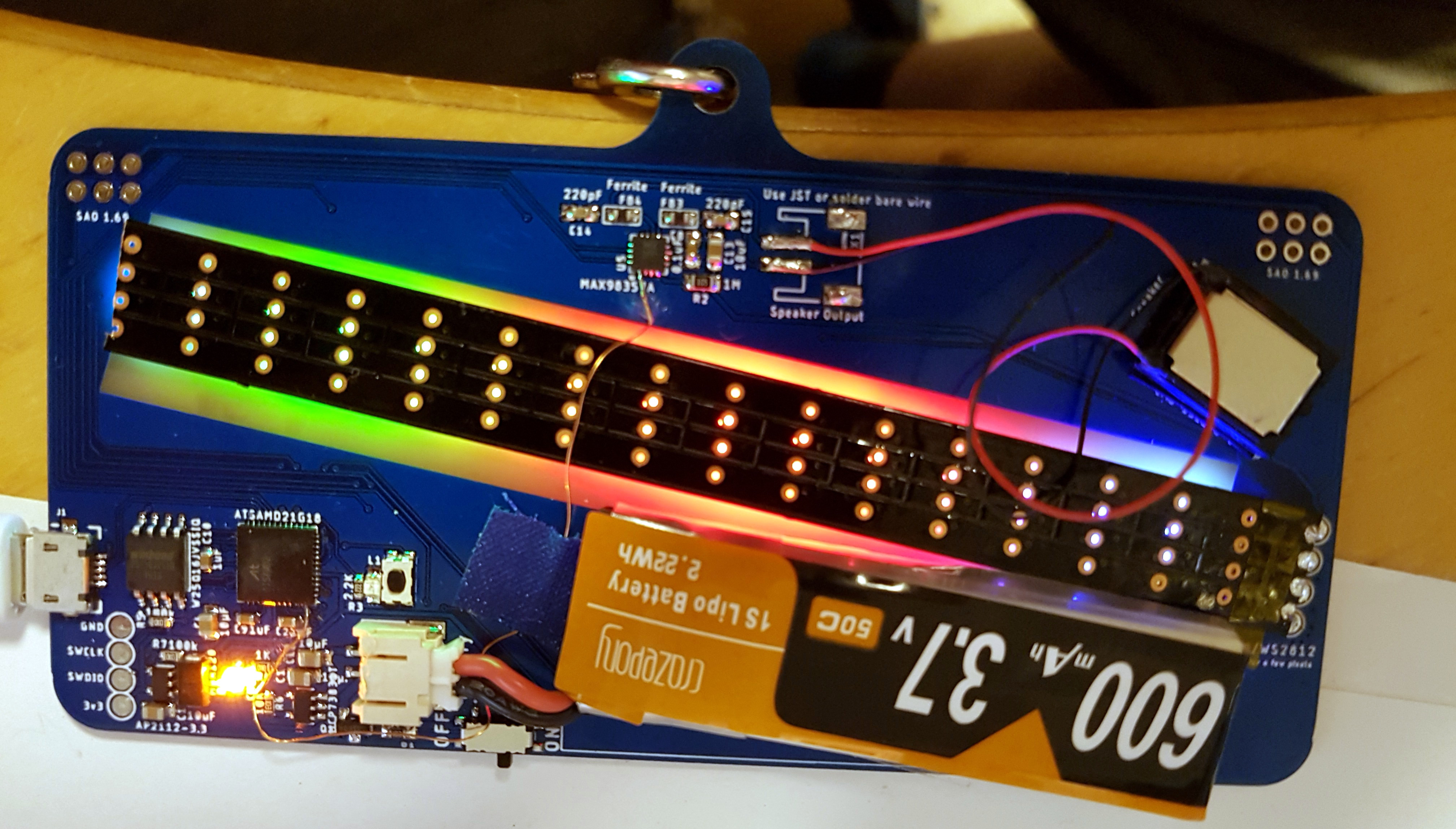
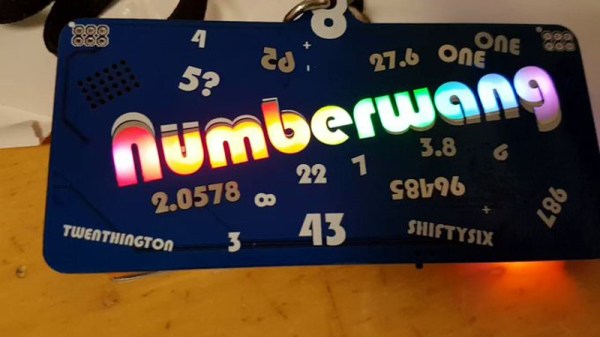
While wandering through CCCamp last weekend, in between episodes of forcing Marmite on the unwary, I ran into the well-known Hackaday.io user [Prof. Fartsparkle]. In a last-minute sprint leading up to the con he built himself the Numberwang badge to join in the colorful after-dark festivities with beautiful board artwork and remarkably enjoyable backlit LED display.

The Numberwang badge itself is a clone of the Adafruit Itsy Bitsy sporting an ATSAMD21G18 CPU and running CircuitPython. It has an LED strip on the reverse shining through the bare FR4 as a diffuser, and the Numberwang effect of selecting random numbers is achieved by a host of random touchable numbers sprinkled across its front. For something he freely admits was a last minute project, we think he’s done a pretty good job!

For those mystified by Numberwang, it is a fictional gameshow from a BBC TV comedy programme that involves contestants answering the quizmaster with random numbers. It joins a rich tradition of such hilarious nonsense, and has as a result become cult television.

If you’re really getting into Numberwang, don’t forget that it’s inspired a programming language.

Continue reading “The Numberwang Badge Brought Cheer To CCCamp 2019”

After The Con: Da Bomb Badge Post Mortem

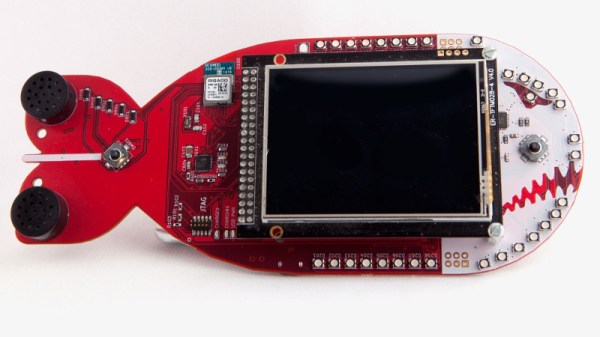
We’ve reported on the world of electronic badges here at Hackaday since their earliest origins in [Joe Grand]’s work for DEF CON 14 in 2006. In that time we’ve seen an astonishing variety of creations, covering everything from abstract artwork to pure functionality in a wearable device. But it’s not been quite so often that we’ve looked at the other side of the BadgeLife coin, so it’s fascinating to read [John Adams]’ account of the work that went into the production of this year’s 500-piece run of the Da Bomb DEF CON indie badge.

In it, [John] goes over scheduling worries, component sourcing issues, PCB assembly delays, and an in-depth look into the finances of such a project. In case anyone is tempted to look at Badgelife as the route to millions, it rapidly becomes apparent that simply not losing too much money is sometimes the best that can be hoped for. There were a few design problems, one of them being that the SAO I2C bus was shared with the LED controller, resulting in some SAOs compatibility issues. In particular the AND!XOR DOOM SAO had its EEPROM erased, creating something of a headache for the team.

A surprise comes in the distribution: obviously shipping is expensive, so you’d think badge pick-ups at the con would be straightforward alternative. Unfortunately, they became something of a millstone in practice, and organising them was a Herculean task. Astoundingly, some paying customers didn’t bother turn up for their badges. Which was especially infuriating since the team lost valuable conference time waiting for them.

Some of you are BadgeLife creators and will nod sagely at this. Still more of you will wish you were BadgeLife creators and find it a useful primer. For everyone else it’s a fascinating read, and maybe makes us appreciate our badges a bit more.

The images may have departed, but just to return to the origins of BadgeLife, here’s our coverage of that first [Joe Grand] badge.

A Radio Transceiver From A Cable Modem Chipset

It’s a staple of our community’s work, to make electronic devices do things their manufacturers never intended for them. Analogue synthesisers using CMOS logic chips for example, or microcontrollers that bitbang Ethernet packets without MAC hardware. One of the most fascinating corners of this field comes in the form of software defined radios (SDRs), with few of us not owning an RTL2832-based digital TV receiver repurposed as an SDR receiver.

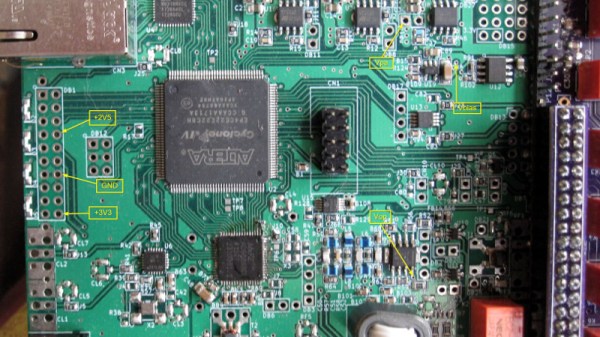
The RTL SDR is not the only such example though, for there is an entire class of cable modem chipsets that contain the essential SDR building blocks. The Hermes-Lite is an HF amateur radio transceiver project that uses an AD9866 cable modem chip as the signal end for its 12-bit SDR transceiver hardware with an FPGA between it and an Ethernet interface. It covers frequencies from 0 to 38.4 MHz, has 384 kHz of bandwidth, and can muster up 5W of output power.

It’s a project that’s been on our radar for the past few years, though somewhat surprisingly this is the first mention of it here on Hackaday. Creator [Steve Haynal] has reminded us that version 2 is now a mature project on its 9th iteration, and says that over 100 “Hermes-Lite 2.0” units have been assembled to date. If you’d like a Hermes-Lite of your own it’s entirely open-source, and they organise group buys of the required components.

Of course, SDRs made from unexpected components don’t have to be exotic.

Spot Adulterated Olive Oil With This Spectrophotometer

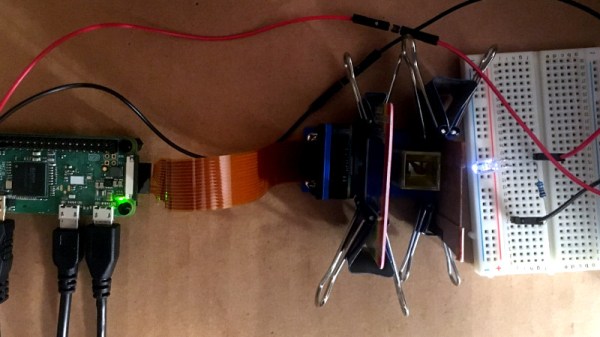
Olive oil at its finest quality is a product that brings alive the Mediterranean cuisine of which it is a staple. Unfortunately for many of us not fortunate enough to possess our own olive grove, commercial olive oils are frequently adulterated, diluted with cheaper oils such as canola. As consumers we have no way of knowing this, other than the taste being a bit less pronounced. Food standards agencies use spectrophotometers to check the purity of oils, and [Daniel James Evans] has created such a device using a Raspberry Pi.

A spectrophotometer shines white light through a sample to be tested, splits the light up into a spectrum with a prism or diffraction grating, and measures the light level at each point in the spectrum to gain a spectral profile of the sample. Different samples can then be compared by overlaying their profiles and looking at any differences. This build shines the light from an LED through a sample of oil, splits the result with a diffraction grating, and captures the spectrum with a Raspberry Pi camera. Commercial instruments are usually calibrated by co-incidentally sampling a pure sample of the same solvent the test subject is dissolved in, in this case the calibration is done against a sample of pure olive oil. The software requires the user to identify the spectrum in the resulting photograph, before generating a curve.

From a basis of having worked with and maintained spectrophotometers in the distant past we would have expected to see an incandescent bulb rather than an LED for a flatter response, but since this is an oil identifier rather than a finely calibrated laboratory instrument this is probably less of an issue.

Over the years we’ve had quite a few spectrophotometer projects here, this Hackaday Prize entry from 2016 is just one of many.

Odd-Sized Military Headphone Connectors, Tamed!

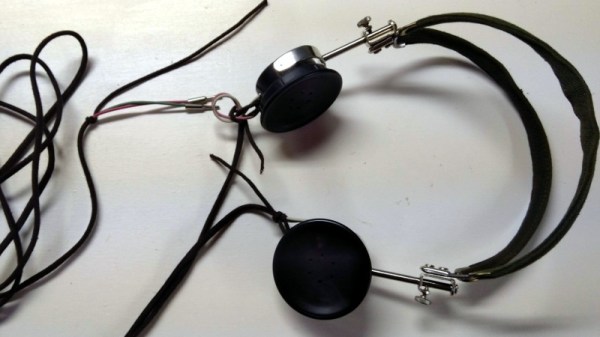
Military headphones, at least the older ones, are like few other sound reproducers. They are an expression of function over form, with an emphasis on robustness over operator comfort. Electrically they most often have high-impedance drivers and annoyingly proprietary connectors for whichever obscure radio system they were a part of.

[John Floren] has a HS-16A headset, the type used by the US military during the Vietnam war. It’s an antiquated design with a dual spring steel headband and on-the-ear ‘phones with no muff for comfort, and a quick bit of research finds that they can be had brand new in their 1960s packaging for somewhere around $20. Their connector is a pair of odd metal pins, and rather than doing what most of us would do and snipping the wire to fit something more useful, he hunted high and low for a TE Connectivity receptacle that would fit them. A short extension and a jack plug allowed him to use these slightly unusual cans.

This isn’t a special hack, but it’s still an interesting read because it sheds a bit of light upon these old-style headphones and reveals that they’re still available for anyone who wants their radio operating to have a retro feel. If you buy a set, you’ll probably still have them decades after more modern pairs have bitten the dust.

Everything You Want To Know About The Cheapest Processors Available

Those of us who use microprocessors in our work will be familiar with their cost, whether we are buying one or two for a project or ten million on reels for a production run. We’re used to paying tens of cents or maybe even a dollar for a little microcontroller in single quantities, and these are probably the cheapest that we might expect to find.

There is a stratum of cheaper devices though, usually from Chinese manufacturers with scant data in English and difficult to source in Europe or the Americas. These chips cost under ten cents each, a figure which seems barely credible. To shed some light upon this world, [cpldcpu] has produced a run-down of some of the available families that even if you will never work with such an inexpensive option still makes for a fascinating read.

These processors are not the type of component you would use for high intensity tasks so it’s probable that you will not be mining cryptocurrency on a brace of them. Thus their architecture is hardly cutting-edge, with the venerable PIC12 being their inspiration and in some cases their direct copy. These are all write-once devices and some of their toolchains are variable in accessibility, but perhaps they aren’t as terrible as some would have you believe. If you are looking for inspiration, we’ve featured one of them before.

TL;DR: the Padauk PFS173, at just under $0.09, has an open-source toolchain and a decent set of peripherals.

Thanks [WilkoL] for the tip.

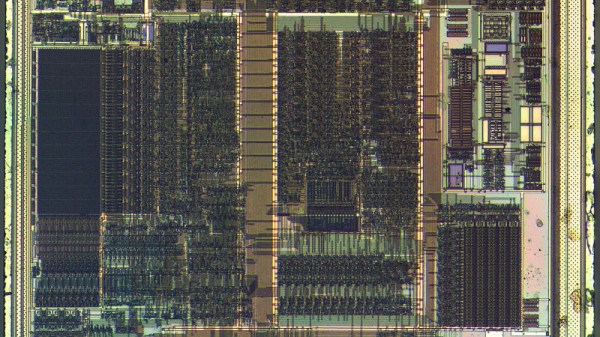
Image: A real PIC12 die shot. ZeptoBars [CC BY 3.0]