Fixing An Agilent Oscilloscope Power Supply

We should all be so lucky as [Salvaged circuitry], who scored a cheap Agilent oscilloscope from an online auction. Of course, its low price had a reason behind it, the ‘scope didn’t work. At fault was its power supply, the repair of which was documented in the video below.

These ‘scopes have relatively straightforward 12 V power supplies, extremely similar to off-the-shelf parts. The video is an interesting primer in switch-mode power supply repair, as the obvious failure of the filter capacitor and a MOSFET is traced further to the PSU controller chip. We see a new capacitor mounted proud of the board to reduce the risk of heat damage, and then some careful solder rework to save some lifted pads.

The result, a working oscilloscope. Maybe we’d have hacked in another 12 V supply, but given that this is a piece of test equipment perhaps it’s best to stay as close to the original spec as possible. As a parting shot he shows us an equivalent power supply, and promises us a side-by-side test in a future video.

These ‘scopes aren’t as popular in our circles as the cheaper Rigol range, but it’s worth remembering that they also have a budget model.

Continue reading “Fixing An Agilent Oscilloscope Power Supply” →

How Can Heavy Metal Fly?

Scientists found a surprising amount of lead in a glacier. They were studying atmospheric pollution by sampling ice cores taken from Alpine glaciers. The surprising part is that they found more lead in strata from the late 13th century than they had in those deposited at the height of the Industrial Revolution. Surely mediaeval times were supposed to be more about knights in shining armour than dark satanic mills, what on earth was going on? Why was the lead industry in overdrive in an age when a wooden water wheel represented high technology?

The answer lies in the lead smelting methods used a thousand miles away from that glacier, and in the martyrdom of a mediaeval saint.

Continue reading “How Can Heavy Metal Fly?” →

Nintendo Switch Built Completely From Replacement Parts

It seems that everybody around us is playing Animal Crossing New Horizons, and we’re not alone in this. But a new Nintendo Switch can’t be had for love nor money, and second hand ones have fallen victim to price gouging. It seems if you’re not playing the game, you’re out of luck, or are you?

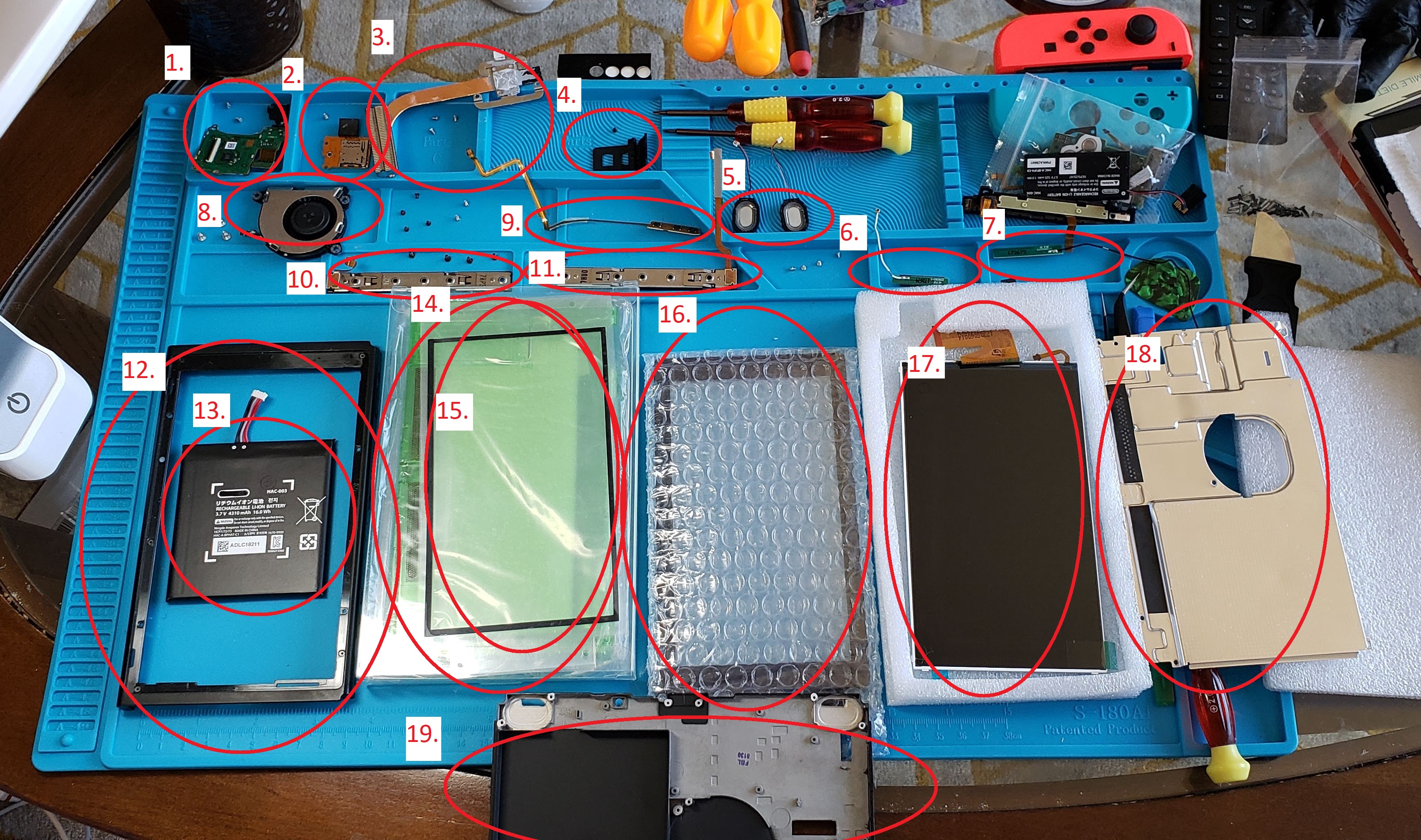
What’s to be done? [Sarbaaz37] found the hardware hacker’s solution to that question: Build a Nintendo Switch entirely from spare parts, of course! It took a month to source the parts and it’s not a project for the fainthearted, but it provides us with a look at all the parts they pack into the handheld. All told, there’s about 22 part numbers in the bill of materials.

Anyone who has peeked inside a laptop recently will be familiar with the arrangement of this type of device. An array of extremely snug-fitting and fragile electronics laid out like a TV dinner has to be carefully assembled in a specific order and this is no different. Along the way [Sarbaaz37] has some pro tips, like cleaning off the stock thermal compound and using a higher quality. The eventual result is a working Switch, which for $200 is not a bad deal, though they do note that the pandemic has since led to a price rise in Nintendo parts as well as consoles.

This is, we think, the first home-made Switch we’ve seen, but it’s not the first desirable piece of consumer electronics made from grey market parts we’ve seen. Who could forget the Shenzhen electronics markets adventure of sourcing all the parts that go into an iPhone?

Thanks [Roel] for the tip.

A Tidy Little OBD Display For Your Car

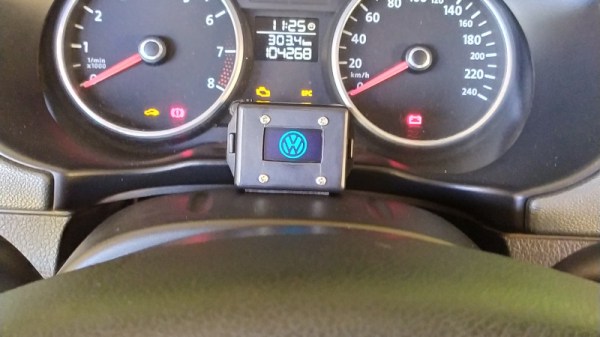
It’s likely that many readers will have an OBD dongle through which they can peer into the inner workings of their car, but the chances are that most of us will have restricted our curiosity to the Bluetooth or USB interface it was supplied with. Not [Frederico Souza Sant’ana] though, because he’s modified his OBD dongle to expose the serial lines between its ELM327 OBD chip and its Bluetooth chip. These go to an Arduino, which powers a small information display to supplement the car’s dashboard. This can display a range of readings as can be seen in the video below the break, he has it monitoring the battery, the various temperatures in the engine bay, and the ignition parameters.

All the software and hardware details can be found in a GitHub repository. In hardware terms it’s a surprisingly simple unit, but it serves to remind us that OBD sniffer dongles are more versatile than we might at first imagine, and good for a bit more than hooking up our smartphones via Bluetooth. If OBD is something you’d like to visit in more depth, in the past we’ve featured an open-source OBD interface, and a retrospective look at the protocol.

Continue reading “A Tidy Little OBD Display For Your Car” →

Yeast Is A Hot Commodity; Brewing And Breadmaking During Lockdown

In the recent frenzy of stocking up with provisions as the populace prepare for their COVID-19 lockdown, there have been some widely-publicised examples of products that have become scarce commodities. Toilet paper, pasta, rice, tinned vegetables, and long-life milk are the ones that come to mind, but there’s another one that’s a little unexpected.

As everyone dusts off the breadmaker that’s lain unused for years since that time a loaf came out like a housebrick, or contemplates three months without beer and rediscovers their inner home brewer, it seems yeast can’t be had for love nor money. No matter, because the world is full of yeasts and thus social media is full of guides for capturing your own from dried fruit, or from the natural environment. A few days tending a pot of flour and water, taking away bacterial cultures and nurturing the one you want, and you can defy the shortage and have as much yeast as you need.

Continue reading “Yeast Is A Hot Commodity; Brewing And Breadmaking During Lockdown” →

The Key To This City Opens A Real Lock

There are few more satisfying moments than the first time you pick a lock. No matter that it’s a dollar-store padlock that you opened with a pick from a $10 eBay kit, the magic of something that should be secure clicking open in the palm of your hand is hard to beat. Pin tumbler locks are surprisingly simple devices, and to demonstrate this [Farmcraft 101] has produced one at 10x scale to demonstrate their operation on the bench.

The video is a delightful exercise in wood-shop voyerism, as we see him construct the various parts of the lock using his lathe and other workshop tools. A key of the size usually reserved for Freedom Of The City is made, but this one really does slide into the keyway and operate those pins. At the back is a latch mechanism, and the result is a fully-functional model that anyone should be able to use to figure out how the lock works.

Thelock itself isn’t the whole story though, because given the date he’s used it as the basis for a cracking April Fool in which he sends up the [Lock Picking Lawyer] and proceeds to demonstrate the glaring insecurities in his creation. Both videos are there for your enjoyment, below the break. And if you can’t wait to have a go at a lock or two, don’t forget you can always make your own tools using paperclips.

[Ed note: streetcleaner bristles. Thank me later.]

Continue reading “The Key To This City Opens A Real Lock” →

Iceland Is Doing Its COVID-19 Proximity Tracing The Open Source Way

As governments around the world grapple with the problem of tracing those who have had contact with a person known to have been infected with the COVID-19 virus, attention has turned to the idea of mobile apps that can divulge who a person has been near so that they can be alerted of potential infections. This has a huge potential for abuse by regimes with little care for personal privacy, and has been a significant concern for those working in that field. An interesting compromise has been struck by Iceland, who have produced an app for their populace that stores the information on the device and only uploads it with the user’s consent once they have received a diagnosis. We can all take a look, because to ensure transparency they have released it as open source.

On signing up for the scheme a central server stores the details of each user as well as their phone number. When the epidemiologists have a need to trace a person’s contacts they send a notification, and the person can consent to their upload. This is a fine effort to retain user privacy, with depending on your viewpoint the flaw or the advantage being that the user can not have their data slurped without their knowledge. Iceland is a country with a relatively small population, so we can imagine that with enough consent there could be effective tracing.

We installed the Android version on the Hackaday phone to have a look, but unfortunately it seems to need to be in Iceland to be of use enough to explore. We would be interested to hear from our Icelandic readers, to hear their views. Meanwhile readers can juxtapose the Icelandic app with another proposal for a more anonymised version.