Who Knew Cut Grass Would Be So Tricky To Move!

Like all publications, here at Hackaday we are besieged by corporate public relations people touting press releases. So-and-so inc. have a new product, isn’t it exciting! But we know you, our readers, we know you like hacks, and with the best will in the world, the vast majority of such things have nothing of the hack about them. Just occasionally though a corporate offering does contain a hack, and today we have a fascinating one from Charm Industrial, who are doing their best to make hydrogen from biomass. They were finding cut grass to be an extremely difficult material to handle, and their account of how they managed to feed it from a hopper into their machinery makes for interesting reading.

You might expect grass to flow from a conical hopper like an ungainly liquid, but in fact it readily clogs and forms bridges, blocking the outlet. Changing the design of the hopper made little difference, so they tried an auger. The auger simply compressed the blockage harder, resulting in the counter-intuitive strategy of running the auger in reverse. But even that didn’t work, leaving the area round the auger clear but the rest of the grass as a solid clump. Rotating plows were tried with multiple different profiles followed, but finally they settled upon a vibrating bin activator. It’s a crash course in materials handling, and though the Hackaday bench is likely to avoid having to handle cut grass except when emptying the lawnmower, it’s still worth a look.

We may have done very little with handling cut grass, but we’ve certainly taken a look at creating it.

Britain Rejoins The Space Race

Jubilant crowds at the gates of Downing Street. (Jenny List)

In a completely unexpected move, the British Prime Minister Theresa May yesterday announced outside Number 10 Downing Street that the UK would resume its space launch programme, 47 years after its cancellation following the launch of the Prospero satellite. She outlined a bold plan with a target of placing the Doc Martens of a British astronaut on the Lunar surface as early as 2024. Funded by the £350m per week Brexit windfall, the move would she said place the country at the forefront of a new 21st century Space Race with the North Koreans.

An estimated 2 million jubilant supporters took to the streets of London at the news, bringing the capital to a halt as they paraded with colourful banners from Hyde Park to Trafalgar Square and down Whitehall past her Downing Street home. Meanwhile the value of shares in the popular British high street bakery firm Patisserie Gregoire jumped by 19% as it was revealed that their new vegan sausage roll had in fact been a secret trial of the British astronaut diet. Continue reading “Britain Rejoins The Space Race”

A New Digital Mode For Radio Amateurs

There used to be a time when amateur radio was a fairly static pursuit. There was a lot of fascination to be had with building radios, but what you did with them remained constant year on year. Morse code was sent by hand with a key, voice was on FM or SSB with a few old-timers using AM, and you’d hear the warbling tones of RTTY traffic generated by mechanical teletypes.

By contrast the radio amateur of today lives in a fast-paced world of ever-evolving digital modes, in which much of the excitement comes in pushing the boundaries of what is possible when a radio is connected to a computer. A new contender in one part of the hobby has come our way from [Guillaume, F4HDK], in the form of his NPR, or New Packet Radio mode.

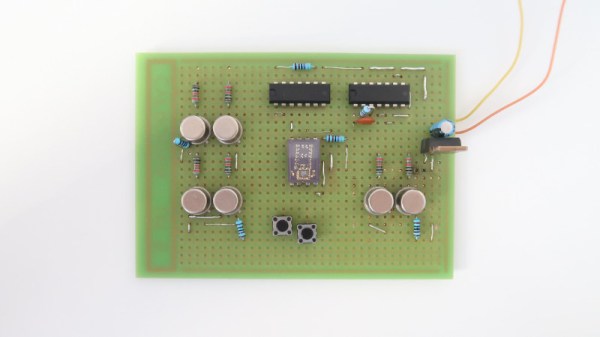
NPR is intended to bring high bandwidth IP networking to radio amateurs in the 70 cm band, and it does this rather cleverly with a modem that contains a single-chip FSK transceiver intended for use in licence-free ISM band applications. There is an Ethernet module and an Mbed microcontroller board on a custom PCB, which when assembled produces a few hundred milliwatts of RF that can be fed to an off-the-shelf DMR power amplifier.

Each network is configured around a master node intended to use an omnidirectional antenna, to which individual nodes connect. Time-division multiplexing is enforced by the master so there should be no collisions, and this coupled with the relatively wide radio bandwidth of the ISM transceiver gives the system a high usable data bandwidth.

Whether or not the mode is taken up and becomes a success depends upon the will of individual radio amateurs. But it does hold the interesting feature of relying upon relatively inexpensive parts, so the barrier to entry is lower than it might be otherwise. If you are wondering where you might have seen [F4HDK] before, we’ve previously brought you his FPGA computer.

Squeezebox Comes To The ESP

Streaming music may now come from somewhere in the cloud to an app on your phone and be sent to the client built in to almost every entertainment device you own, but there was a time when the bleeding edge lay in dedicated streaming device that connected to your existing set-up. One of the players in this market was Logitech with their Squeezebox line of products, and while the original hardware may have been discontinued it remains very much alive among its dedicated userbase due to the free nature of the Logitech Media Server software and implementations of the slimproto streaming protocol in players. Now you can create a network player on about as cheap hardware as it is possible to find, because [Bgiraut] has produced a client for the ESP32 and ESP8266.

The software can be found on GitHub, and comes with the warning that it’s an early proof-of-concept rather than a polished release. It has two options for playback that both require a little bit of extra hardware, an I2S DAC for uncompressed streams or a VS1053 codec module for compressed ones, but neither of those need be expensive.

You can find Logitech Media Server from its download page, and give this device a try. Meanwhile we’ve covered many Squeezebox implementations, including ones on the Raspberry Pi, and the PogoPlug.

Thanks [joyofdivisions] for the tip.

Executing A Vehicle Keyless Entry Attack

You read about well-publicised security exploits, but they always seem to involve somebody with a deity’s grasp of whatever technology is being employed, as well as a pile of impossibly exotic equipment. Surely a mere mortal could never do that!

Happily, that’s not always the case, and to prove it [Gonçalo Nespral] replicated an attack against RF devices such as some garage doors and motor vehicle locks that use a rolling code. His inspiration came from a device from2015, that encouraged the owner of a key to keep transmitting fresh codes. It did this by swamping the receiver of the car, garage door, or whatever with a strong slightly off frequency signal. This would cause the lock to not work, so the user would try again and again. The attacker listens with a very narrow bandwidth receiver on-frequency that is good enough to reject the jamming signal, and can harvest a sequence of the rolling codes enough to compromise it.

[Gonçalo]’s set-up uses a YARD stick One transceiver dongle as its transmitter, and an RTL-SDR for receive. A GNU Radio setup is used to retrieve the key data, and some custom Python code does the remaining work. We wouldn’t advocate using this in the wild and it could conceivably also gain you access to another car with a flashing light on top, but it’s an interesting exposé of the techniques involved.

Rolling code keyfob attacks are something we covered a few years ago, back when these attacks were all shiny and new.

How Much Apple Does A Hamburger Get You?

A while ago, [Skippy] bought a cheap knock-off of the Apple USB mains charger from an AliExpress seller, for the British low, low price of 89p. Normally we’d give you a dollar conversion, but since that’s coincidentally the price of the basic McDonalds hambuger in the UK we’ll go with the hamburger as a unit of conversion. And as any self-respecting hacker would, he subjected it to a teardown and gave it a few tests.

Surprisingly though its pins were a little long it was just within the BS1363 pin spacing specification, probably due to its external dimensions copying the Apple original. The emissions test he performed might surprise readers, as it gave the little device its first pass. Radiated RF emissions were well below the test threshold, a welcome sight for anyone who has had to test a device. Sadly the same could not be said for conducted emissions, and it was happily spraying RF to all and sundry from its connections.

Taking a look inside revealed the usual litany of frightening safety fails. There was no insulation between the mains pins and the circuit board, and a secondary capacitor was even touching one of the pins. Meanwhile another capacitor connecting both sides of the circuit was not of the required Y rating. These and a raft of others make the device illegal for sale in Europe without further tests, but to give some numbers to it all he subjected it to a screen test applying 600 VAC common mode to its pins and checking for leakage current through the device. This it failed, and indeed it did not recover from the test.

So in this case, the price of a hamburger definitely does not get you an Apple, nor even does it get you an equivalent. But of course, you knew that, because we’ve talked about fake Apple chargers and power supplies many times before.

Save An Old Drill From Landfill, With Some Lithium-Ion Magic

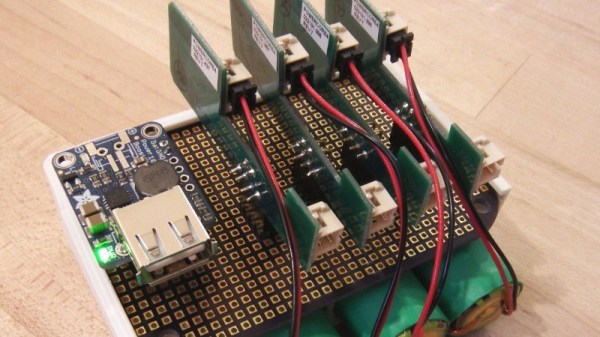
What do you do, when your trusty cordless drill starts to lose battery capacity? You bought it a decade ago and parts are a distant memory, so there’s no chance of buying a new pack. If you are [Danilo Larizza], you strip away the old NiMh cells, and replace them with a custom pack (Italian, Google Translate link) made from 18650 Li-ion cells.

The build is a straightforward one to anyone familiar with lithium-ion packs, but to a battery newbie it should serve as a handy step-by-step description. He starts by selecting a range of matched cells from discarded laptop batteries and adds an off-the-shelf battery management board to keep everything safe. Interestingly he appears to have soldered his wires to the cells rather than the more usual spot-welding, sadly for many of us a spot-welder is beyond our means. It would be interesting to know both the mechanical integrity of the resulting connection and whether the heat of soldering might in some way affect the cells.

Firing up the drill with the new pack is not the immediate success he hoped it would be, the start-up current is so high that the battery management board goes into a fault condition. This situation is resolved with a model that can take more current, and he can take his drill out once more.

If you are annoyed by the rise of cordless tools, you’re in good company. Meanwhile if you lack a spot-welder for batteries, have a look at one of the nicer ones we’ve seen.