If You’re Going To Make A Model Engine, You Might As Well Make It A Merlin

It has been remarked before in more than one Hackaday post, that here are many communities like our own that exist in isolation and contain within them an astonishing level of hardware and engineering ability. We simply don’t see all the work done by the more engineering-driven and less accessory-driven end of the car modification scene, for example, because by and large we do not move in the same circles as them.

One such community in which projects displaying incredible levels of skill are the norm is the model making world. We may all have glued together a plastic kit of a Spitfire or a Mustang in our youth, but at the opposite end of the dial when it comes to models you will find craftsmanship that goes well beyond that you’d find in many high-end machine shops.

A project that demonstrates this in spades is [mayhugh1]’s quarter-scale model of a vintage Rolls-Royce Merlin V12 piston aero engine. This was the power plant that you would have found in many iconic Allied aircraft of the WW2 era, including the real-life Spitfires and all but the earliest of those Mustangs. And what makes the quarter-scale Merlin just that little bit more special, is that it runs. Just add fuel.

The build took place over a few years and many pages of a forum thread, and includes multiple blow-by-blow accounts, photos, and videos. It started with a set of commercial castings for the engine block, but their finishing and the manufacture of all other engine parts is done in the shop. In the final page or so we see the video we’ve placed below the break, of the finished engine in a test frame being run up on the bench, with a somewhat frightening unguarded airscrew attached to its front and waiting to decapitate an unwary cameraman. Sit down with a cup of your favourite beverage, and read the build from start to finish. We don’t think you’ll be disappointed.

Continue reading “If You’re Going To Make A Model Engine, You Might As Well Make It A Merlin”

Scribble Your Way To Quick Printed Circuit Boards

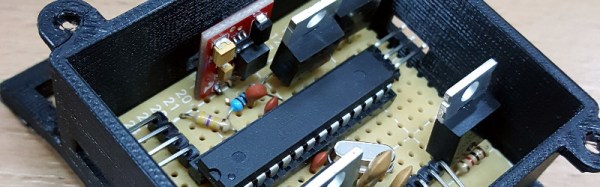
There are a variety of techniques employed by electronic constructors seeking the convenience of a printed circuit board without the inconvenience of making a printed circuit board. Dead bug style construction in which the components float on a spiders-web of soldered leads above a ground plane is one, Manhattan style construction in which pads made from small cut squares of bare copper-clad PCB are glued on top of a groundplane is another.

[Freestate QRP] has another take on this type of electronics, with what he calls “Scribble style” construction. He cuts away copper from bare board to create pads and rudimentary tracks, and for him the magic ingredient comes from his choice of an engineer’s scribe to do the job. This is where the “scribble” comes from, creating a pad is as simple as drawing it with the scribe.

Of course, this technique is not entirely new, constructors have been doing this type of work for years with Dremel tools, hand engraving tools, and similar. If you’ve ever tried to do it with a knife or scalpel you will know that it’s hardly an easy task with those hand tools so the prospect of another one doing a better job is rather interesting. He’s ready and able to demonstrate it in action, showing us a couple of RF circuits using the technique.

Have you tried this technique, or one like it? How did you get on, tell us in the comments. Meanwhile, you might like to read our own [Dan Maloney]’s look at dead bug and Manhattan construction.

A Great Guide To Software PLLs

There are some things that you think you know quite well because you learned them in your youth and you understand their principles of operation. Then along comes a link in your morning feed that reminds you of the limits of your knowledge, and you realize that there is a whole new level of understanding to be reached.

Take Phase Locked Loops (PLLs) for example. You learn how they work, you use them for frequency synthesis, and you know they can do other things like recover noisy clock lines and do FM demodulation. But then you read [Paul Lutus’] Understanding Phase-Locked Loops page, and a whole new vista opens.

He’s discussing PLLs in the context of software, as part of a weather fax decoder project, and this allows a perspective that was unavailable to those of us who learned about them through the medium of hardware such as the venerable 4046 CMOS chip. We can easily look at different PLLs with varying parameters, for example their use with a narrowband loop filter to retrieve signals buried in the noise, all through some straightforward code tweaks rather than extensive circuitry. It’s a page that’s a few years old now, but resources like this one do not age.

If PLLs are entirely new to you then you need to reat last year’s excellent PLL primer by Hackaday’s own [Al Williams].

[via Hacker News]

[PLL diagram: Chetvorno CC0]

Attack Some Wireless Devices With A Raspberry Pi And An RTL-SDR

If you own one of the ubiquitous RTL-SDR software defined radio receivers derived from a USB digital TV receiver, one of the first things you may have done with it was to snoop on wide frequency bands using the waterfall view present in most SDR software. Since the VHF and UHF bands the RTL covers are sometimes a little devoid of signals, chances are you homed in upon one of the ISM bands as used by plenty of inexpensive wireless devices for all sorts of mundane control tasks. Unless you reside in the depths of the wilderness, ISM band sniffing will show a continuous procession of chirps; short bursts of digital data. It is surprising, the number of radio-controlled devices you weren’t aware were in your surroundings.

Some of these devices, such as car security keys, are protected by rolling encryption schemes to deter would-be attackers. But many of the more harmless devices simply send a command in the open without the barest of encryption. The folks at RTL-SDR.com put up a guide to recording these open data bursts on a Raspberry Pi and playing them back by transmitting them from the Pi itself.

It’s not the most refined of attack because all it does is take the recorded file and retransmit it with the [F5OEO] RPiTX software. But they do demonstrate it in action with a wireless lightbulb, a door bell, a wireless relay, and a remote-controlled switched socket. Since the data in question is transmitted as OOK, or on-off keying, the RPiTX AM mode stands in for the transmitter.

You can see it in action in the video below the break. Now, have you investigated the ISM band chirps in your locality?

Continue reading “Attack Some Wireless Devices With A Raspberry Pi And An RTL-SDR”

That Decentralised Low Voltage Local DC Power Grid, How Did It Do?

Early on in the year, Hackaday published one of its short daily pieces about plans from the people behind altpwr.net for a low voltage DC power grid slated for the summer’s SHACamp 2017 hacker camp in the Netherlands. At the time when it was being written in the chill of a Northern Hemisphere January the event seemed so far away, but as the summer fades away along with the deep tan many SHACamp attendees gained in the Dutch sunlight it’s worth going back and revisiting the project. Did they manage it, and how did they do? This isn’t really part of our coverage of SHACamp itself, merely an incidental story that happens to have the hacker camp as its theatre.  Continue reading “That Decentralised Low Voltage Local DC Power Grid, How Did It Do?”

A 3D-Printed Coffee Grinder

It’s safe to say that a Venn diagram of Hackaday readers and coffee drinkers would have significant intersection, many of you will be lovers of the bean. Some of you will be happy enough with a spoonful of instant granules and a bit of boiling water, but among your number there will undoubtedly be owners of significant quantities of coffee-related machinery and paraphernalia.

If your coffee enthusiasm extends to grinding your own direct from the bean, then [Christian Pederkoff]’s project should hit the mark, he’s created a rather neat 3D-printed coffee grinder. Sadly the creation of a steel burr and ring was beyond his 3D-printing capabilities so those parts come from a commercial grinder, but the housing, shaft coupler and hopper are all from his printer. Power is from a conveniently available source, he’s made use of an automotive windscreen wiper motor. The whole is a straightforward and easy-to-assemble unit that we think would sit well alongside many readers’ coffee making equipment.

If coffee projects are your thing, we have a few for your entertainment. Another not quite so neat enclosure for a coffee grinder, for example, or a tea-light-powered filter coffee machine for power cut beverage satisfaction.

Re-Engineering The Ford Model A Engine

Over the nearly a quarter century since the Web has been in existence, there have been various websites and projects in the field covered by Hackaday that have done the rounds and captured our attention for a while. Some have turned into major projects and products, others have collapsed spectacularly, while many have faded away and been forgotten.

It was one of those “I wonder what happened to… ” moments that prompted a search for just such a project that did the rounds a little at the start of this decade. Re-Engineering the Model A Engine is [Terry Burtz]’s project to take the Ford Model A engine from the 1920s and re-engineer it with the benefit of some upgrades to increase its longevity and reliability. The new engine would look identical to the original unit, but would feature modern metallurgy, a re-engineered crankshaft with up-to-date bearings, a pressurised lubrication system, and some cooling system modifications.

The web site has a fascinating technical description and history of the Model A engine, along with a detailed examination of the proposed upgrades. There is a long list of project updates, but sadly work stalled in 2015 due to difficulties finding an iron foundry that could cast the blocks at an affordable price. It’s a shame to see a promising project get so far and fall at this late hurdle, is it too much to hope that among the Hackaday readership there might be people in the foundry business who could advise? It’s quite likely that there would be a queue of Model A owners who would be extremely grateful.

If you think you’ve seen some veteran Ford action here before, you’d be right, but only to a point. Meanwhile where this is being written a similar project for a 1950s Standard Triumph engine would be most welcome.