AM, The Original Speech Transmission Mode

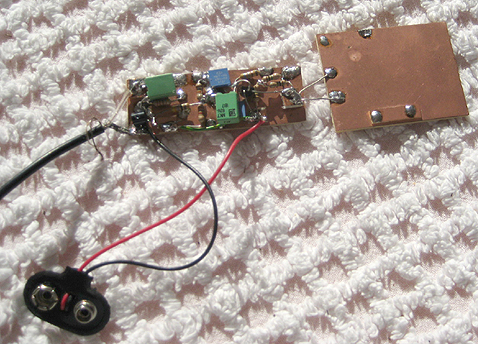
Here’s a question: when did you last listen to an AM radio station? If your answer is “recently”, chances are you are in the minority.

You might ask: why should you listen to AM? And you’d have a point, after all FM, digital, online, and satellite stations offer much higher quality audio, stereo, and meta information, and can now be received almost anywhere. Even digital receivers are pretty cheap now, and it’s by no means uncommon for them to not even feature the AM broadcast band at all. Certainly this has driven an exodus of listeners to the extent that AM radio has been in slow decline for decades, indeed it’s disappearing completely in some European countries.

Continue reading “AM, The Original Speech Transmission Mode”

Hacking A Fluke Multimeter To Serve Readings Over WiFi

Your multimeter is probably your most useful instrument if you work regularly with electronics. It goes with you everywhere, and is your first port of call in most cases when you are presented with a piece of equipment. And when you think about it, it’s a pretty amazing instrument. Multimeter technology has advanced to the point at which even an inexpensive modern device has functions that would have required a hefty budget a few decades ago.

There is still one thing affordable multimeters remain unable to do: they can’t log their readings for analysis on a computer. They’re an instantaneous instrument, just as they always have been.

Lord of Hackaday [Sprite_TM] decided to hack his multimeter to serve its readings over Wi-Fi. Rather than start with a throwaway meter from the bargain bin, he did it with a Fluke. The meter he chose was a Fluke 15B+, the company’s budget offering for the Indian and Chinese markets, since he had one spare.

Opening up the 15B+, he was presented with its processor concealed under a blob of epoxy and thus unidentifiable. Armed with the knowledge that other similar Flukes contain Fortune Semiconductor parts, he investigated as many data sheets as he could find from the same company and finally identified it as an FS98O24 one-time-programmable microprocessor. Sadly this chip has no serial port, but he did find an I2C EEPROM which he correctly guessed held calibration settings. Removing this chip gave him a meter with slightly off calibration, but also gave him a serial port of sorts.

Further detective work allowed him to identify the baud rate, and supplying random commands delivered him some that returned data packets. Eventually he identified a packet containing the states of the LCD’s segments, from which he could derive its displayed value. Connecting an ESP8266 module with appropriate software left him with a Wi-Fi connected multimeter. There was a little more refinement to his hack, he created a power management board to activate the ESP when needed, and a neat hack to display its IP address on the screen.

Multimeter hacks have featured several times here at Hackaday. We’ve had another serial port hack, or how about a remote display for another Fluke on a Gameboy Advance?

Retrotechtacular: 6207, A Study In Steel

If you ever encounter railroad or railway enthusiasts, you may have heard the view that at some point in the past there was a golden age of rail transport that has somehow been lost. It’s something that’s up for debate as to when that age was or even whether with a selection of new super-high-speed trains snaking across our continents we’re in a golden age now, but it’s true to say that the rail business has had its fair share of decline in the last half-century.

It’s quite likely that when they talk of a golden age, they really mean a golden age of steam rail transport. At which point depending on where you live in the world it’s easier to put your finger on a decade. For UK residents a good candidate would be the 1930s; steam locomotive design had reached its peak, the rail network hadn’t been worn out by the demands of wartime, and private car ownership hadn’t eaten into their passenger numbers. The country was divided up into a set of regional rail monopolies, each of which had their own locomotive works and designers who were in fierce competition to show that their machines were the best and the fastest.

The LMS, the London Midland and Scottish railway company, served the northwestern segment of the country, North Wales, and the West of Scotland. Their high-speed express trains were in hot competition with those of the LNER, the London and North Eastern Railway, who served the eastern side of the country, to offer the fastest service from London to Scotland. It’s difficult to grasp through an 80-year lens, but this battle was one of national excitement, with the fastest locomotives becoming household names nationwide. The railway companies were justifiably proud of their engineering expertise, and so featured their locomotives as a key part of their marketing to the general public.

And so we come to the subject of today’s Retrotechtacular piece, a film below the break from 1935 following the construction of a high-speed express locomotive from start to finish in the LMS’s Crewe railway works. 6207 was one of a class of thirteen 4-6-2 Pacific locomotives designed by the company’s chief engineer [William Stanier], built between 1932 and 1935 and known as the Princess Royal class, all being named for princesses. In the film we see the various parts of the locomotive being cut, cast and forged from raw metal before being assembled in the Crewe plant. All the machinery is human controlled, and one of the surprises is sometimes the number of people involved in each task. The level of skill and experience in precision metalworking to be found in plants like Crewe was immense, and in some cases it is very difficult to find its equivalent in our own time.

Continue reading “Retrotechtacular: 6207, A Study In Steel”

Mining Platinum From The Road

For several decades now all petrol-driven motor vehicles have had to feature a catalytic converter in their exhaust systems to meet the requirements of emissions legislation. These feature a high surface area coated with platinum, palladium, and rhodium, which catalyses the high-temperature breakdown of the exhaust gasses.

When a vehicle reaches the end of its life its catalytic converter is recycled and those metals are recovered, but this recovery does not account for all the metal. [Cody Reeder] noticed that the weight of platinum in a catalytic converter taken from a scrap vehicle is significantly less than that of a new one. Some of that metal has escaped, so where has it gone?

The answer to that question is that it has become detached from the converter and blown out through the rear of the exhaust pipe. Therefore in the area around a busy highway with many thousands of cars passing there must be a reasonable concentration of platinum. The video below the break details [Cody]’s quest to verify that theory, and it opens with him and a friend sweeping dust from beside a freeway in the early hours. The resulting bags contain a lot of gravel and bits of tire, plus a few cigarette butts and a large amount of very fine dust. He sieves away the debris, and heats a sample of dust in a furnace with a flux mixture containing lead oxide. He hopes that as this oxide degrades to metallic lead it will dissolve any platinum and settle in the bottom of his crucible, and indeed when he pours out the resulting slag there is a bead of lead. Taking away the lead reveals a speck of impure platinum, which he further purifies and assays to determine the percentage of platinum and to detect the other catalyst metals.

He finally arrives at a figure of 6.7 g per ton of his fine-sifted roadside dirt “ore”, a figure which as he points out would be considered quite valuable were it to be encountered in a mine. His process might be a little difficult for individuals with sweeping brushes to hit pay dirt and a modern gold rush to descend on their local Interstate, but it’s not impossible that a highways agency equipped with sweeper trucks could have the metal extracted at a more profitable level.

Continue reading “Mining Platinum From The Road”

A Cake Tin Makes A Great Tube Amp Chassis

If you have ever had a go at building a tube-based project you will probably be familiar with the amount of metalwork required to provide support structures for the tubes themselves and the various heavy transformers and large electrolytic capacitors. Electronic construction sixty years ago was as much about building the chassis of a project as it was about building the project itself, and it was thus not uncommon to see creative re-use of a chassis salvaged from another piece of equipment.

This morning we stumbled upon a rather nice solution to some of the metalwork woes facing the tube constructor courtesy of [Bruce], who built his tube audio amplifier on a chassis made from a cake tin and with its transformers housed in decorative display tins.

The circuit itself is a straightforward single-ended design using an ECL82 triode-pentode on each stereo channel, and comes courtesy of [Nitin William]. The power supply is on-board, and uses a pair of silicon diodes rather than another tube as the rectifier.

It’s true that [Bruce] has not entirely escaped metalwork, he’s still had to create the holes for his tubes and various mountings for other components. But a lot of the hard work in making a tube chassis is taken care of with the cake tin design, and the result looks rather professional.

We have something of a personal interest in single-ended tube amplifiers here at Hackaday, as more than one of us have one in our constructional past, present, or immediate futures. They are a great way to dip your toe in the water of tube amplifier design, being fairly simple and easy to make without breaking the bank. We’ve certainly featured our share of tube projects here over the years, for example our “Groove tube” round-up, or our look at some alternative audio amplifiers.

How An Amiga Graphics Business Ran In The 1990s

If you have ever used an eraser to correct a piece of pencil work, have you ever considered how much of an innovation it must have seemed when the first erasers were invented? It might seem odd to consider a centuries-old piece of stationery here on Hackaday, but there is a parallel in our own time. Digital image manipulation is such a part of everyday life these days as to have become run-of-the-mill for anyone with a mobile phone and the right app, but it’s easy to forget how recent an innovation it really is. Only a few decades ago your only chance of manipulating a photograph was to spend a lot of time in a darkroom with a photographic developer of exceptional skill, now children who have never known a world in which it wasn’t possible can manipulate their selfies with a few deft touches of the screen.

[Steve Greenfield] pointed us at a detailed description of the business he ran in the 1990s, offering digital and composite photography using an upgraded Amiga 3000.  It caught our attention as a snapshot of the state of digital image manipulation when these things still lay at the bleeding edge of what was possible.

His 3000 was highly customised from the stock machine. It featured a Phase 5 68060 accelerator board, a Cybervision 64 graphics card, a then-unimaginably-huge 128MB RAM, and an array of gigabyte-plus Fast SCSI drives.  To that he had attached a Polaroid SCSI digital camera with a then-impressive 800×600 pixel resolution. The Polaroid had no Amiga drivers, so he ran the Shapeshifter Mac emulator to capture images under the MacOS of the day. The fastest 68000-series Mac only had a 68040 which the early PowerPC Macs could only emulate, so he writes that his 68060-equipped Amiga ran the Mac software faster than any Mac at the time.

His stock-in-trade was attending sci-fi conventions and giving costumed attendees pictures with custom backgrounds, something of a doddle on such a souped-up Amiga. He writes of the shock of some Microsoft employees on discovering a 60MHz computer could run rings round their several-hundred-MHz Pentiums running Windows 95.

His business is long gone, but its website remains as a time capsule of the state of digital imagery two decades ago. The sample images are very much of their time, but for those used to today’s slicker presentation it’s worth remembering that all of this was very new indeed.

In a world dominated by a monoculture of Intel based desktop computers it’s interesting to look back to a time when there was a genuine array of choices and some of them could really compete. As a consumer at the start of the 1990s you could buy a PC or a Mac, but Commodore’s Amiga, Atari’s ST, and (if you were British) Acorn’s ARM-based Archimedes all offered alternatives with similar performance and their own special abilities. Each of those machines still has its diehard enthusiasts who will fill you in with a lengthy tale of what-if stories of greatness denied, but maybe such casualties are best viewed as an essential part of the evolutionary process. Perhaps the famous Amiga easter egg says it best, “We made Amiga …

Here at Hackaday we’ve covered quite a few Amiga topics over the years, including another look at the Amiga graphics world. It’s still a scene inspiring hardware hackers, for example with this FPGA-based Amiga GPU.

Amiga 3000 image: By [Joe Smith] [Public domain], via Wikimedia Commons.

Hands-On With The BBC Micro:Bit

It’s been a long wait, but our latest single board computer for review is finally here! The BBC micro:bit, given free to every seventh-grade British child, has landed at Hackaday courtesy of a friend in the world of education. It’s been a year of false starts and delays for the project, but schools started receiving shipments just before the Easter holidays, pupils should begin lessons with them any time now, and you might even be able to buy one for yourself by the time this article goes to press.

The micro:bit top view

It’s a rather odd proposition, to give an ARM based single board computer to coder-newbie children in the hope that they might learn something about how computers work, after all if you are used to other similar boards you might expect the learning curve involved to be rather steep. But the aim has been to position it as more of a toy than the kind of development board we might be used to, so it bears some investigation to see how much of a success that has been.

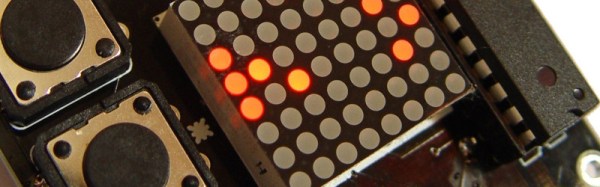
Opening the package, the micro:bit kit is rather minimalist. The board itself, a short USB lead, a battery box and a pair of AAA cells, an instruction leaflet, and the board itself.  Everything is child-sized, the micro:bit is a curved-corner PCB about 50mm by 40mm. The top of the board has a 5 by 5 square LED matrix and a pair of tactile switches, while the bottom has the surface-mount processor and other components, the micro-USB and power connectors, and a reset button. Along the bottom edge of the board is a multi-way card-edge connector for the I/O lines with an ENIG finish. On the card edge connector several contacts are brought out to wide pads for crocodile clips with through-plated holes to take 4mm banana plugs, these are the ground and 3V power lines, and 3 of the I/O lines.

Continue reading “Hands-On With The BBC Micro:Bit”