An Electric Converted Tractor CAN Farm!

Last October we showed you a video from [LiamTronix], in which he applied an electric conversion to a 1960s Massey-Ferguson 65 which had seen better days. It certainly seemed ready for light work around the farm, but it’s only now that we get his video showing the machine at work. This thing really can farm!

An MF 65 wasn’t the smallest of 1960s tractors, but by today’s standards it’s not a machine you would expect to see working a thousand acres of wheat. Instead it’s a typical size for a smaller operation, perhaps a mixed farm, a small livestock farm, or in this case a horticulture operation growing pumpkins. In these farms the tractor doesn’t often trail up and down a field for hours, instead it’s used for individual smaller tasks where its carrying or lifting capacity is needed, or for smaller implements. It’s in these applications that we see the electric 65 being tested, as well as some harder work such as hauling a trailer load of bales, or even harrowing a field.

In one sense the video isn’t a hack in itself, for that you need to look at the original build. But it’s important to see how a hack turned out in practice, and this relatively straightforward conversion with a DC motor has we think proven itself to be more than capable of small farm tasks. Its only flaw in the video is a 30 minute running time, something he says he’ll be working on by giving it a larger battery pack. We’d use it on the Hackaday ancestral acres, any time!

Continue reading “An Electric Converted Tractor CAN Farm!”

This Home Made Laptop Raises The Bar

With ready availability of single board computers, displays, keyboards, power packs, and other hardware, a home-made laptop is now a project within most people’s reach. Some laptop projects definitely veer towards being cyberdecks while others take a more conventional path, but we’ve rarely seen one as professional looking as [Byran Huang]’s anyon_e open source laptop. It really takes the art to the next level.

The quality is immediately apparent in the custom CNC-machined anodised aluminium case, and upon opening it up the curious user could be forgiven for thinking they had a stylish commercial machine in their hands. There’s a slimline mechanical keyboard and a glass trackpad, and that display is an OLED. In fact the whole thing had been built from scratch, and inside is an RK3588 SoC on a module sitting on a custom-designed motherboard. It required some effort for it to drive the display, a process we’ve seen cause pain to other designers, but otherwise it runs Debian. The batteries are slimline pouch cells, with a custom controller board driven by an ESP32.

This must have cost quite a bit to build, but it’s something anyone can have a go at for themselves as everything is in a GitHub repository. Purists might ask for open source silicon at its heart to make it truly open source, but considering what he’s done we’ll take this. It’s not the first high quality laptop project we’ve seen by any means, but it may be the first that wouldn’t raise any eyebrows in the boardroom. Take a look at the video below the break.

Continue reading “This Home Made Laptop Raises The Bar”

A Ribbon Microphone Is Harder Than You Think

There’s a mystique around ribbon microphones due to their being expensive studio-grade items, which has led more than one experimenter down the rabbit hole of making one. [Catherine van West] has posted her experiments in the field, and it makes for an interesting read.

The recipe for a ribbon microphone is very simple indeed — suspend a corrugated ribbon of foil in a magnetic field, and take the voltage across the ribbon. But that simplicity hides some significant issues, as the foil is much thinner than the stuff you might roast your turkey under. Such lightweight foil is extremely fragile, and the signwriters leaf used here proved to be difficult to get right.

Then when the microphone is built there’s still the exceptionally low impedance and small voltage across the ribbon to contend with. The choice here is a transformer rather than a FET preamp, which surprised us.

The result is by all accounts a decent sounding microphone, though with some hum pickup due to difficulty with shielding. Should you give one a try? Maybe not, but that hasn’t stopped others from giving it a go.

Dillo Turns 25, And Releases A New Version

The chances are overwhelming, that you are reading this article on a web browser powered by some form of the Blink or WebKit browser engines as used by Google, Apple, and many open source projects, or perhaps the Gecko engine as used by Firefox. At the top end of the web browser world there are now depressingly few maintained browser engines — we think to the detriment of web standards evolution.

Moving away from the big players though, there are several small browser projects which eschew bells and whistles for speed and compactness, and we’re pleased to see that one of the perennial players has released a new version as it passes its quarter century.

Dillo describes itself as ” a fast and small graphical web browser”, and it provides a basic window on the web with a tiny download and the ability to run on very low-end hardware. Without JavaScript and other luxuries it sometimes doesn’t render a site as you’d see it in Chrome or Firefox, but we’re guessing many users would relish some escape from the web’s cycle-sucking garbage. The new version 3.2.0 brings bug fixes, as well as math formula rendering, and navigation improvements.

The special thing about Dillo is that this is a project which came back from the dead. We reported last year how a developer resurrected it after a previous release back in 2015, and it seems that for now at least it has a healthy future. So put it on your retro PC, your original Raspberry Pi, or your Atari if you have one, and try it on your modern desktop if you need reminding just how fast web browsing can be.

This isn’t the only interesting browser project on the block, we’re also keeping an eye on Ladybird, which is aiming for those big players rather than simplicity like Dillo.

Thanks [Feinfinger] for the tip.

A PDA From An ESP32

The ESP32 series of microcontrollers have been with us for quite a few years now and appeared in both Tensilica and RISC-V variants, both of which deliver an inexpensive and powerful device. It’s thus shown up in quite a few handheld computers, whether they be conference badges or standalone devices, and this is definitely a field in which these chips have more to give. We’re pleased then to see this e-ink PDA from [ashtf8], which we think raises the bar on this type of device.

At its heart is an ESP32-S3, on the back side of a QWERTY keyboard PCB, and for a display it has an e-ink screen. To get over the annoying e-ink refresh when typing text it uses a hybrid of e-ink and OLED, with a small OLED holding the current line which can be periodically sent to the e-ink. Perhaps the nicest thing about the hardware though is the clear resin printed clamshell case, and a hand-cast silicone membrane for the keyboard. That has always been a part considered difficult to produce, and here he is making one from scratch. Take a look at the video below the break.

Software-wise it has a range of apps with more promised, but even as it stands it looks useful enough to work with. If that’s not enough, then perhaps an ESP32 operating system would help.

Continue reading “A PDA From An ESP32”

No Crystal Earpiece? No Problem!

A staple of starting off in electronics ion years past was the crystal set radio, an extremely simple AM radio receiver with little more than a tuned circuit and a point contact diode as its components. Point contact diodes have become difficult to find but can be replaced with a cats whisker type detector, but what about listening to the resulting audio? These circuits require a very high impedance headphone, which was often supplied by a piezoelectric crystal earpiece. [Tsbrownie] takes a moment to build a replacement for this increasingly hard to find part.

It shouldn’t have come as a surprise, but we were still slightly taken aback to discover that inside these earpieces lies the ubiquitous piezoelectric buzzer element. Thus given a 3D-printed shell to replace the one on the original, it’s a relatively simple task to twist up a set of wires and solder them on. The result is given a test, and found to perform just as well as the real thing, in fact a little louder.

In one sense this is such a simple job, but in another it opens up something non-obvious for anyone who needs a high impedance earpiece. The days of the crystal radios and rudimentary transistor hearing aids these parts were once the main target for may both have passed, but just in case there’s any need for one elsewhere, now we can fill it. Take a look at the video, below the break.

Fancy trying a crystal radio? We’ve got you covered.

Continue reading “No Crystal Earpiece? No Problem!”

Piezo Buzzer Makes A Drum

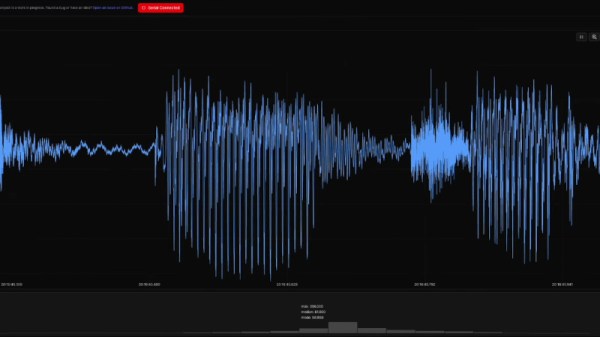
The humble piezo disc buzzer is much more than something that makes tinny beeps in retro electronic equipment, it can also be used as a sensor. Tapping a piezo buzzer gives an interesting waveform, with a voltage spike followed by an envelope, and then a negative rebound voltage. It’s something [Igor Brichkov] is using, to make a simple but effective electronic drum.

First of all, the output of the buzzer must be tamed, which he does by giving it a little impedance to dissipate any voltage spikes. There follows some simple signal conditioning with passive components, to arrive at an envelope for the final drum sound. How to turn a voltage into a sound? Using a voltage controlled amplifier working on a noise source. The result is recognizably the drum sound, entirely in electronics.

In a world of digital music it’s easy to forget the simpler end of sound synthesis, using circuits rather than software. If you hanker for the Good Old Days, we have an entire series on logic noise, doing the job with 4000 series CMOS logic.

Continue reading “Piezo Buzzer Makes A Drum”