A photo of the PDP-1 replica.

Hacking Printed Circuit Board To Create Casing And Instrument Panels

Over on Hackaday.io our hackers [Angelo] and [Oscarv] are making a replica of the PDP-1. That is interesting in and of itself but the particularly remarkable feature of this project is its novel use of printed circuit boards for casing and instrument panels.

What does that mean in practice? It means creating a KiCad file with a PCB for each side of the case/panel. These pieces can then be ordered from a board house and assembled. In the video below the break you will see an example of putting such a case together. They use sticky tape for scaffolding and then finish things off by soldering the solder joints on each edge together.

Continue reading “Hacking Printed Circuit Board To Create Casing And Instrument Panels”

A man standing next to a host of small automatic trash cans

Automated Rubbish Removal System

The hackers over at [HTX Studio] built a set of twenty trash cans which can automatically catch and remove rubbish.

In order to catch trash a bin needs to do two things: detect where trash will land; and then get there, fast. The second part is easy: three big motors with wheels under the bin. But how does a bin know where the trash will land? It uses a camera installed in the bin itself for that.

[HTX Studio] iteratively trained a model to process visual information from the camera to identify common types of trash. When it sees a trained object flying through the air it rushes to catch it where it will land. After many rounds of fine-tuning it finally started to work reliably.

Continue reading “Automated Rubbish Removal System”

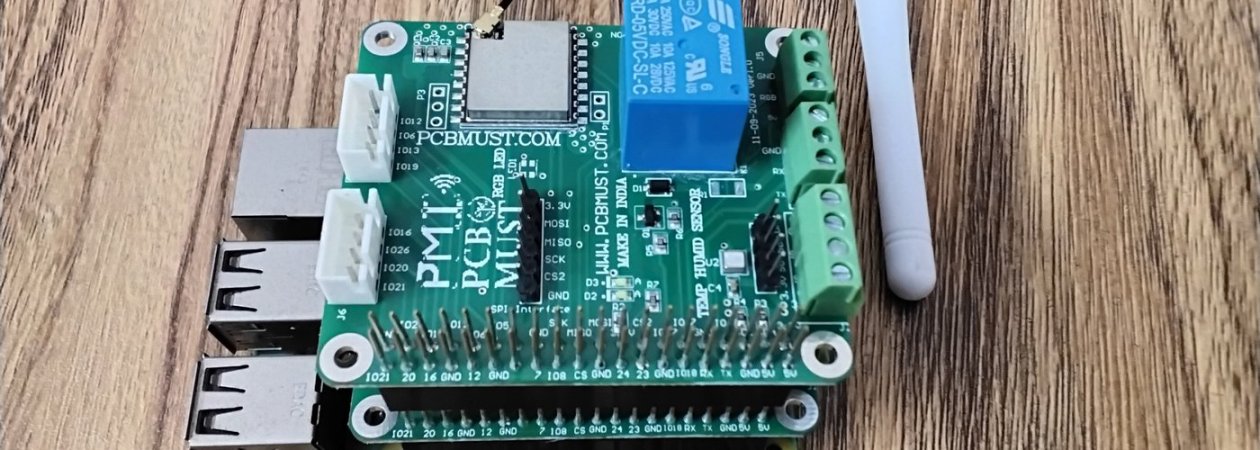
A photo of the HAT with the LoRa module and relay visible on the top

LoRaSense Pi Hat Aims To Kick Start IoT Projects

[Avi Gupta] recently sent in their LoRaSense RGB Pi HAT project. This “HAT” (Hardware Attached to Top) is for any Raspberry Pi with 40-pin header. The core of the build is the custom printed circuit board which houses the components and interconnects. The components include an SHT31 temperature and humidity sensor, an SX1278 LoRa module, and a 10 amp 220 VAC relay. The interconnects include support for UART, I2C, SPI, and WS2812B RGB LED interfaces as well as a stackable header for daisy chaining HATs.

The attached components in combination support a wide range of use cases. Possible uses for this Raspberry Pi HAT include smart home systems, agricultural projects, industrial monitoring, smart greenhouse, remote weather stations, or alerting systems. You can detect weather conditions, send and receive information, switch mains powered loads, and use RGB LEDs for status and alerting.

If you’re interested in LoRa technology be sure to read about the Yagi antenna that sends LoRa signals farther.

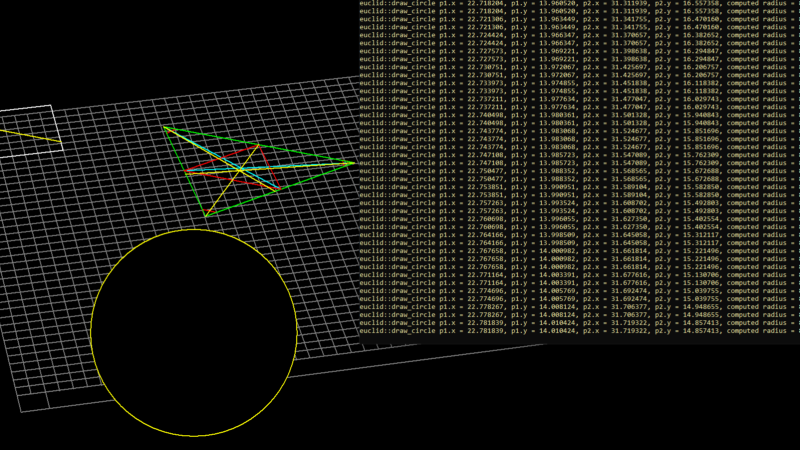
Some renderings of shapes made from lines including triangles and a circle.

2025 One Hertz Challenge: Analog Clock For Microsoft Windows

Our hacker [glgorman] sent in their submission for the One Hertz Challenge: an analog software clock for Microsoft Windows.

I guess we’d have to say that this particular project is a work-in-progress. There is no final clock, yet. But a number of yak’s have been shaved. For instance, we have code for computing geometric objects without using branch instructions, including points and lines and circles and such.

The notes dive deep into various rabbit holes. At one point we find ourselves computing the angle to the sun in the sky, that we may be able to cast the shadow of the clock hands on our clock face. The notes include miscellaneous source code snippets and various screenshots of geometric renderings which have been achieved so far.

Continue reading “2025 One Hertz Challenge: Analog Clock For Microsoft Windows”

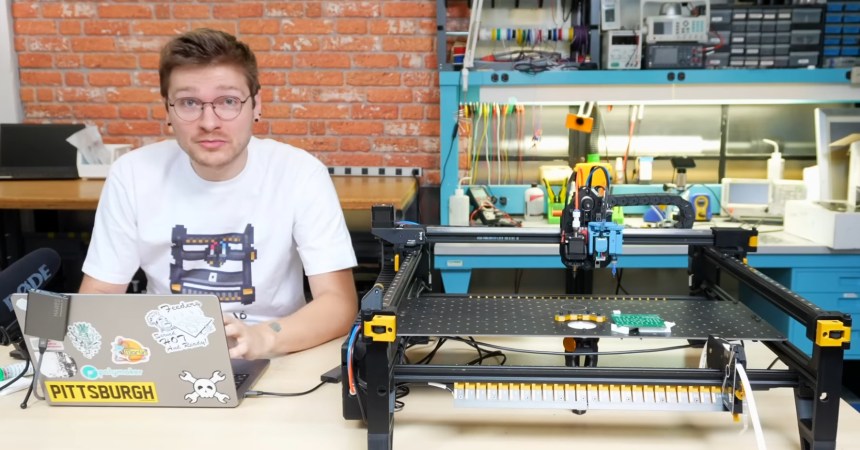
Stephen Hawes operating his LumenPnP

The LumenPnP Pasting Utility: Never Buy Solder Stencils Again?

Over on his YouTube channel the vivacious [Stephen Hawes] tells us that we never need to buy solder stencils again!

A big claim! And he is quick to admit that his printed solder paste isn’t presently quite as precise as solder stencils, but he is reporting good success with his technique so far.

[Stephen] found that he could print PCBs with his fiber laser, populate his boards with his LumenPnP, and reflow with his oven, but… what about paste? [Stephen] tried making stencils, and in his words: “it sucked!” So he asked himself: what if he didn’t need a stencil? He built a Gerber processing, G-code generating, machine-vision implemented… website. The LumenPnP Pasting Utility: https://paste.opulo.io/

Continue reading “The LumenPnP Pasting Utility: Never Buy Solder Stencils Again?”

A photo of the project on a breadboard in a briefcase.

2025 One Hertz Challenge: Precise Time Ref Via 1 Pulse-Per-Second GPS Signal

Our hacker [Wil Carver] has sent in his submission for the One Hertz Challenge: Precise Time Ref via 1 Pulse-Per-Second GPS Signal.

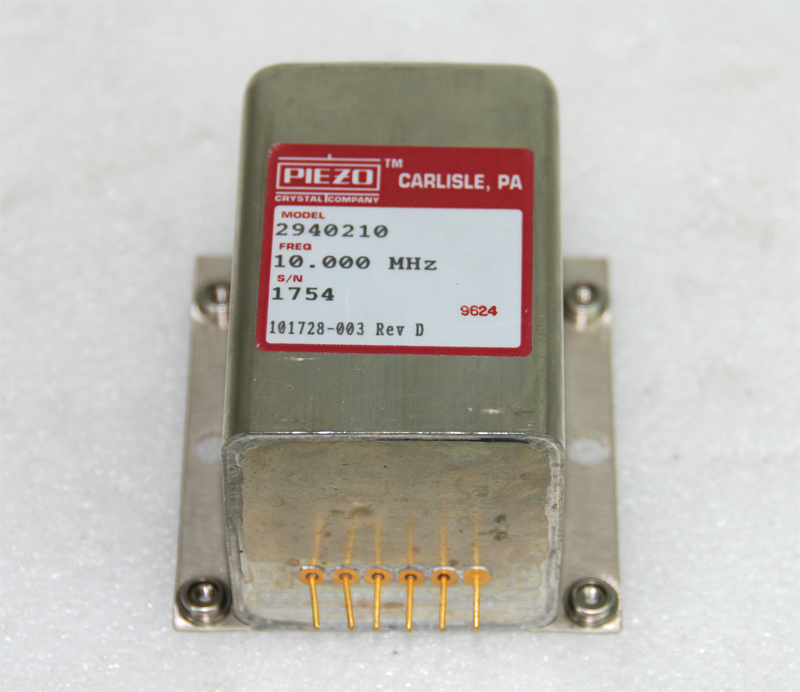
The Piezo 2940210 10 MHz crystal oscillatorThis GPS Disciplined Oscillator (GPSDO) project uses a Piezo 2940210 10 MHz crystal oscillator which is both oven-controlled (OCXO) and voltage-controlled (VCXO). The GPSDO takes the precision 1 Pulse-Per-Second (PPS) GPS signal and uses it to adjust the 10 MHz crystal oscillator until it repeatedly produces 10,000,000 cycles within one second.

[Wil] had trouble finding all the specs for the 2940210, particularly the EFC sensitivity (S), so after doing some research he did some experiments to fill in the blanks. You can get the gory details in his notes linked above.

Continue reading “2025 One Hertz Challenge: Precise Time Ref Via 1 Pulse-Per-Second GPS Signal”

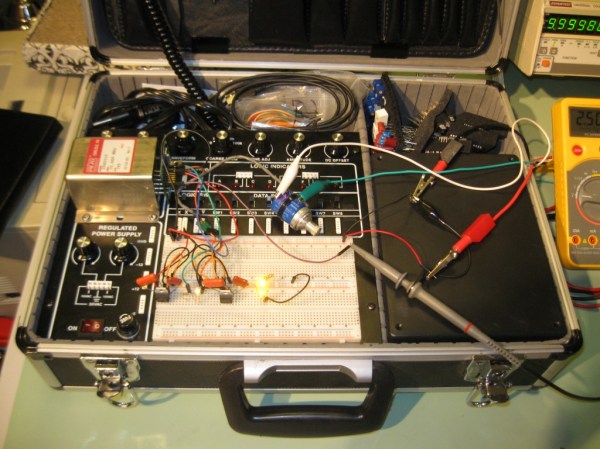
A photo of the circuitry along with an oscilloscope

Eight Artificial Neurons Control Fully Autonomous Toy Truck

Recently the [Global Science Network] released a video of using an artificial brain to control an RC truck.

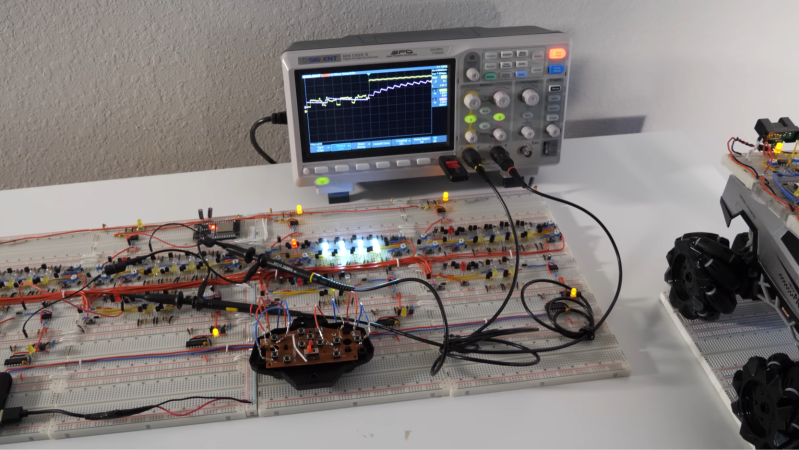
The video shows a neural network comprised of eight artificial neurons assembled on breadboards used to control a fully autonomous toy truck. The truck is equipped with four proximity sensors, one front, one front left, one front right, and one rear. The sensor readings from the truck are transmitted to the artificial brain which determines which way to turn and whether to go forward or backward. The inputs to each neuron, the “synapses”, can be excitatory to increase the firing rate or inhibitory to decrease the firing rate. The output commands are then returned wirelessly to the truck via a hacked remote control.

This particular type of neural network is called a Spiking Neural Network (SNN) which uses discrete events, called “spikes”, instead of continuous real-valued activations. In these types of networks when a neuron fires matters as well as the strength of the signal. There are other videos on this channel which go into more depth on these topics.

The name of this experimental vehicle is the GSN SNN 4-8-24-2 Autonomous Vehicle, which is short for: Global Science Network Spiking Neural Network 4 Inputs 8 Neurons 24 Synapses 2 Degrees of Freedom Output. The circuitry on both the vehicle and the breadboards is littered with LEDs which give some insight into how it all functions.

If you’re interested in how neural networks can control behavior you might like to see a digital squid’s behavior shaped by a neural network.

Continue reading “Eight Artificial Neurons Control Fully Autonomous Toy Truck”