They Want To Put A Telescope In A Crater On The Moon

When we first developed telescopes, we started using them on the ground. Humanity was yet to master powered flight, you see, to say nothing of going beyond into space. As technology developed, we realized that putting a telescope up on a satellite might be useful, since it would get rid of all that horrible distortion from that pesky old atmosphere. We also developed radio telescopes, when we realized there were electromagnetic signals beyond visible light that were of great interest to us.

Now, NASA’s dreaming even bigger. What if it could build a big radio telescope up on the Moon?

Continue reading “They Want To Put A Telescope In A Crater On The Moon”

Common Enzyme Breaks Down PLA Fast

The global issue of plastic waste has prompted scientists to seek innovative solutions for recycling. Single-use plastics, notorious for their environmental impact, require new methods for efficient and sustainable management. For some common plastics, though, salvation could be at hand, with researchers identifying a common enzyme that can be used to break them down fast.

Researchers at King’s College London have discovered an enzyme used in laundry detergents that can break down PLA plastics within 24 hours, using a little heat as an aid. Normally, this is achieved via composting methods that take weeks or months. This method transforms the plastics back into their original chemical components, offering a rapid and eco-friendly recycling process. The monomers can then be reused for manufacturing new plastic items.

One wonders if this could also be used in another way – perhaps in a multimaterial printer, allowing PLA to be used for supports and then broken down. It’s probably not that necessary, given other degradable materials exist, but it’s something to think about.

This project is a significant leap forward in recycling technology, showcasing the potential for enzymes to revolutionize how we handle plastic waste. It could also be a great way to recycle all those errant deformed Pikachus that keep ending up in your hackerspace’s 3D-printing waste basket. In any case, plastic waste is a problem the world needs to solve, and quickly, because it’s not going anywhere any time soon. Video after the break.

Continue reading “Common Enzyme Breaks Down PLA Fast”

Recovering A Busted Video Capture Device With Firmware Flashing Tricks

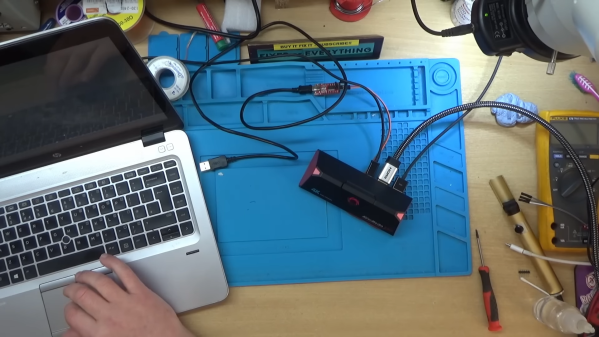
Sometimes, you have a piece of hardware that just up and stops working on you. In today’s fast-paced world, it’s easy to toss something broken and move on. [BuyItFixIt], as you imagine, makes it their purpose to, well, fix things instead. Their latest efforts involved resurrecting a dead AVerMedia Live Gamer 2 Plus capture device sourced off eBay.

The device was advertised as being dead, with no power. Probing around the board when powered up showed that there was some basic activity going on with one of the flash chips, but the device simply wouldn’t spring to life. This suggested that perhaps the flash had become corrupted, which was confirmed when reading the chip mostly returned 0xFF. Sadly, the device was so badly bricked that the usual update methods via SD card simply wouldn’t work.

Eventually, hunting down a debug header provided a way in. [BuyItFixIt] was able to find a way to flash firmware over this connection instead, but there was a problem. The firmware they had was formatted for loading via SD card, and wouldn’t work for the debug mode entry route. Instead, getting the device going would require recovering firmware from a similar working device, and then using that as a guide to assemble a proper workable firmware update to get the device back to an operational state.

It’s a great tale of perseverance and triumph, particularly given many would give up after the first update attempt failed. We’ve seen [BuyItFixIt] pull off some heroic repairs before, too. Video after the break.

Continue reading “Recovering A Busted Video Capture Device With Firmware Flashing Tricks”

Avocado-Shaped Robot Makes Its Way Through The Rainforest

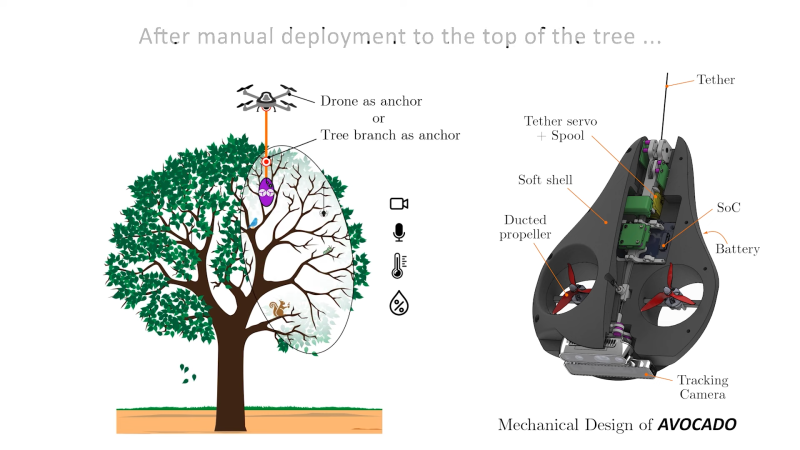
When you think of a robot getting around, you probably think of something on wheels or tracks. Maybe you think about a bipedal walking robot, more common in science fiction than our daily lives. In any case, researchers went way outside the norm when they built an avocado-shaped robot for exploring the rainforest.

The robot is the work of doctoral students at ETH Zurich, working with the Swiss Federal Institute for Forest, Snow, and Landscape research. The design is optimized for navigating the canopy of the rainforest, where a lot of the action is. Traditional methods of locomotion are largely useless up high in the trees, so another method was needed.

The avocado robot is instead tethered to a cable which is affixed to a high branch on a tree, or even potentially a drone flying above. The robot then uses a winch to move up and down as needed.  A pair of ducted fans built into the body provide the thrust necessary to rotate and pivot around branches or other obstacles as it descends. It also packs a camera onboard to help it navigate the environment autonomously.

It’s an oddball design, but it’s easy to see how this design makes sense for navigating the difficult environment of a dense forest canopy. Sometimes, intractable problems require creative solutions. Continue reading “Avocado-Shaped Robot Makes Its Way Through The Rainforest”

Fixing A Tractor Dashboard From Over 10,000 Miles Away

[BuyItFixIt] is well known as a dab hand at, well, fixing things… and presumably buying them, too. Recently, they received an email calling for help of the former kind. One of their Australian viewers owned the same model of tractor, but with a dead digital dash. Thankfully, help was at hand!

The problem turned out to be due to a dead EEPROM on the Australian tractor. In contrast, [BuyItFixIt] had a perfectly working dashboard on their tractor. Thus, they set about disassembling the dash and dumping the EEPROM to try and sort the stricken farm implement. This posed some risk of ending up with two dead dashboards, necessitating a careful hand. In any case, the Case tractor had a fairly simple dash with a majority of through-hole components, making it fairly easy to work with. The Microchip 93LC46B chip was in a DIP package, and was removed with the aid of some low-melting point solder in short order. The contents of the EEPROM were then dumped to a file using a XGecu T48 programmer.

With the file sent off via email, the Australian tractor owner flashed a fresh EEPROM and reinstalled it in their cluster. They were greeted with success, with the only complication being that the hours reading on the cluster had to be corrected to match the previous reading on their machine.

It’s a fairly simple story of fixing an embedded system, but it’s an educational one. It also comes with a deeper dive into how the CASE dashboard works. Just about anyone with basic electronic skills could pull this off and save an entire tractor in the process. It’s great to see these jobs documented so that we can all learn useful basic skills like these. Video after the break.

Continue reading “Fixing A Tractor Dashboard From Over 10,000 Miles Away”

Navigate Burning Man With Ease With This Custom Tool

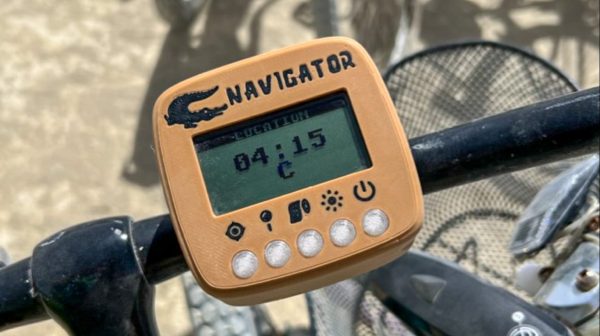
When setting up a city in the desert, the team behind Burning Man does its best to lay things out in an ordered fashion. Even still, getting around at ground level can be a challenge at times, and it’s easy to get lost. To help get around easier, [Zach] developed a nifty GPS device built specifically for navigating the ephemeral clock-like city.

The device is built for a few simple purposes. It shows where you are, it helps you navigate somewhere you’ve been before, and it helps you navigate to portable toilets. It’s set up to be usable both on bike and on foot, the typical ways of getting around the playa. Since Black Rock City is fairly simple, it uses an arrow to point to a desired waypoint, and is capable of storing up to five points of interest. It’s built using a cheap GNSS receiver and transflective LCD screen, and a Pi Pico is the brains of the operation.

The value of the device is obvious, particularly when exploring deeper areas of the playa, or after the road signs have been removed or structures have been taken down or burnt to ashes. We’ve seen some other great projects from the desert festival before, too. If you’ve got your own playa-spec hacks, don’t hesitate to let us know!

Robot Can Read Braille Much Faster Than Humans With New Sensor

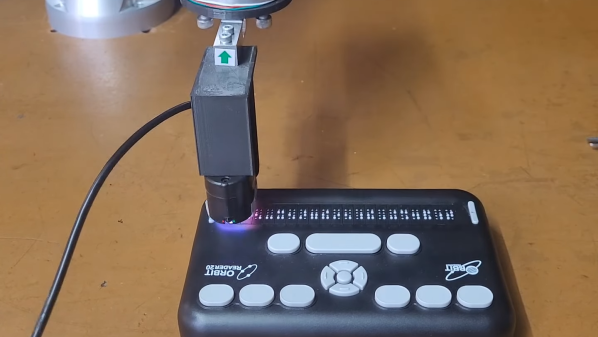
Braille is a method of physical writing used to allow humans to read by touch — most commonly used as a substitute for printed text by those who may be visually impaired. Both displaying Braille and reading it is difficult to do with machines, but there has been a development in the latter area. A research team has trained a robot to read Braille at a speed far exceeding humans.

The robot was developed by a team at the University of Cambridge. Rather than trying to read Braille by touch, it instead uses a camera and an image recognition algorithm to do the job. Their solution is a bit ironic in a way, given the purpose Braille was created for. The robot can quickly sweep across a Braille display, working at a rate of up to 315 words per minute at 87% accuracy. That’s roughly twice as fast as a human reading Braille, with a similar level of accuracy. Some nifty de-blurring algorithms were needed to achieve this speed from the camera’s video feed.

We’ve also seen some impressive development on the other side of all those little bumps, with two Braille devices taking home awards during the final Hackaday Prize in 2023.
Continue reading “Robot Can Read Braille Much Faster Than Humans With New Sensor”