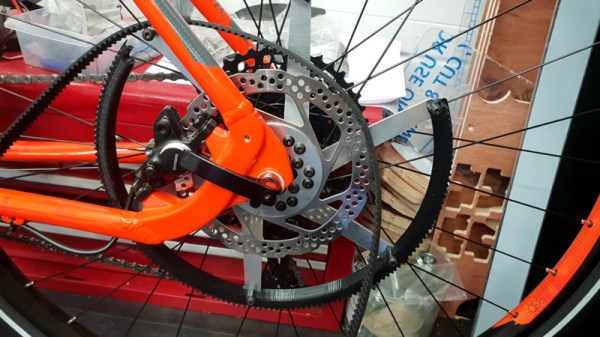
[Tom Stanton] is well-regarded in the maker community, and has put much effort in over the years on a variety of electric vehicle builds. In the process of upgrading his e-bike last year, he ran into some issues with the main drive pulley. Rather than rely on guesswork, he threw engineering at the problem.
The problem concerned the mounting bolts on the pulley’s hub, which would pull out under high torque. [Tom’s] initial finite element simulations had suggested the design was sound, but reality was proving otherwise. After further analysis and testing, [Tom] determined that his analysis hadn’t properly simulated the bolt pull-out condition. With this corrected in the software, it was readily apparent that there simply wasn’t enough material around the bolt holes to hold the torque load.
With the simulation now more closely agreeing with reality, [Tom] was able to correct the design. New parts were created with a strengthened mounting section, and the pulley was successfully able to deal with the loads in service.
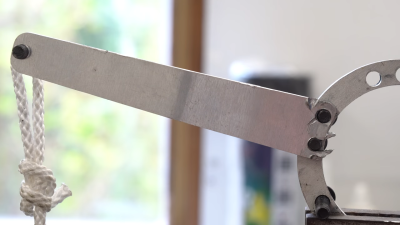
It’s a great example of using engineering simulation tools to solve a problem quickly, rather than simply guessing and hoping things will hold up. We’ve seen [Tom]’s work before, too — like this fun backyard trebuchet build. Video after the break.
Continue reading “The Trials And Tribulations Of E-Bike Drivetrain Design”



 Hailing from the recent past of 2014, it’s a design that is well-suited to the average makerspace. Built out of layers of lasercut chipboard and acrylic, it creates 16 seperate pockets for LEDs with very little bleed in between. A black bezel is fitted to complete the effect, along with frosted white acrylic diffusers for each triangle element.