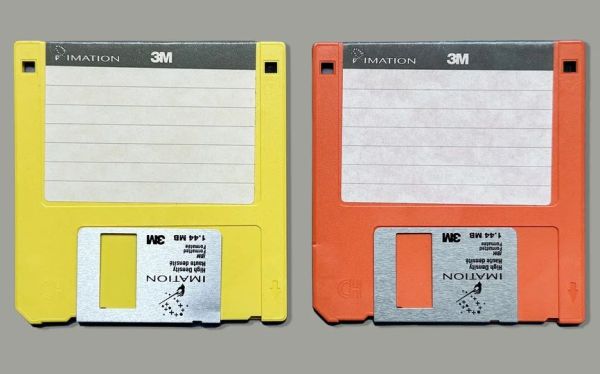
3M’s Floppy Disks: A Story Of Success And The Birth Of Imation

3M, or as it was officially called until 2002, the Minnesota Mining and Manufacturing Company is one of those odd-duck companies where if you ask what products they manufacture the answer is pretty close to a general ‘yes’. Throughout its 121 year history, it’s moved from producing sandpaper to also producing adhesives, laminates, personal protective equipment, as well as a nearly infinite list of further products which at one point in time included a magnetic storage range of products. How this latter came to be is the subject of an article by [Ernie Smith], focusing on floppy disk storage.

Although 3M was not the one to invent floppy disks or magnetic storage, their expertise in making small grains of material stick in an organized fashion on a wide range of materials came in handy. This first allowed 3M to make a name for itself with its Scotch magnetic (reel-to-reel) tape, followed by 3M moving into the floppy disk market by 1973. Over the years following this introduction, 3M storage media came to be known as highly reliable, but as the 1990s saw the magnetic storage market mature and stagnate, 3M management saw the writing on the wall and spun this division off into a new company: Imation.

While the floppy disk isn’t quite dead yet, at this point in time Imation and its main competitors like Memorex are now mostly just a fading memory — while 3M is still plowing ahead, creating new divisions and divesting as opportunities arise.
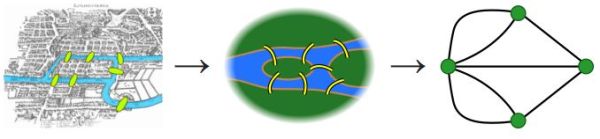
Reduction of a physical map to a graph.

Where Graph Theory Meets The Road: The Algorithms Behind Route Planning

Back in the hazy olden days of the pre-2000s, navigating between two locations generally required someone to whip out a paper map and painstakingly figure out the most optimal route between those depending on the chosen methods of transport. For today’s generations no such contrivances are required, with technology having obliterated even the a need to splurge good money on a GPS navigation device and annual map updates.

These days, you get out a computing device, open Google Maps or equivalent, ask it how you should travel somewhere, and most of the time the provided route will be the correct one, including the fine details such as train platform and departure times. Yet how does all of this seemingly magical route planning technology work? It’s often assumed that Dijkstra’s algorithm, or the A* graph traversal algorithm is used, but the reality is that although these pure graph theory algorithms are decidedly influential, they cannot be applied verbatim to the reality of graph traversal between destinations in the physical world.

Continue reading “Where Graph Theory Meets The Road: The Algorithms Behind Route Planning”

Amazon’s ‘Just Walk Out’ Shopping Is Out, Moves To Dash Carts At Its Grocery Stores

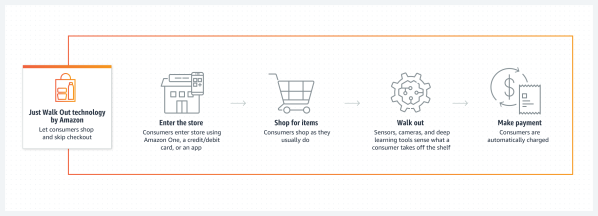
After a few years of Amazon promoting a grocery shopping experience without checkout lines and frustrating self-checkout experiences, it is now ditching its Just Walk Out technology. Conceptualized as a store where you can walk in, grab the items you need and walk out with said items automatically charged to your registered payment method, it never really caught much traction. More recently it was revealed that the technology wasn’t even as automated as portrayed, with human workers handling much of the tedium behind the scenes. This despite claims made by Amazon that it was all powered by deep machine learning and generative AI.

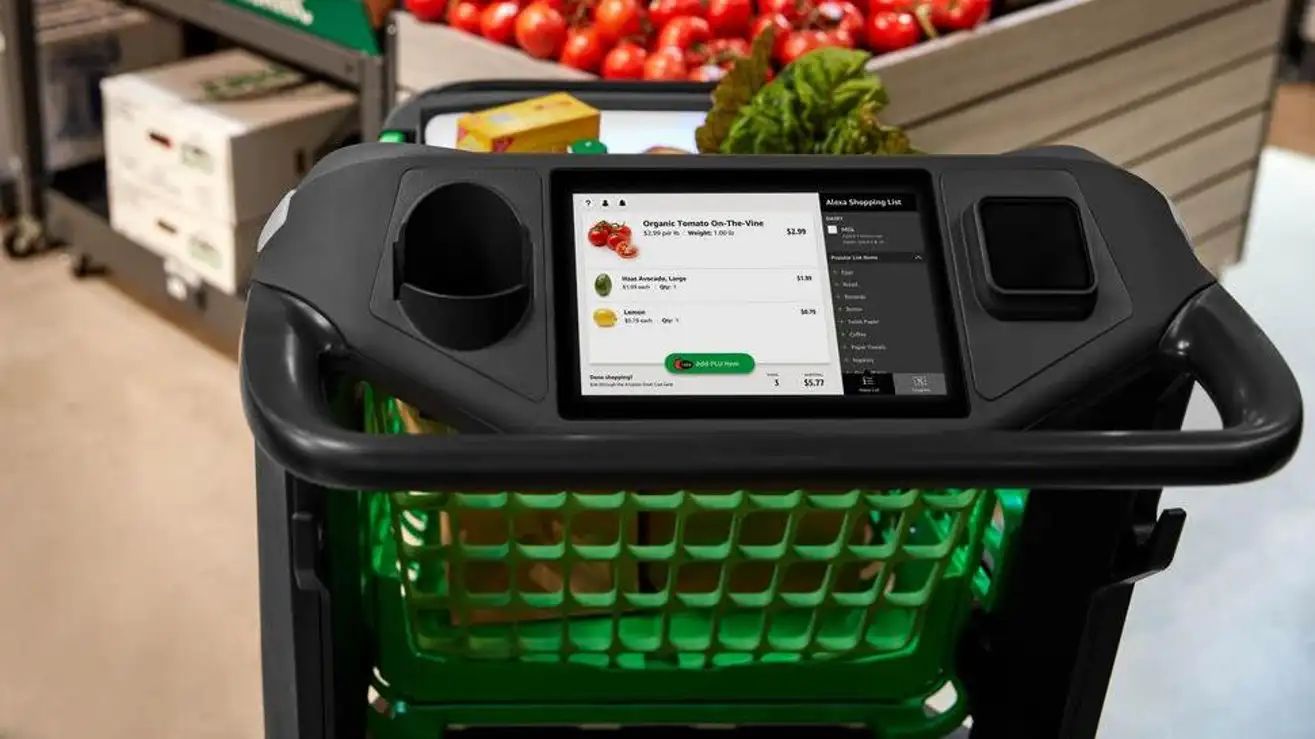
An Amazon Dash Cart's user interface, with scanner and display. (Credit: Amazon)
An Amazon Dash Cart’s user interface, with scanner and display. (Credit: Amazon)

Instead of plastering the ceilings of stores full with cameras, it seems that Amazon instead wishes to focus on smart shopping carts that can keep track of what has been put inside them. These so-called Dash Carts are equipped with cameras and other sensors to scan barcodes on items, as well as weigh unlabeled items (like fruit), making them into somewhat of a merging of scales at the vegetable and fruit section of stores today, and the scanning tools offered at some grocery stores to help with self-checkout.

As the main problem with the Just Walk Out technology was that it required constant (700 out of 1,000 sales in 2022) human interaction, it will be interesting to see whether the return to a more traditional self-service and self-checkout model (albeit with special Dash Lanes) may speed things along. Even so, as Gizmodo notes, Amazon will still keep the Just Walk Out technology running across locations in the UK and elsewhere. Either this means the tech isn’t fully dead yet, or we will see a revival at some point in time.

Space Mirrors: Dreams Of Turning The Night Into Day Around The Clock

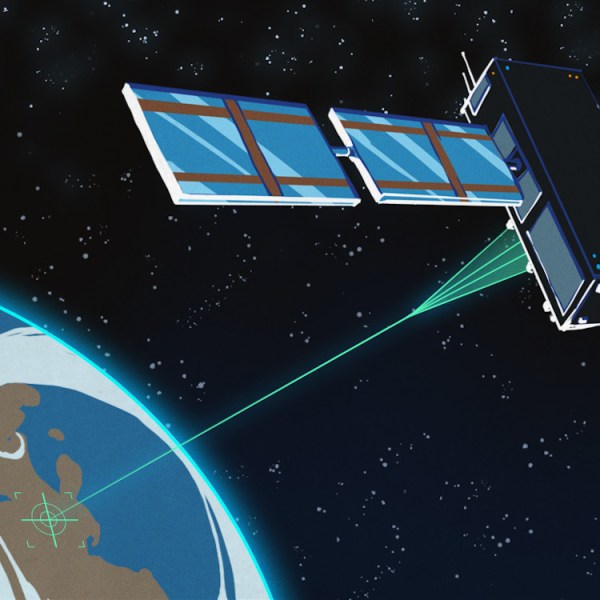
Recently, a company by former SpaceX employee Ben Nowack – called Reflect Orbital – announced that it is now ready to put gigantic mirrors in space to reflect sunshine at ground-based solar farms. This is an idea that’s been around for a hundred years already, both for purposes of defeating the night through reflecting sunshine onto the surface, as well as to reject the same sunshine and reduce the surface temperature. The central question here is perhaps what the effect would be of adding or subtracting (or both) of solar irradiation on such a large scale as suggested?

We know the effect of light pollution from e.g. cities and street lighting already, which suggests that light pollution is a strongly negative factor for the survival of many species. Meanwhile a reduction in sunshine is already a part of the seasons of Autumn and Winter. Undeniable is that the Sun’s rays are essential to life on Earth, while the day-night cycle (as well as the seasons) created by the Earth’s rotation form an integral part of everything from sleep- and hibernation cycles, to the reproduction of countless species of plants, insects, mammals and everyone’s favorite feathered theropods.

With these effects and the gigantic financial investments required in mind, is there any point to space-based mirrors?

Continue reading “Space Mirrors: Dreams Of Turning The Night Into Day Around The Clock”

SatCat5: UART, SPI And I2C Via Ethernet With FPGA-Based Design

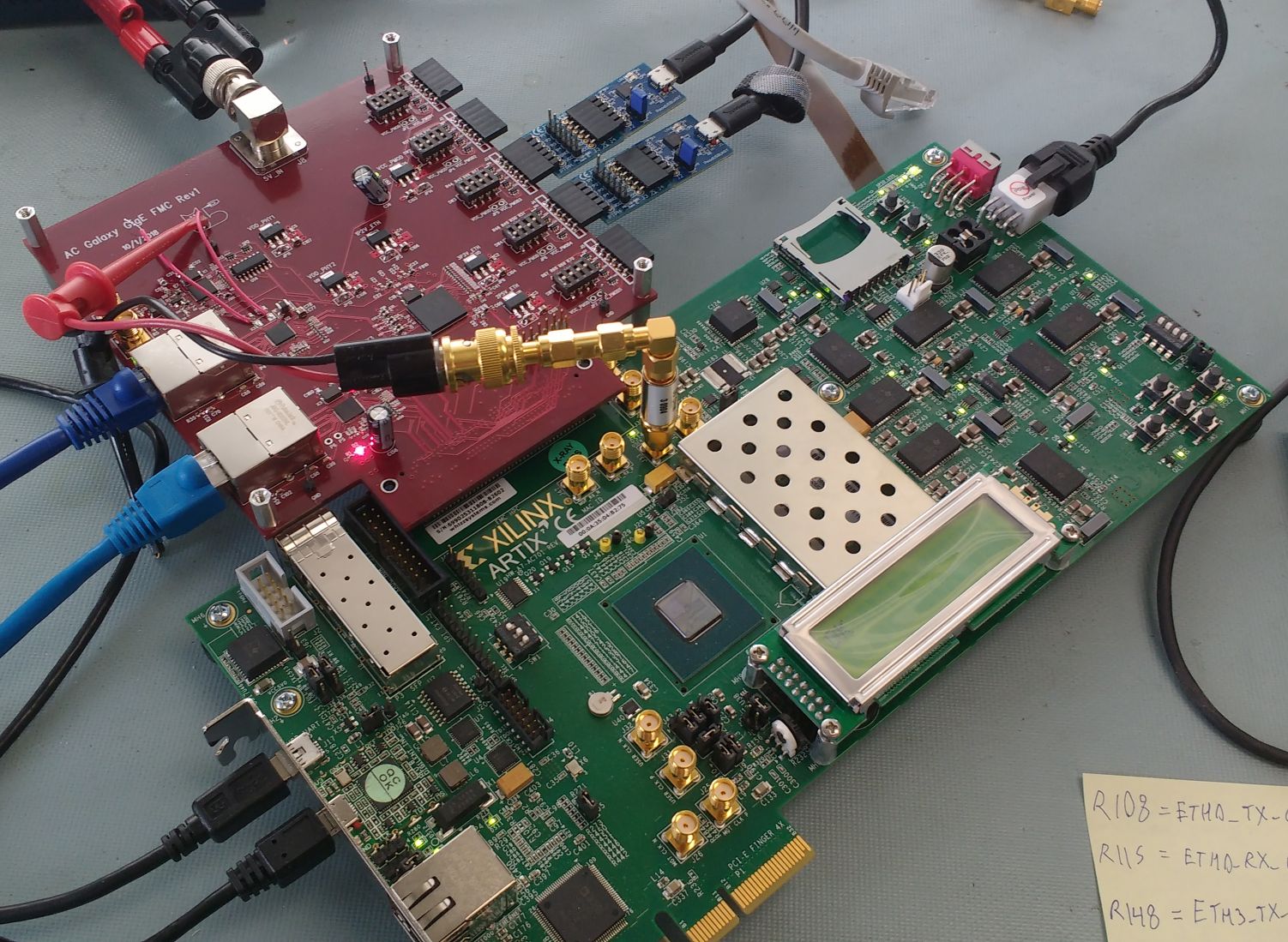
Arty A7-based prototype of SatCat5 with custom switch I/O board. (Credit: The Aerospace Corporation)

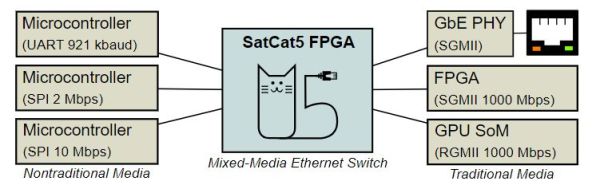
To the average microcontroller, Ethernet networks are quite a step up from the basic I2C, SPI and UART interfaces, requiring either a built-in Ethernet MAC or SPI-based MAC, with tedious translation between Ethernet and those other interfaces. Yet what if this translation could be done automatically and transparently?  This is what the SatCat5 FPGA-based project by [The Aerospace Corporation] aims to provide: a gateway akin to an unmanaged Ethernet switch that also supports those non-Ethernet links. Recently they answered a range of questions about the project on Hacker News.

The project name comes from the primary target audience: smallsat and cubesat developers, which is an area where being able to route more traffic over a common Ethernet-based bus is a major boon. The provided Xilinx Artix-7-based reference design (pictured) gives a good idea of how it can be used: it combines an Arty A7 development board with a custom PCB containing an Ethernet switch IC (SJA1105), TJA1100 transceiver, two RJ45 jacks and four PMOD connectors, here connected to two UARTs for bidirectional communication between them. Ethernet frame encapsulation is provided using the standard Serial Line Internet Protocol (SLIP), with more details covered in the FAQ. At a minimum an FPGA like a Lattice iCE40 is required, with an MCU capable of using the provided C++ libraries, or a custom implementation.

Thanks to [STR-Alorman] for the tip.

ESP-Drone: Building An ESP32-Based Quadcopter For Not Much Cash

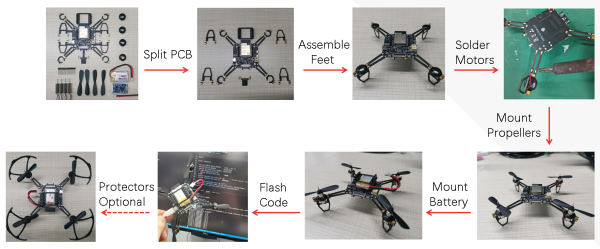
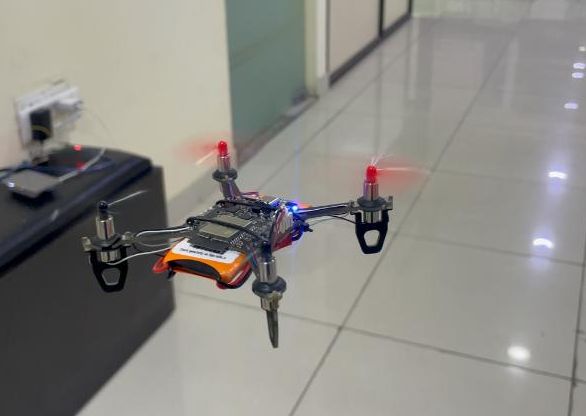
What’s the cheapest quadcopter you can build? As [Circuit Digest] demonstrates with their variant of the ESP-Drone project by Espressif, you only need a minimum of parts: an ESP32 MCU, an inertial measurement unit (IMU) such as the MPU6050, and four MOSFETs to drive the brushless DC motors. As the PCB also forms the structural frame and landing struts for the quadcopter, not even a 3D printer is needed. All told, [Circuit Digest] figures the total BOM comes in at around 1,000 Indian Rupees, or about $12 USD.

The fully assembled ESP-Drone flying around. (Credit: Circuit Digest)

While this [Circuit Digest] project provides basic IMU functionality, the Espressif project also has a few expansion boards detailed on its hardware page, depending on the base model of the mainboard you pick. The [Circuit Digest] project follows the ESPlane-V2-S2 version with no expansion boards, but the ESP32-S2-Drone V1.2 mainboard can be extended with position-hold, pressure and compass modules, as well as custom boards.

As a derivative of the Bitcraze Crazyflie project, the ESP-Drone firmware also supports the rather nifty cfclient software for remote monitoring, logging and control. This may also be in the [Circuit Digest] firmware, but wasn’t listed among the features.

Continue reading “ESP-Drone: Building An ESP32-Based Quadcopter For Not Much Cash”

Using Electroadhesion To Reversibly Adhere Metals And Graphite To Hydrogels And Tissues

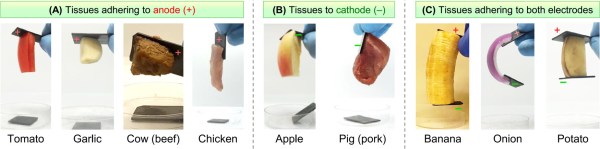
The usual way to get biological tissues and materials like gels and metals to stick together is using sutures, adhesives or both. Although this generally works, it’s far from ideal, with adhesives forming a barrier layer between tissues and the hard or impossible to undo nature of these methods. A viable alternative might be electroadhesion using cation and anion pairs, which uses low-voltage DC to firmly attach the two sides, with polarity reversal loosening the connection with no permanent effects. This is what a group of researchers have been investigating for a few years now, with the most recent paper on the topic called Reversibly Sticking Metals and Graphite to Hydrogels and Tissues by [Wenhao Xu] and colleagues published this year in ACS Central Science.

This follows on the 2021 study published in Nature Communications by [Leah K. Borden] and colleagues titled Reversible electroadhesion of hydrogels to animal tissues for suture-less repair of cuts or tears. In this study a cationic hydrogel (quaternized dimethyl aminoethyl methacrylate, QDM) was reversibly bonded to bovine aorta and other tissues, with said tissues functioning as the anionic element. Despite demonstrated functionality, the exact mechanism which made the application of 3-10 VDC (80 – 125 mA) for under a minute (10+ seconds) cause both sides to bond so tightly, and reversibly, is still unknown. This is where the recent study provides a mechanism and expands the applications.

Continue reading “Using Electroadhesion To Reversibly Adhere Metals And Graphite To Hydrogels And Tissues”