LabVIEW Abandons Mac After Four Decades

When National Instruments (NI) released LabVIEW in 1986 it only targeted the Macintosh, with ports to other platforms coming later on in the 1990s. Now, NI has announced that with the next version in 2024, LabVIEW will only be released for Linux and Windows, leaving behind Apple’s software platform after nearly four decades. The news was covered by Apple Insider, which cites a forum thread on the NI website in which the details of LabVIEW for macOS are discussed. This news comes on the heels of the announcement of Valve dropping macOS support with Counter Strike 2.

In both cases the issue at hand appears to be both a combination of a low user count (less than 1% of CS:GO players) and the complexity of using proprietary APIs (Cocoa, Metal, etc.) that have led to the decision to terminate the macOS releases. Not that macOS users aren’t used to app-related bloodbaths after losing all 32-bit applications back in 2019, but the trend of more high-profile applications and games not supporting the OS does seem to be ramping up.

Perhaps the only positive news here for people who bought into the Apple hardware ecosystem here is that Windows runs on M1/M2 Macs, and there is even an experimental Linux distribution in the form of Asahi Linux to conceivably dual-boot into for those applications that just don’t want to run on Apple’s OS.

National Research Council laboratories in Ottawa

Canada Abruptly Ends Official Time Signal

In a sudden move that was noted not only by Canadian media, but also international media channels, the National Research Council Time Signal that was broadcast by Canadian Broadcasting Corporation (CBC) on CBC Radio One since November 5 1939 was turned off on October 9th, after eighty-four years, one world war, countless generations, and the rise of modern technology. Although perhaps obsolete by today’s standards, this 15 to 60 second long broadcast at 13:00 Eastern Time every single day has been a constant in the life of Canadians, whether they tuned into local radio, or (increasingly) via Internet radio.

The NRC Time Signal consisted out of a series of 800 Hz sinewave ‘beeps’ followed by a second-long signal to indicate the top of the hour. Back in the day this was extremely useful to sync one’s clocks, watches and other time-keeping devices to. Yet between the transmission delays caused by Internet radio and the increased availability of NTP and other time sources on modern-day devices, the signal’s main use appears to have become a nostalgic reminder of what once was a constant of each and every day.

In this regard the public response to the rather unceremonious decommissioning without prior announcement was rather predictable. After all, even if it wasn’t that useful, why throw out something that is more recognizable than any other radio jingle for generations of Canadians?

Top image: National Research Council laboratories in Ottawa.

Ingenuity’s 62nd Flight And Attempting A New Speed Record

One of the fun aspects of exploring a new planet is that you can set a lot of new records, as is the case with the very first Mars-based helicopter, Ingenuity. Since its inaugural flight on April 19th of 2021, Ingenuity has flown 61 times, setting various records for distance traveled and other parameters. Although setting the first record is easy on account of anything being better than literally nothing, the real challenge lies in exceeding previously set records, as the team behind Ingenuity seeks to do again with flight 62 and a new speed record.

Targeting October 12th, the goal is to travel 268 meters (1.33 furlong) at a maximum altitude of 18 meters while hitting 10 meters per second (36 km/h), which would shatter the 8 m/s (28.8 km/h) set by flight 60. Although still quite a distance to the 240 m/s required to hit Mach 1 on Mars, the fact that this feat is being performed by a first-of-its-kind helicopter in the thin Martian atmosphere, using off-the-shelf components that were expected to last maybe a handful of flights, is nothing short of amazing.

(Thanks to [Mark Stevens] for the tip!)

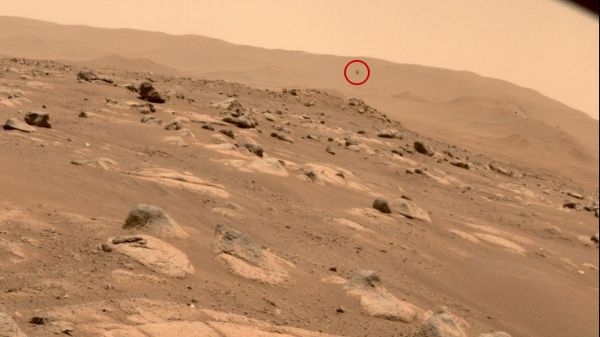
(Top image: Fourth flight of Ingenuity (circled), captured by Perseverance rover. Source: NASA/JPL)

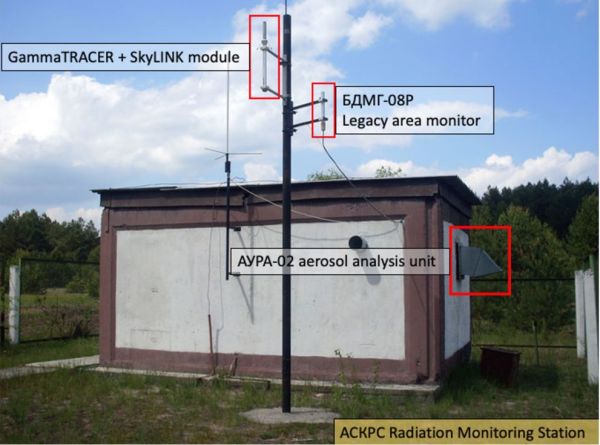
A monitoring station as set up in the CEZ, featuring both the legacy (ARMS) and new wireless monitoring system.

How The 2022 CEZ Event Shows The Fragility Of Environmental Sensors In High-Risk Areas

In what reads somewhat like a convoluted detective story, the events unfolding at the Chornobyl Exclusion Zone (CEZ) in Ukraine during late February had the media channels lighting up with chatter about ‘elevated gamma radiation levels’, which showed up on the public CEZ radiation monitoring dashboard for a handful of gamma radiation sensors. This happened right before this reporting system went off-line, leaving outside observers guessing at what was going on. By the time occupying forces had been driven out of the CEZ, the gamma radiation levels were reported as being similar to before the invasion, yet the computer hardware which was part of the monitoring system had vanished along with the occupying forces. After considering many explanations, this left security researchers like [Ruben Santamarta] to consider that the high values had been spoofed.

Continue reading “How The 2022 CEZ Event Shows The Fragility Of Environmental Sensors In High-Risk Areas”

Learning About Ferroresonant Transformers While Fixing A 1970s Power Supply

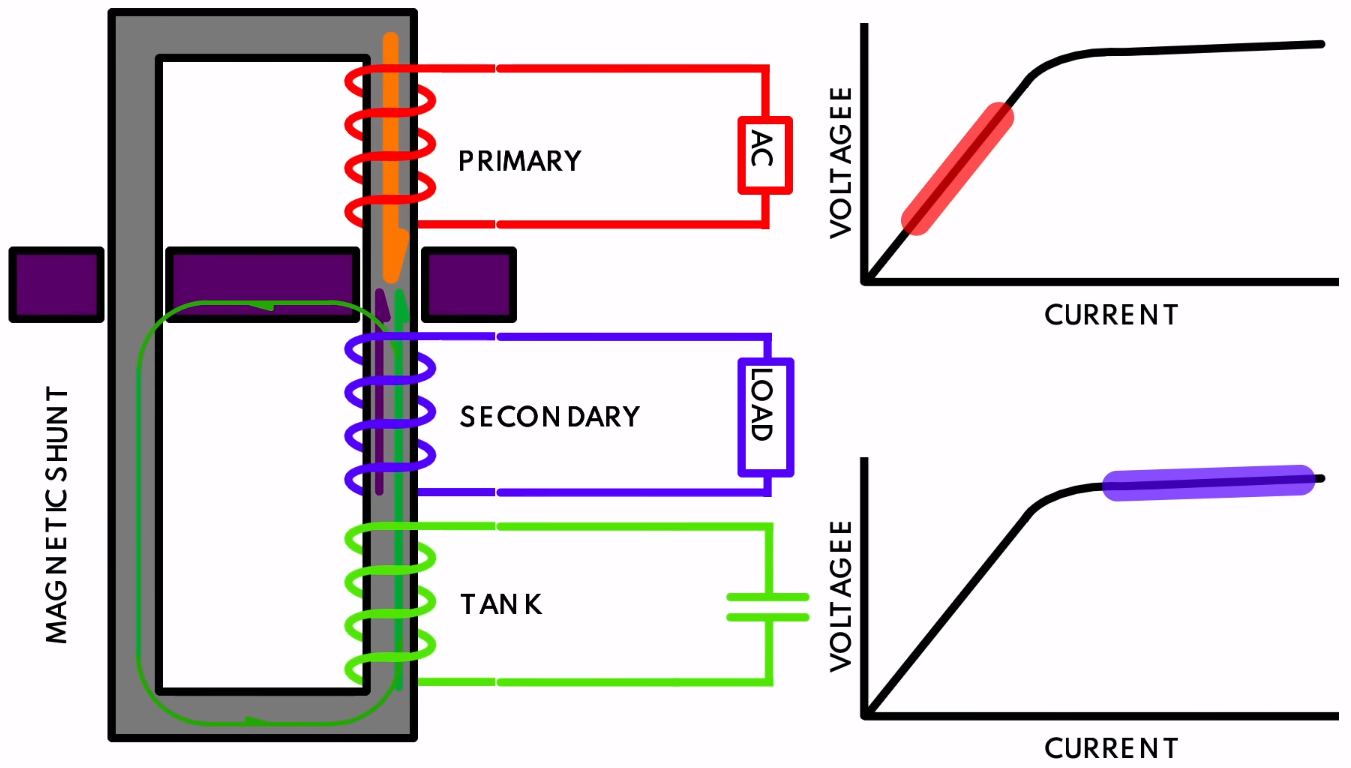
Ferroresonant (constant voltage) transformer diagram. Secondary side is kept in full saturation with the tank, keeping voltage constant. (Credit: Usagi Electric)

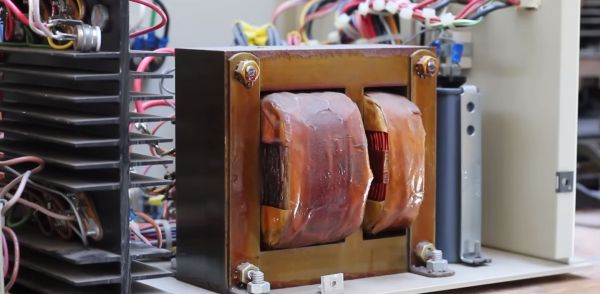
While troubleshooting the power supply of a 1970s Centurion system, [Usagi Electrics] came across a fascinating feature of these units: the ferroresonant, or constant voltage transformer (CVT). The main difference between a regular transformer and a CVT is that the former has a quite direct correlation between the input and output voltage, as the magnetic flux induced on the primary side is directly translated to the secondary (output) side.

A CVT adds a second element on the secondary side in the form of a tank circuit (LC circuit) – essentially a large capacitor – along with a magnetic shunt that ‘short circuits’ part of the magnetic flux between the primary and secondary side. The result of this is that even as the primary side is kept well below the saturation point where efficiency plummets, the secondary side is kept within this saturation region, enabling a very constant output voltage across a wide range of input voltages. For the Centurion’s power supply this input range goes from 90 to 130 VAC.

Continue reading “Learning About Ferroresonant Transformers While Fixing A 1970s Power Supply”

Pushing The Boundaries Of Tiny Mechanical Devices With Compliant Mechanisms

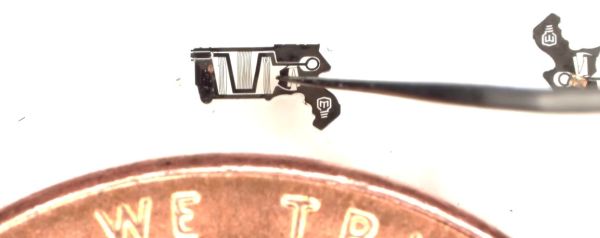
Mechanical actions underlie much of what makes modern day society function, whether it’s electric motors, combustion engines, switches, levers, or the springs inside a toy blaster gun that propel foam darts at unsuspecting siblings. Yet as useful as it would be to scale such mechanisms down to microscopic levels, this comes with previously minor issues on a macroscopic scale, such as friction and mechanical strength, becoming quickly insurmountable. Or to put in more simple terms, how to make a functioning toy blaster gun small enough to be handled by ants? This is the topic which [Mark Rober] explores in a recent video.

Continue reading “Pushing The Boundaries Of Tiny Mechanical Devices With Compliant Mechanisms”

Designing A Macintosh-to-VGA Adapter With An LM1881

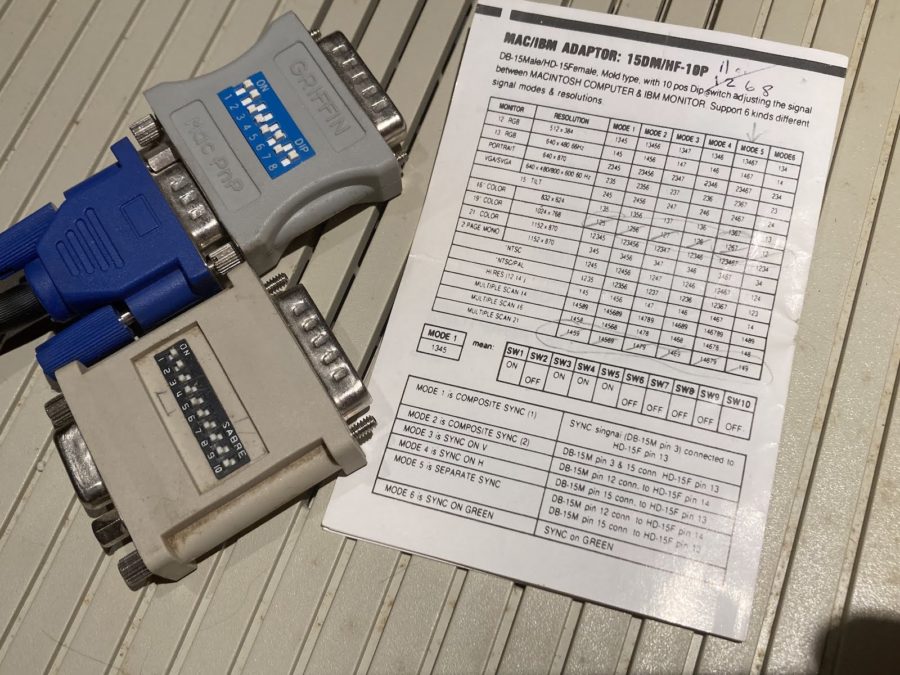
Old-school Macintosh-to-VGA adapter. Just solve for X, set the right DIP switches and you’re golden.

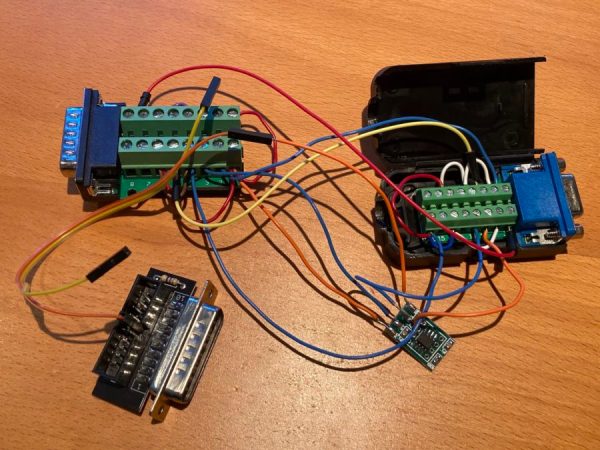
If you’re the happy owner of a vintage Apple system like a 1989 Macintosh IIci you may know the pain of keeping working monitors around. Unless it’s a genuine Apple-approved CRT with the proprietary DA-15-based video connector, you are going to need at least an adapter studded with DIP switches to connect it to other monitors. Yet as [Steve] recently found out, the Macintosh’s rather selective use of video synchronization signals causes quite a headache when you try to hook up a range of VGA-equipped LCD monitors. A possible solution? Extracting the sync signal using a Texas Instruments LM1881 video sync separator chip.

Much of this trouble comes from the way that these old Apple systems output the analog video signal, which goes far beyond the physical differences of the DA-15 versus the standard DE-15 D-subminiature connectors. Whereas the VGA standard defines the RGB signals along with a VSYNC and HSYNC signal, the Apple version can generate HSYNC, VSYC, but also CSYNC (composite sync). Which sync signal is generated depends on what value the system reads on the three sense pins on the DA-15 connector, as a kind of crude monitor ID.

Theoretically this should be easy to adapt to, you might think, but the curveball Apple throws here is that for the monitor ID that outputs both VSYNC and HSYNC you are limited to a fixed resolution of 640 x 870, which is not the desired 640 x 480. The obvious solution is then to target the one monitor configuration with this output resolution, and extract the CSYNC (and sync-on-green) signal which it outputs, so that it can be fudged into a more VGA-like sync signal. Incidentally, it seems that [Steve]’s older Dell 2001FP LCD monitor does support sync-on-green and CSYNC, whereas newer LCD monitors no longer list this as a feature, which is why now more than a passive adapter is needed.

Although still a work-in-progress, so far [Steve] has managed to get an image on a number of these newer LCDs by using the LM1881 to extract CSYNC and obtain a VSYNC signal this way, while using the CSYNC as a sloppy HSYNC alternative. Other ICs also can generate an HSYNC signal from CSYNC, but those cost a bit more than the ~USD$3 LM1881.