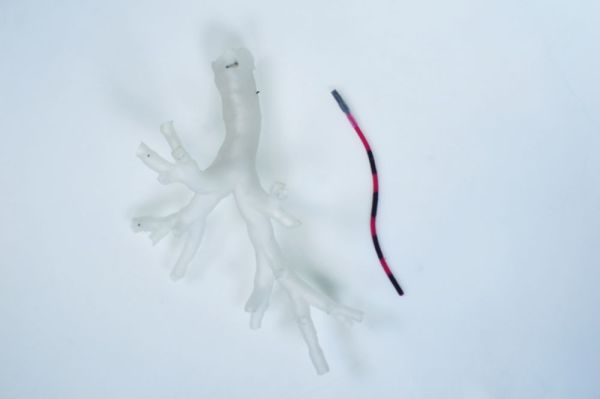
Close-up of a magnetic tentacle robot next to a phantom bronchiole (Credit: University of Leeds)

The Healing Touch Of Magnetic Tentacles In Photothermal Lung Cancer Therapy

Of the body’s organs, the lungs are among the trickiest to take a biopsy and treat cancer in, both due to how important they are, as well as due to their inaccessibility. The total respiratory surface within the average human lungs is about 50 to 75 square meters. Maneuvering any kind of instrument down the endless passages to reach a suspicious area, or a cancerous region to treat is nearly impossible. This has so far left much of the lungs inaccessible.

The standard of care for lung cancer is generally surgical: remove parts of the lung tissue. However, a proposed new method using magnetic tentacles may soon provide a more gentle approach, as described in Nature Engineering Communications by Giovanni Pittiglio and colleagues (press release).

The tentacles are made out of a silicone substrate with embedded magnets that allow for it to be steered using external magnetic sources. With an embedded laser fiber, the head of the tentacle can be guided to the target area, and the cancerous tissue sublimated using an external laser source. In experiments on cadavers with this system, the researchers found that they could enter 37% deeper into the lungs than with standard equipment. The procedure was also completed with less tissue displacement.

Considering the high fatality rate of lung cancers, the researchers hope that this approach could soon be turned into a viable therapy, as well as for other medical conditions where a gentle tentacle slithering into the patient’s body could effect treatments previously considered to be impossible.

Heading image: Close-up of a magnetic tentacle robot next to a phantom bronchiole (Credit: University of Leeds)


Input impedance plottet as a function of trace impedance for trace lengths of 1/10, 1/16 and 1/20 of a wavelength. (Credit: Baltic Labs)

When Does Impedance Matching A PCB Trace Become Unavoidable?

A common joke in electronics is that every piece of wire and PCB trace is an antenna, with the only difference being whether this was intentional or not. In practical terms, low-frequency wiring is generally considered to be ‘safe’, while higher frequency circuits require special considerations, including impedance (Z) matching.  Where the cut-off is between these two types of circuits is not entirely clear, however, with various rules-of-thumb in existence, as [Sebastian] over at Baltic Lab explains.

A popular rule is that no impedance matching between the trace and load is necessary if the critical length of a PCB trace (lcrit) is 1/10th of the wavelength (λ). Yet is this rule of thumb correct? Running through a number of calculations it’s obvious that the only case where the length of the PCB trace doesn’t matter is when trace and load impedance are matched.

According to these calculations, the 1/10 rule is not a great pick if your target is a mismatch loss of less than 0.1 dB, with 1/16 being a better rule. Making traces wider on the PCB can be advisable here, but ultimately you have to know what is best for your design, as each project has its own requirements. Even when the calculations look good, that’s no excuse to skip the measurement on the physical board, especially with how variable the dielectric constant of FR4 PCB material can be between different manufacturers and batches.

Heading image: Input impedance plotted as a function of trace impedance for trace lengths of 1/10, 1/16, and 1/20 of a wavelength. (Credit: Baltic Labs)

Continue reading “When Does Impedance Matching A PCB Trace Become Unavoidable?”

Random Access Memory From A Rotating Drum In A Bendix G15

When it’s the 1950s and you are tasked to design a computer system that features not only CPU registers but also a certain amount of RAM, you do not have a lot of options. At this point in time, discrete logic was the rule, and magnetic core memory still fairly new and rather expensive. This is where the rotating drum comes in, which is somewhat like a cross between an old-style cylinder record and a hard drive. In a recent [Usagi Electric] video, a 1950s Bendix G15 system is demonstrated, which features such a rotating drum device, alongside both tube-based circuits and newfangled diode-based circuitry.

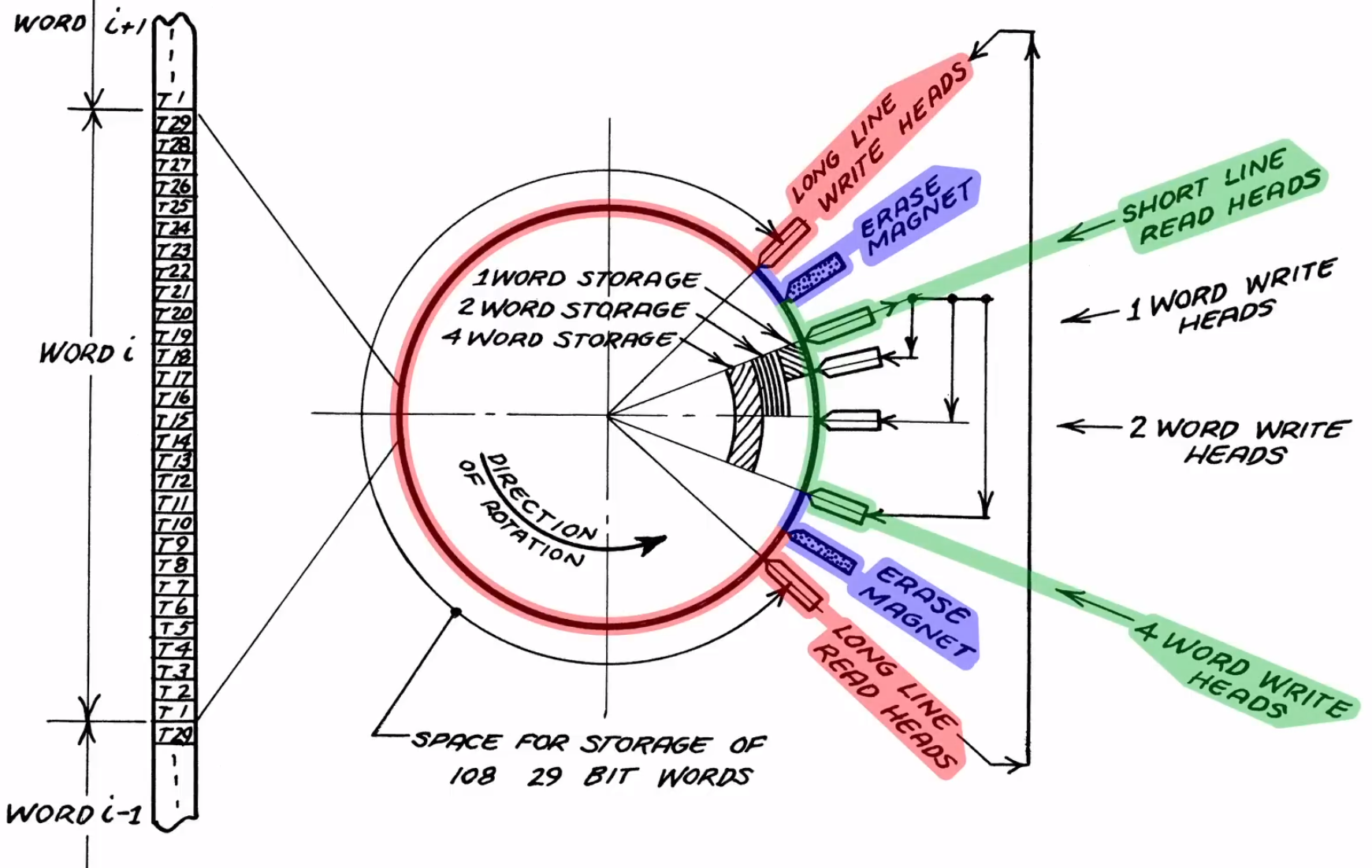
Simplified diagram of a rotating drum random access memory unit, showing the read-erase-write process as the drum spins.

This particular unit was borrowed from the System Source museum, with the intent to restore it to a working condition. Part of this process involved figuring out the circuitry, which was made easy by the circuit schematic drawings that came with the original machine. According to the official brochure by the manufacturer, the ‘short lines’ that are intended for the CPU registers, the access time was less than 1 millisecond, which is pretty darn fast considering the era and the discrete CPU’s clock speed.

For the drum itself, however, popping the cover off the unit showed that it had suffered some damage that had resulted in the multiple heads contacting the surface. Despite this disappointment, it’s not the end of the restoration, however. The museum has one more Bendix G15 standing around, with a rotating drum unit that looks to be in mint condition. The damaged magnetic coating on the other rotating drum may conceivably be resurfaced, which if successful could provide new hope to a lot of retro systems out there that also use magnetic media, whether in drum or disk format.

Continue reading “Random Access Memory From A Rotating Drum In A Bendix G15”

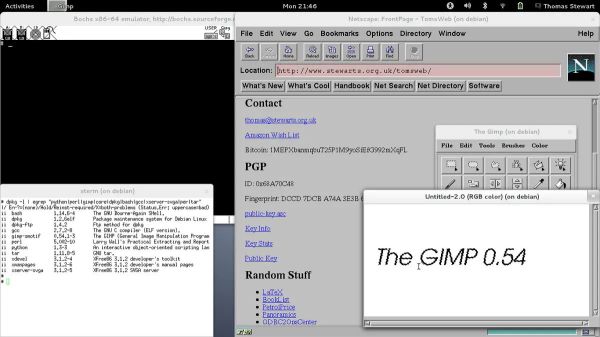
Debian Buzz (1.1) running under Bochs. (Credit: Thomas Stewart)

Looking Back On 30 Years Of Debian

The early history of Linux is a rather murky period to most, long before the era of glitzy marketing and proclamations of ‘the Linux desktop’ being the next hot thing. This was also the era when the first Linux distributions were born, as the Linux kernel never came as a whole OS package – unlike the BSDs – which necessitated others to package it with the elements that make up kernel and user space, such as the GNU tools.

One of these original distributions was Debian, which this month celebrates its 30th birthday. Its entire history, starting with the initial 0.01 release is covered in great detail on the Debian website. After the first release of the Linux kernel in 1991, it would take until August of 1993 when [Ian Murdock] embarked on the Debian project, sponsored by the GNU Project of the Free Software Foundation. This was a pretty rough period, with much of 1994 spent figuring out the basics of the system, the package manager and establishing a release system. Continue reading “Looking Back On 30 Years Of Debian”

A Soyuz-2.1b rocket booster with a Fregat upper stage and the Luna 25 lunar lander blasts off from a launchpad at the Vostochny Cosmodrome in Amur Oblast, Russia.

Luna 25’s Demise: Raising Fundamental Questions About Russia’s Space Program

The recent news that Russia’s Luna 25 Moon lander had made an unexpected lithobraking detour into the Moon’s surface, rather than the expected soft touchdown was met by a variety of responses, ranging from dismay to outright glee, much of it on account of current geopolitical considerations. Yet politics aside, the failure of this mission casts another shadow on the prospects of Russia’s attempts to revive the Soviet space program after a string of failures, including its ill-fated Mars 96 and Fobos-Grunt Mars missions, the latter of which also destroyed China’s first Mars orbiter (Yinghuo-1) and ignited China’s independent Mars program.

To this day, only three nations have managed to land on the Moon in a controlled fashion: the US, China, and the Soviet Union. India may soon join this illustrious list if its Chandrayaan-3 mission’s Vikram lander dodges the many pitfalls of soft touchdowns on the Moon’s surface. While Roscosmos has already started internal investigation, it does cast significant doubt on the viability of the Russian Luna-Glob (‘Lunar Sphere’) lunar exploration program.

Will Russia manage to pick up where the Soviet Union left off in 1976 with the Luna 24 lunar sample return mission?

Continue reading “Luna 25’s Demise: Raising Fundamental Questions About Russia’s Space Program”

Resin Printer Temperature Mods And Continuous IPA Filtration

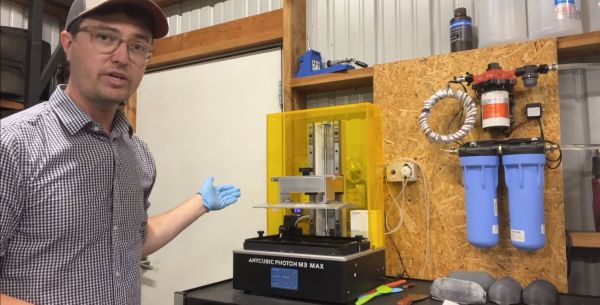
Two essential parts to producing successful resin 3D prints: keeping resin at its optimal temperature and lots and lots of IPA to clean the printed parts with after printing. Unfortunately, most consumer MSLA printers do not come with a resin tray heater, and tossing out IPA after every cleaning session because of some resin contamination is both wasteful and somewhat expensive. These are two things that can be fixed in a number of ways, with [Nick Wilson] going for the ‘crank it to 11’ option, using a high-tech, fully integrated solution for both problems.

The vat with IPA is kept clean through the use of a diaphragm pump that circulates the alcohol through two filter stages, one for larger — up to 5 micrometer — particulates and one for smaller 0.5-micrometer junk. A 405 nm LED lighting section before the filters is intended to cure any resin in the IPA, theoretically leaving the IPA squeaky clean by the time it’s returned to the vat.

For the resin tray heater, a more straightforward 12V 150 Watt silicone heater strip is stuck to the outside edge of the metal resin tray, along with a temperature-controlled relay that toggles the heater strip on and off until the resin reaches the desired temperature. None of these are necessarily expensive solutions, but they can be incredibly useful if you do a fair amount of resin printing.

Continue reading “Resin Printer Temperature Mods And Continuous IPA Filtration”

Building A Hydraulic Lego Excavator Using Standard Pneumatic Cylinders

Everyone already knows that Lego Technic is pretty rad when it comes to existing, pre-made kits, but there’s also quite a bit of hacking potential left. One such area is the lack of hydraulics in Lego Technic, an egregious oversight that [Brick Technology] simply had to correct. His effort results in a partially hydraulic, fully remote-controlled excavator. Rather than a traditional gear hydraulic pump as you’d expect in a real-life excavator, a custom peristaltic pump is used to move the fluid to the hydraulic cylinders (rams for our British and Oceanic friends).

The undercarriage is (sadly) purely electrical, with a slip-ring providing power to the electric final drives in the tracks, enabling it to spin around endlessly without limitations. Where the hydraulics come into play is in the excavator’s arm, with two hydraulic lift cylinders on the boom, one cylinder to control the stick, and a final cylinder to control the bucket. Rather than a hydraulic switch, the setup is simplified by using a single peristaltic pump per cylinder circuit.

Remote control and power are provided using the rather chonky BuWizz 3.0 Pro, which offers a wireless control link (here controlled using BrickController 2 on Android). Although original Lego cylinders were used, these are only intended for pneumatics, where it’s hoped that the used mixture of water and windscreen wiper fluid will prevent corrosion.

(Thanks to [Keith Olson] for the tip)

Continue reading “Building A Hydraulic Lego Excavator Using Standard Pneumatic Cylinders”