The Challenge Of Weather Modification In The Face Of Climate Change

Over the past decades we have been able to observe a change in the Earth’s climate, caused by an increasing amount of energy being retained in the atmosphere. This in turn has affected weather systems around the globe, causing more extreme weather. As a result, the prospect of weather control is more relevant than ever for the nations which are most directly impacted by severe rain and winds.  Although the concept of weather modification is not new, it used to be primarily focused on rather limited aspects, such as cloud seeding to increase precipitation.

Recent proposals such as Japan’s weather modification moonshot program seek to find ways to prevent or lessen the impact of torrential rains, typhoons and similar extreme weather events which accompany climate change.  This proposal is part of Japan’s multi-topic Moonshot R&D program which seeks to advance the state of the art in a wide range of fields in a very significant way by 2050. As far as weather modification is concerned, this naturally raises many questions. Clearly we are capable of affecting the climate through emissions of e.g. greenhouse gases and large-scale construction, but are there ways in which humans can affect the climate and weather in a more refined manner that benefits society, or is this something which will remain beyond our grasp for the foreseeable future?

Continue reading “The Challenge Of Weather Modification In The Face Of Climate Change”

Reverse-engineering The Milwaukee M18 Redlink Protocol

In an ideal world, every single battery pack for power tools would use the same physical interface and speak a clearly documented protocol with chargers. Since we live in a decidedly less-than-ideal world, we get to enjoy the fun pastime of reverse-engineering the interfaces and protocols of said battery packs.

Hooking up a logic analyzer to a M18 battery and charger.

A recent video from the [Tool Scientist] goes over what is already known about the Milwaukee M18 Redlink protocol, used with the manufacturer’s M18-series of batteries, before diving into some prodding and poking of these packs’ sensitive parts to see what comes out of their interface.

Previously, [Buy It Fix It] shared their findings on Reddit, covering the basic protocol, including the checksum method, but without an in-depth analysis of the entire charging protocol. Meanwhile [Quagmire Repair] performed an in-depth teardown and reverse-engineering of the M18 hardware, including the circuitry of the BMS.

Putting these two things together, [Tool Scientist] was able to quickly get some of his M18 packs strapped down into the analysis chair for both passive analysis, as well as the effect of overvoltage, undervoltage, overheating and freezing the battery pack on the output reported by the battery’s BMS.

One of the lists of commands and response messages obtained by [Tool Scientist] on YouTube.
The result is a rather comprehensive list of instructions obtained under these various conditions, including a fault condition (05) returned by the BMS of one pack indicating its likely demise. Overall, it does not appear to be a particularly special (or well-designed) protocol, but it does make for a good reverse-engineering target, while adding to the body of collective knowledge on these widely available battery packs.

Hopefully the same inertia that prevents people from moving outside the designated power tool ecosystem due to the incompatible battery packs will also ensure that this level of  knowledge will remain relevant for the foreseeable future, especially since the manufacturers of knock-off battery packs seem rather unwilling to share the results of their own reverse-engineering efforts.

Continue reading “Reverse-engineering The Milwaukee M18 Redlink Protocol”

Mistranslation Of Newton’s First Law Discovered After Nearly 300 Years

For hundreds of years, we have been told what Newton’s First Law of Motion supposedly says, but recently a paper published in Philosophy of Science (preprint) by [Daniel Hoek] argues that it is based on a mistranslation of the original Latin text. As noted by [Stephanie Pappas] in Scientific American, this would seem to be a rather academic matter as Newton’s Laws of Motion have been superseded by General Relativity and other theories developed over the intervening centuries. Yet even today Newton’s theories are highly relevant, as they provide very accessible approximations for predicting phenomena on Earth.

Similarly, we owe it to scientific and historical accuracy to address such matters, all of which seem to come down to an awkward translation of Isaac Newton’s original Latin text in the 1726 third edition to English by Andrew Motte in 1729. This English translation is what ended up defining for countless generations what Newton’s Laws of Motion said, along with the other chapters in his Philosophiæ Naturalis Principia Mathematica.

Continue reading “Mistranslation Of Newton’s First Law Discovered After Nearly 300 Years”

Determining The Size Of The New US Lithium Deposit Amidst Exploding Demand

With demand for lithium in the world market projected to increase by 2040 to as much as eight times the demand in 2022, finding new deposits of this metal has become a priority. Currently most of the world’s lithium comes from Australia, Chile, China and Argentina, with potential new mining sites under investigation. One of these sites is the McDermitt caldera in the US, a likely remnant of the Yellowstone hotspot and resulting volcanic activity. According to a recent study (Chemistry World article) by Thomas R. Benson and colleagues in Science Advances, this site may not only contain between 20 to 40 million tons of lithium in the form of the mineral clay illite, but was also formed using a rather unique process.

This particular group of mineral clays can contain a number of other chemicals, which in this particular case is lithium due to the unique way in which the about 40 meter thick layer of sediment was formed. Although lithium is a very common metal, its high reactivity means that it is never found in its elementary form, but instead bound to other elements. Lithium is thinly distributed within the Earth’s crust and oceans. Incidentally, the Earth’s oceans contain by far the largest amount of lithium, at approximately 230 billion tons.

So how much lithium could be extracted from this new area, and how does this compare to the increasing demand?

Continue reading “Determining The Size Of The New US Lithium Deposit Amidst Exploding Demand”

Out With The Circus Animals, In With The Holograms

As futuristic as holographic technology may sound, in a sense it’s actually already in widespread commercial use. Concerts and similar events already use volumetric projection, with a fine mesh (hologram mesh or gauze) acting as the medium on which the image is projected to give the illusion of a 3D image. The widespread availability of this technology has now enabled Germany’s Roncalli circus to reintroduce (virtual) animals to its shows after ceasing the use of live lions and elephants in 1991 and other animals in 2018.

For the sticklers among us, these are of course not true holograms, as they do not use a recorded wavefront, nor do they seek to recreate a wavefront. Rather they employ as mentioned volumetric projection to essentially project in ‘thin air’, giving the illusion of a tangible object being present. By simultaneously projecting multiple views, to an observer standing outside the projection mesh, it would thus appear that there is a physical, three-dimensional object which can be observed. In the case of the Roncalli circus there are 11 projectors lining the circumference of the mesh.

To a circus the benefits of this approach are of course manifold, as not only do they no longer have to carry lots of animals around every time the circus moves to a new location – along with the on-site demands – but they get to experiment with new shows and new visuals that were never before possible. Ironically, this could mean that after 3D fizzled out at movie theaters, circuses and similar venues may be in a position to make it commonplace again for the masses.

RGB Graphics On A DEC Rainbow With Reverse-Engineered Monitor

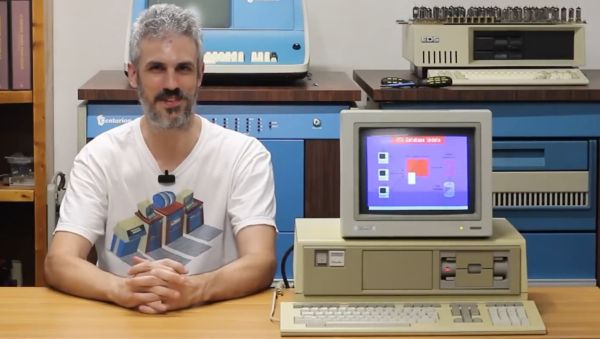
One of the delights of the boring pre-VGA era is that you get to express your creativity when it comes to making a random color CRT work with an equally exciting dual CPU computer like the DEC Rainbow 100. This is the situation that the folk over at Usagi Electric found themselves in with a recent project. The Rainbow 100 is an interesting computer in that it can boot not only DOS with its 8088 processor, but also CP/M on the Z80 processor. Although generally used in monochrome mode, it supports a color graphic card to output RGB signals via its male DB15 connector.

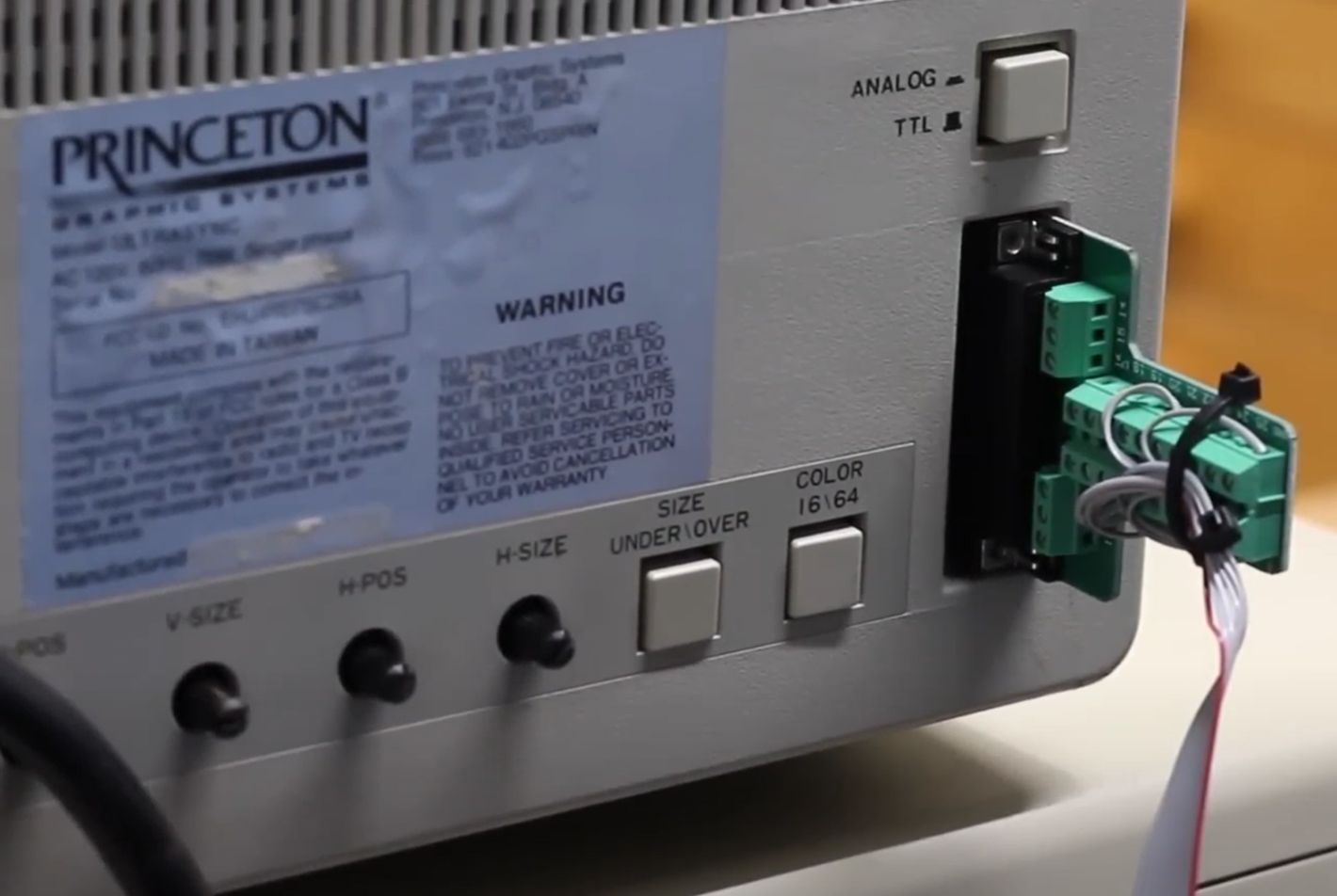
DEC Rainbow 100 to Princeton Ultrasync adapter. With strain-relief zip tie.

Unfortunately, the target monitor – a Princeton Ultrasync – featured a female DB25 connector that obviously wasn’t going to connect directly, thus requiring a spot of reverse engineering. Making this very easy, the PCB containing the input connector had the traces clearly marked with the intended signal, which just left the mapping of the two connectors. One complication here was with the Rainbow 100 outputting an RGB signal with sync-on-green, whereas the monitor expected a separate synchronization signal.

Fortunately, most analog monitors aren’t particularly fussy so long as they get the expected signal somewhere in the input, which just left the final issue, of the Rainbow 100 outputting the monochrome signal on a special monochrome pin. This allowed everything to work as it should, and leaving those of us who joined the computing era in the 90s appreciative of standard VGA cables, other than for those weird Sun and Apple systems with their proprietary connectors.

Continue reading “RGB Graphics On A DEC Rainbow With Reverse-Engineered Monitor”

On Vim, Modal Interfaces And The Way We Interact With Computers

The ways in which we interact with computers has changed dramatically over the decades. From flipping switches on the control panels of room-sized computers, to punching holes into cards, to ultimately the most common ways that we interact with computers today, in the form of keyboards, mice and touch screens. The latter two especially were developed as a way to interact with graphical user interfaces (GUI) in an intuitive way, but keyboards remain the only reasonable way to quickly enter large amounts of text, which raises many ergonomic questions about how to interact with the rest of the user interface, whether this is a command line or a GUI.

For text editors, perhaps the most divisive feature is that of modal versus non-modal interaction. This one point alone underlies most of the Great Editor War that has raged since time immemorial. Practically, this is mostly about highly opiniated people arguing about whether they like Emacs or vi (or Vim) better. Since in August of 2023 we said our final farewell to the creator of Vim – Bram Moolenaar – this might be a good point to put down the torches and pitchforks and take a sober look at why Vim really is the logical choice for fast, ergonomic coding and editing.

Continue reading “On Vim, Modal Interfaces And The Way We Interact With Computers”