High-Precision Air Bearing CNC Lathe And Grinder

You know you’re in for a treat when you are told that a lathe which can reach a resolution of one micrometer (1×10⁻⁶, a millionth of a meter, or 0.00004″ for people who love zeros) is ‘not hard to build’.  This is one of the opening statements in this video by [Dan Gelbart], as he walks the viewer through the details of a custom CNC lathe which he built. (Video embedded below.)

As it’s a combined CNC lathe and grinder, it uses custom software he had developed specifically for the machine. Much of the high precision of the machine is courtesy of air bearings. All but two of the air bearings were made by [Dan], with the two surplus air bearings he used coming from machines used in the semiconductor industry.

The bed of the machine is formed out of off-the-shelf reference granite, to which the other parts are epoxied, providing a stable base with well-defined dimensions. Though perhaps a few light years beyond most DIY lathe efforts, [Dan]’s videos nevertheless provide a treasure trove of tips and information for lathe builders and users alike. Certainly worth a look.

Thanks [Drew] for the tip in the comments.
Continue reading “High-Precision Air Bearing CNC Lathe And Grinder”
Brachiograph: A Simple And Cheap Pen-Plotter

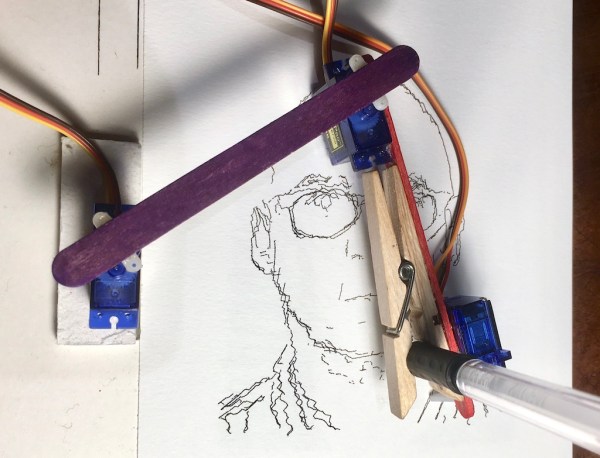
The BrachiGraph project consists out of two parts, the hardware design for a servo-driven drawing arm (pen plotter) and software utilities (written in Python) that allow the drawing arm’s servos to be controlled in order to convert a bitmap image into a collection of lines that can be used to draw an image resembling the original, in a variety of styles. All of the software and designs needed to make your own version can be found on the Github page for the project.

docs/images/readme_combined_image.png

Considering an estimated €14 worth of materials for the project, the produced results are nothing short of amazing, even if the principles behind the project go back to the Ancient Greek , of course. The basic hardware is that of a pantograph, which provides the basic clues for how the servos on the plotter arm are being driven.

The main achievement here is definitely that of minimalism, with three dirt-cheap SG-90 microservos along with some bits of wood, a clothes-peg or equivalent, and of course a pen providing a functional plotter that anyone can assemble on a slow Sunday afternoon from random bits lying around the workshop.


Planting 20 Million Trees, Using Drones, Cannons, And More Unconventional Ways

When YouTuber MrBeast hit 20 million subscribers, it kicked off the promise to plant 20 million new trees by 2020. While seeming rather mad for a single person to attempt such a feat, the channel has begun an organized effort under the banner of ‘Team Trees‘. With many famous and less famous YouTubers and other online personalities pitching in, along with a number of companies and organizations, it seems like it’s not as far-fetched of an idea as it first seemed.

We’ve embedded MrBeast’s video after the break where you’ll also find a video by Mark Rober, who teamed up a company called DroneSeed, who use large flying drones to distribute seeds contained in nutrition pods over large areas. Their focus is on reforestation after large wildfires and other events that leave the land devoid of trees. Of course, this being seeds, it will take quite a while for results to become visible.

The impatient Canadians over at Linus Media Group figured that they’d rather plant tree seedlings at a breakneck pace, cobbling together a nitrogen cannon that fires a nutrition pellet into the soil, creating the hole for the seedling, or alternately firing the pellet and seedling into the soil in one go from the breach-loading cannon. Obviously the results from the latter method are decidedly more questionable, taking a bit chunk out of the about 300 seedlings they were planning to add to the local nature.

Regardless of the method chosen, any significant reforestation around the world could be a crucial part of reducing the global increase of atmospheric CO2, and the climate challenges this creates.  With sources putting the total number of trees in the world today at about 3 trillion, 20 million more doesn’t seem like a lot, yet techniques we’re learning today to speed up the process of reforestation might play a major role in the near future.

Continue reading “Planting 20 Million Trees, Using Drones, Cannons, And More Unconventional Ways”

The Blessings And Destruction Wrought By Lead Over Millennia

Everyone one of us is likely aware of what lead — as in the metal — is. Having a somewhat dull, metallic gray appearance, it occupies atomic number 82 in the periodic table and is among the most dense materials known to humankind. Lead’s low melting point and malleability even when at room temperature has made it a popular metal since humans first began to melt it out of ore in the Near East at around 7,000 BC in the Neolithic period.

Although lead’s toxicity to humans has been known since at least the 2nd century BC and was acknowledged as a public health hazard in the late 19th century, the use of lead skyrocketed in the first half of the 20th century. Lead saw use as a gasoline additive beginning in the 1920s, and the US didn’t abolish lead-based paint until 1978, nearly 70 years after France, Belgium and Austria banned it.

With the rise of consumer electronics, the use of lead-based solder became ever more a part of daily life during the second part of the 20th century, until an increase in regulations aimed at reducing lead in the environment. This came along with the World Health Organization’s fairly recent acknowledgment that there is truly no safe limit for lead in the human body.

In this article I’ll examine the question of why we are still using lead, and if we truly must, then how we can use this metal in the safest way possible.

Continue reading “The Blessings And Destruction Wrought By Lead Over Millennia”

DNS-over-HTTPS Is The Wrong Partial Solution

Openness has been one of the defining characteristics of the Internet for as long as it has existed, with much of the traffic today still passed without any form of encryption. Most requests for HTML pages and associated content are in plain text, and the responses are returned in the same way, even though HTTPS has been around since 1994.

But sometimes there’s a need for security and/or privacy. While the encryption of internet traffic has become more widespread for online banking, shopping, the privacy-preserving aspect of many internet protocols hasn’t kept pace. In particular, when you look up a website’s IP address by hostname, the DNS request is almost always transmitted in plain text, allowing all the computers and ISPs along the way to determine what website you were browsing, even if you use HTTPS once the connection is made.

The idea of also encrypting DNS requests isn’t exactly new, with the first attempts starting in the early 2000s, in the form of DNSCrypt, DNS over TLS (DoT), and others. Mozilla, Google, and a few other large internet companies are pushing a new method to encrypt DNS requests: DNS over HTTPS (DoH).

DoH not only encrypts the DNS request, but it also serves it to a “normal” web server rather than a DNS server, making the DNS request traffic essentially indistinguishable from normal HTTPS. This is a double-edged sword. While it protects the DNS request itself, just as DNSCrypt or DoT do, it also makes it impossible for the folks in charge of security at large firms to monitor DNS spoofing and it moves the responsibility for a critical networking function from the operating system into an application. It also doesn’t do anything to hide the IP address of the website that you just looked up — you still go to visit it, after all.

And in comparison to DoT, DoH centralizes information about your browsing in a few companies: at the moment Cloudflare, who says they will throw your data away within 24 hours, and Google, who seems intent on retaining and monetizing every detail about everything you’ve ever thought about doing.

DNS and privacy are important topics, so we’re going to dig into the details here. Continue reading “DNS-over-HTTPS Is The Wrong Partial Solution”

The Long History Of Fast Reactors And The Promise Of A Closed Fuel Cycle

The discovery of nuclear fission in the 1930s brought with it first the threat of nuclear annihilation by nuclear weapons in the 1940s, followed by the promise of clean, plentiful power in the 1950s courtesy of nuclear power plants. These would replace other types of thermal plants with one that would produce no exhaust gases, no fly ash and require only occasional refueling using uranium and other fissile fuels that can be found practically everywhere.

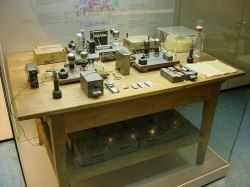
The equipment with which nuclear fission was experimentally proven in 1938.

As nuclear reactors popped up ever faster during the 1950s and 1960s, the worry about running out of uranium fuel became ever more present, which led to increased R&D in so-called fast reactors, which in the fast-breeder reactor (FBR) configuration can use uranium fuel significantly more efficiently by using fast neutrons to change (‘breed’) 238U into 239Pu, which can then be mixed with uranium fuel to create (MOX) fuel for slow-neutron reactors, allowing not 1% but up to 60% of the energy in uranium to be used in a once-through cycle.

The boom in uranium supplies discovered during the 1970s mostly put a stop to these R&D efforts, with some nations like France still going through its Rapsodie, Phénix and SuperPhénix designs until recently finally canceling the Generation IV ASTRID demonstrator design after years of trying to get the project off the ground.

This is not the end of fast reactors, however. In this article we’ll look at how these marvels of engineering work and the various fast reactor types in use and under development by nations like Russia, China and India.

Continue reading “The Long History Of Fast Reactors And The Promise Of A Closed Fuel Cycle”

Saying Farewell To Another B-17 And Its Crew

The harsh reality of keeping historical airplanes airworthy and flying is that from time to time one will crash. Thus it was that on October 2nd a Boeing B-17 Flying Fortress crash-landed after technical troubles. Incidentally, this is the very same airplane which we covered only a number of days ago. Painted to look like another B-17 of WWII (Nine-o-Nine, variant B-17G-30-BO), this late-model B-17G-85-DL aircraft wasn’t finished in time to join World War II, but instead spent its 74 years being a flying museum to these amazing airplanes.

Details about the cause of the crash are still scarce, but from radio communication between the crew and tower, it’s understood the B-17 was having having issues with the number 4 engine, which was seen sputtering and smoking by a witness. The airplane’s pilots tried to perform an emergency landing at Bradley International Airport, Connecticut, where it had taken off from only moments ago. Unfortunately the aircraft ran off the runway and struck a building, after which it burst into flames. The NTSB has indicated that they have dispatched a team to investigate the crash, and say that a preliminary report is likely two weeks away.

Of the thirteen people on board, seven died, with the remaining six surviving with injuries. One person on the ground was injured as well. The vintage bomber (civilian registration number N93012) has been all but completely destroyed in the fire, with only a section of the wing and tail remaining recognizable.

We feel terrible about such loss of life and hope the injured make a speedy recovery. The loss of yet another B-17 is also tough to swallow, as this leaves just ten airworthy B-17s. How long until we say farewell to this part of our history, with the final flight of a B-17, or its kin?

(Thanks to Pez for this update)