Watkin’s Tower: London’s Failed Eiffel Tower

The city of London is no stranger to tall constructions today, but long before the first skyscrapers would loom above its streets, Watkin’s Tower was supposed to be the tallest structure in not only London but also the entirety of the UK. Inspired by France’s recently opened Eiffel tower, railway entrepreneur and Member of Parliament [Sir Edward Watkin] wanted to erect a structure that would rival the Eiffel tower, as part of a new attraction park to be constructed near the Middlesex hamlet of Wembley. In a retrospective, [Rob’s London] channel takes a look at what came to be known as Watkin’s Folly among other flattering names.

The first stage of Watkin's Tower at Wembley Park. The only to be ever completed. (Source: Wikimedia)
The first stage of Watkin’s Tower at Wembley Park. The only to be ever completed. (Source: Wikimedia)

After [Gustave Eiffel], the architect of the Eiffel tower recused himself, a design competition was held for a tower design, with the Illustrated Catalogue of the 68 designs submitted available for our perusal. The winner turned out to be #37, an eight-legged, 366 meter tall tower, much taller than the 312.2 meter tall Eiffel tower, along with multiple observation decks and various luxuries to be enjoyed by visitors to Wembley Park.

Naturally, [Watkin] commissioned a redesign to make it cheaper, which halved the number of legs, causing subsidence of the soil and other grievances later on. Before construction could finish, the responsible company went bankrupt and the one constructed section was demolished by 1907. Despite this, Wembley Park was a success and remains so to this day with Wembley Stadium built where Watkin’s Folly once stood.

Continue reading “Watkin’s Tower: London’s Failed Eiffel Tower”

How A DIY Chicken Coop Door Opener Went From Simple To Complex

How hard could it be to make a chicken coop door that can be configured to open and close automatically using a straightforward interface? That’s the question that [Jeff Sandberg] set out with, after three years of using a more basic off-the-shelf unit that offered no remote access nor a convenient user interface. The use case for [Jeff] was rather straightforward: the door would be open during the day and closed at night to keep the hens safely inside the coop.

The commercial solution offered an RTC-backed programmable interface as well as a light sensor, but the latter wasn’t always reliable in inclement weather and making simple changes to the programming when e.g. the hens had to stay inside a day due to work on the yard, was much more complicated than needed, plus had to be done on the spot. The new system would solve all these ills.

That said, the existing door mechanism was doing a fine job and could be kept. This just left making a new box with electronics to control it, starting with an ESP32C3 with the ESPHome firmware that is hooked into the local Home Assistant system, along with a motor to lift and lower the door and with magnetic contact sensors.

So far so easy. The hard part came with the installation, which involved trenching to the hen house for mains power, repairing the damage from this, and troubleshooting a power issue that turned out to be due to a dodgy power adapter. The payoff is that now the chicken coop is also part of the smart home and their owner never has to trudge through a soggy garden again to adjust the programming on a dim LC display with far too few buttons.

Bipolar Uranium Extraction From Seawater With Ultra-Low Cell Voltage

As common as uranium is in the ground around us, the world’s oceans contain a thousand times more uranium (~4.5 billion tons) than can be mined today. This makes extracting uranium as well as other resources from seawater a very interesting proposition, albeit it one that requires finding a technological solution to not only filter out these highly diluted substances, but also do so in a way that’s economically viable. Now it seems that Chinese researchers have recently come tantalizingly close to achieving this goal.

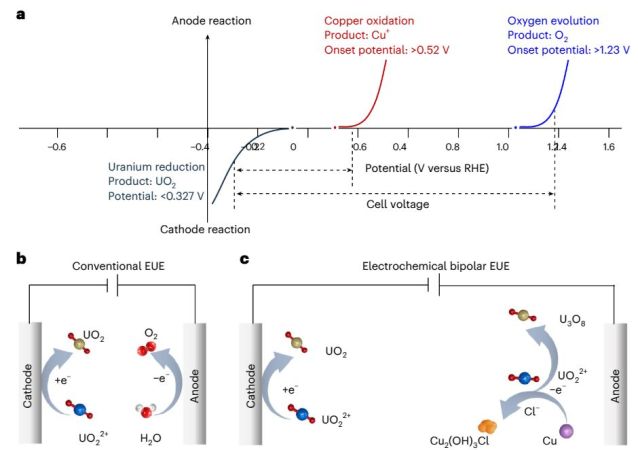
The anode chemical reaction to extract uranium. (Credit: Wang et al., Nature Sustainability, 2025)

The used electrochemical method is described in the paper (gift link) by [Yanjing Wang] et al., as published in Nature Sustainability. The claimed recovery cost of up to 100% of the uranium in the seawater is approximately $83/kilogram, which would be much cheaper than previous methods and is within striking distance of current uranium spot prices at about $70 – 85.

Of course, the challenge is to scale up this lab-sized prototype into something more industrial-sized. What’s interesting about this low-voltage method is that the conversion of uranium oxide ions to solid uranium oxides occurs at both the anode and cathode unlike with previous electrochemical methods. The copper anode becomes part of the electrochemical process, with UO2 deposited on the cathode and U3O8 on the anode.

Among the reported performance statistics of this prototype are the ability to extract UO22+ ions from an NaCl solution at concentrations ranging from 1 – 50 ppm. At 20 ppm and in the presence of Cl ions (as is typical in seawater), the extraction rate was about 100%, compared to ~9.1% for the adsorption method. All of this required only a cell voltage of 0.6 V with 50 mA current, while being highly uranium-selective. Copper pollution of the water is also prevented, as the dissolved copper from the anode was found on the cathode after testing.

The process was tested on actual seawater (East & South China Sea), with ten hours of operation resulting in a recovery rate of 100% and 85.3% respectively. With potential electrode optimizations suggested by the authors, this extraction method might prove to be a viable way to not only recover uranium from seawater, but also at uranium mining facilities and more.

Using A Videocard As A Computer Enclosure

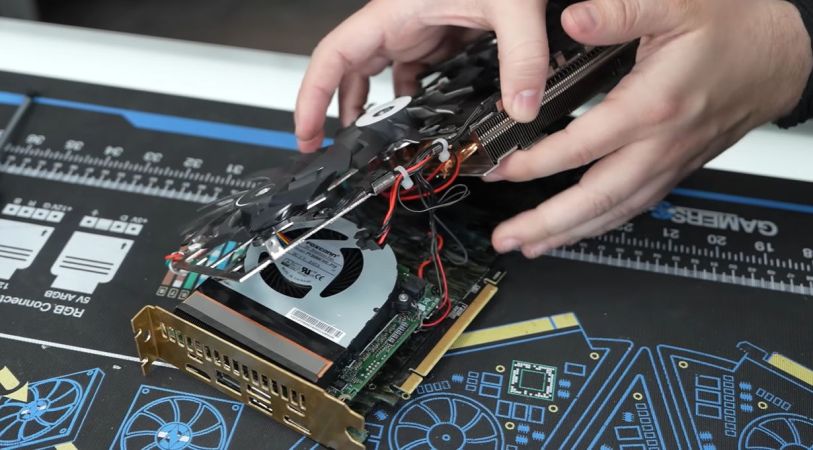
The CherryTree-modded card next to the original RTX 2070 GPU. (Credit: Gamers Nexus)

In the olden days of the 1990s and early 2000s, PCs were big and videocards were small-ish add-in boards that blended in with other ISA, PCI and AGP cards. These days, however, videocards are big and computers are increasingly smaller. That’s why US-based CherryTree Computers did what everyone has been joking about, and installed a PC inside a GPU, with [Gamers Nexus] having the honors of poking at the creatively titled GeeFarce 5027POS Micro Computer.

As CherryTree describes it on their website, this one-off build was the result of a joke about how GPUs nowadays are more expensive than the rest of the PC combined. Thus they did what any reasonable person would do and put an Asus NUC 13 with a 13th gen Core i7, 64 GB of and 2 TB of NVMe storage inside an (already dead) Asus Aorus RTX 2070 GPU.

In the [Gamers Nexus] video we can see that it’s definitely a quick-and-dirty build, with plenty of heatshrink and wires running everywhere in addition to the chopped off original heatsink. That said, from a few meter away it still looks like a GPU, can be installed like a GPU (but the PCIe connector does nothing) and is in the end a NUC PC inside a GPU shell that you can put a couple of inside a PC case.

Presumably the next project we’ll see in this vein will see a full-blown x86 system grafted inside a still functioning GPU, which would truly make the ‘install the PC inside the GPU’ meme a reality.

Continue reading “Using A Videocard As A Computer Enclosure”

Generating Plasma With A Hand-Cranked Generator

Everyone loves to play with electricity and plasma, and [Hyperspace Pirate] is no exception. Inspired by a couple of 40×20 N52 neodymium magnets he had kicking around, he decided to put together a hand-cranked generator and use it to generate plasma with. Because that’s the kind of fun afternoon projects that enrich our lives, and who doesn’t want some Premium Fire™ to enrich their lives?

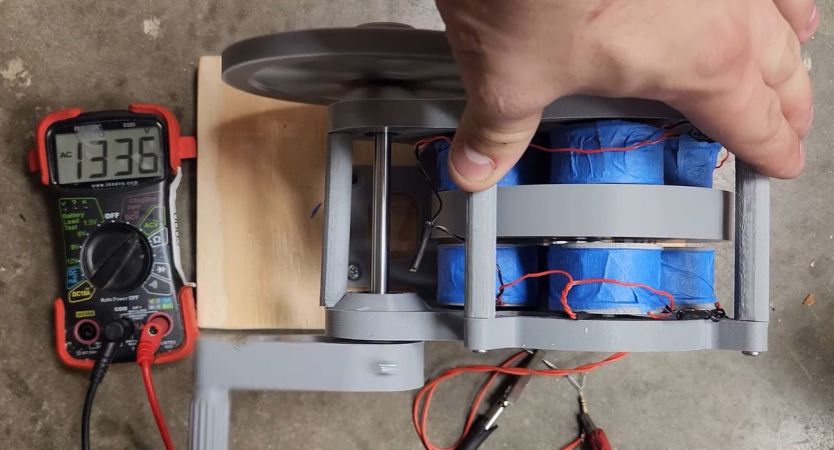
The generator itself is mostly 3D printed, with the magnets producing current in eight copper coils as they spin past. Courtesy of the 4.5:1 gear on the crank side, it actually spins at over 1,000 RPM with fairly low effort when unloaded, albeit due to the omission of iron cores in the coils. This due to otherwise the very strong magnets likely cogging the generator to the point where starting to turn it by hand would become practically impossible.

Despite this, the generator produces over a kilovolt with the 14,700 turns of 38 AWG copper wire, which is enough for the voltage multiplier and electrodes in the vacuum chamber, which were laid out as follows:

Circuit for the plasma-generating circuit with a vacuum chamber & hand-cranked generator. (Credit: Hyperspace Pirate, YouTube)

Some of our esteemed readers may be reminded of arc lighters which are all the rage these days, and this is basically the hand-cranked, up-scaled version of that. Aside from the benefits of having a portable super-arc lighter that doesn’t require batteries, the generator part could be useful in general for survival situations. Outside of a vacuum chamber the voltage required to ionize the air becomes higher, but since you generally don’t need a multi-centimeter arc to ignite some tinder, this contraption should be more than sufficient to light things on fire, as well as any stray neon signs you may come across.

If you’re looking for an easier way to provide some high-voltage excitement, automotive ignition coils can be pushed into service with little more than a 555 timer, and if you can get your hands on a flyback transformer from a CRT, firing them up is even easier.

Continue reading “Generating Plasma With A Hand-Cranked Generator”

The Ongoing BcacheFS Filesystem Stability Controversy

In a saga that brings to mind the hype and incidents with ReiserFS, [SavvyNik] takes us through the latest data corruption bug report and developer updates regarding the BcacheFS filesystem in the Linux kernel. Based on the bcache (block cache) cache mechanism in the Linux kernel, its author [Kent Overstreet] developed it into what is now known as BcacheFS, with it being announced in 2015 and subsequently merged into the Linux kernel (6.7) in early 2024. As a modern copy-on-write (COW) filesystem along the lines of ZFS and btfs, it was supposed to compete directly with these filesystems.

Despite this, it has become clear that BcacheFS is rather unstable, with frequent and extensive patches being submitted to the point where [Linus Torvalds] in August of last year pushed back against it, as well as expressing regret for merging BcacheFS into mainline Linux. As covered in the video, [Kent] has pushed users reporting issues to upgrade to the latest Linux kernel to get critical fixes, which really reinforces the notion that BcacheFS is at best an experimental Alpha-level filesystem implementation and should probably not be used with important data or systems.

Although one can speculate on the reasons for BcacheFS spiraling out of control like this, ultimately if you want a reliable COW filesystem in Linux, you are best off using btrfs or ZFS. Of course, regardless of which filesystem you use, always make multiple backups, test them regularly and stay away from shiny new things on production systems.

Continue reading “The Ongoing BcacheFS Filesystem Stability Controversy”

Feline Genetics And Why Orange Cats Are The Most Special

Recently, butlers to orange-colored cats got a bit of a shock when reading the news, as headlines began to call out their fuzzy feline friends as ‘freaks of nature’ and using similarly uncouth terms. Despite the name-calling, the actual reason for this flurry of feline fascination was more benign — with two teams of scientists independently figuring out the reason why some cats have fur that is orange. Tracking down the reason for this turned out to be far more complicated than assumed, with the fact that about 80% of orange cats are male being only the tip of the cat-shaped iceberg.

It was known to be an X chromosome-linked mutation, but rather than the fur coloring being affected directly, instead the mechanism was deduced to be a suppression of the black-brownish pigmentation (eumelanin) in favor of the orange coloration (pheomelanin). Finding the exact locus of the responsible ‘O gene’ (for orange) in the cat genome has been the challenge for years, which turned out to be a mutation related to the X-linked ARHGAP36 gene, whose altered expression results in the suppression of many melanogenesis genes.

Interestingly, this particular mutation appears to be of a singular origin that apparently persisted over millennia courtesy of the domestication of humans (H. sapiens) by Felis catus.

Continue reading “Feline Genetics And Why Orange Cats Are The Most Special”