Building An Internal Combustion Engine From Hardware Store Parts

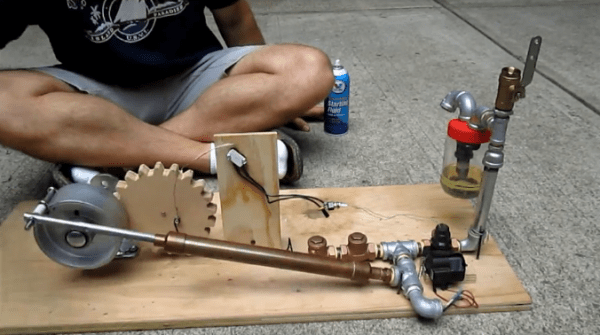
[MacGyver] [Lou Wozniak] is on a mission to build an internal combustion engine using only hardware store parts. What you see above is his third attempt at it. Depending on your hardware store this may have ventured outside of what they sell because [Lou] switched over to using gasoline. But the first two attempts were powered by a propane torch fuel canister.

Unfortunately it still isn’t running. But the demo below makes us think that he’s really close. Timing is always touchy and that seems to be what is causing the problems. He makes use of a lot of plumbing fixtures. At the right you can see the parts (including a peanut butter jar) which make his carburetor with a valve pointing straight up as the choke. The fuel and air mixture moves down through the pipe to the cylinder and valve assembly where it is ignited by the black grill igniter module. His custom cut plywood gear moves with the fly-wheel. It triggers his improvised spark plug by using a bit of wire to pull on the leaf switch.

We feel like he’s so close to getting this up and running. If you have any advice on where he might be going wrong [Lou] welcomes your input.

Continue reading “Building An Internal Combustion Engine From Hardware Store Parts”
Defcon Presenters Preview Hack That Takes Prius Out Of Driver’s Control

hacking-control-of-a-prius

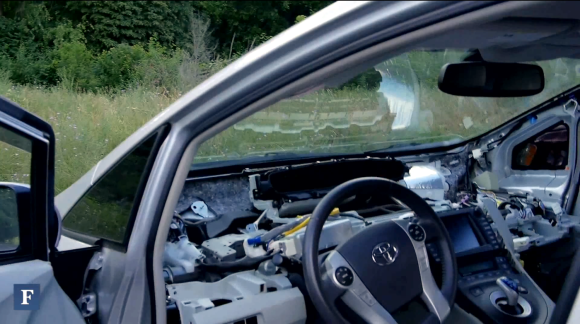
This one’s a treasure trove of CAN bus hacks that will scare the crap out of an unsuspecting driver — or worse. [Charlie Miller] and [Chris Valasek] are getting ready to present their findings, which were underwritten by DARPA, at this year’s Defcon. They gave a Forbes reporter a turn in the driver’s seat in order to show off.

You’ve got to see the video on this one. We haven’t had this much fun looking at potentially deadly car hacking since Waterloo Labs decided to go surfing on an Olds. The hacks shown off start as seemingly innocent data tweaks, like misrepresenting your fuel level or displaying 199 mph on the speedometer while the car is standing still. But things start to get interesting when they take that speed readout from 199 down to zero instantly, which has the effect of telling the car you’ve been in a crash (don’t worry, the airbags don’t fire). Other devilish tricks include yanking the steering wheel to one side by issuing a command telling the car to park itself when driving down the road. Worst of all is the ability to disable the brakes while the vehicle is in motion. Oh the pedal still moves, but the brake calipers don’t respond.

The purpose of the work is to highlight areas where auto manufacturers need to tighten up security. It certainly gives us an idea of what we’ll see in the next Bond film.

Continue reading “Defcon Presenters Preview Hack That Takes Prius Out Of Driver’s Control”

Drive Bay Form Factor Dual Dekatron Readouts For RAM And CPU Usage

optical-drive-dual-dekatron

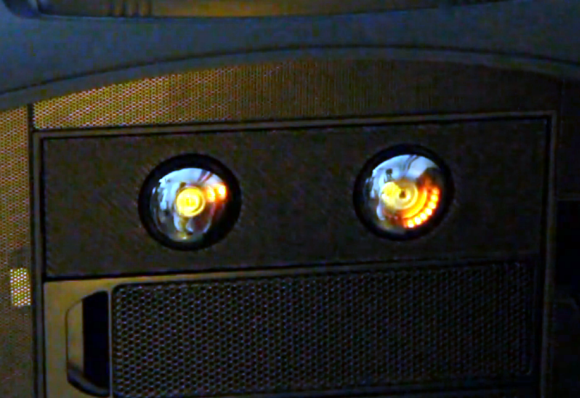
The two circular displays seen above are Dekatrons built into an optical drive enclosure. [Matt Sylvester] picked up a couple of different types of these tubes on eBay. He etched his own driver, and was able to control them with an Arduino. After a few months went by he decided to revisit the project to see if it would work as a CPU and RAM usage meter.

These tubes need high voltage to get the neon display glowing brightly. This raised some concerns about having those voltage levels inside of his PC, as well as the noise which may be introduced by the supply. To deal with those issues [Matt] gutted an old optical drive, using its case to physically isolate the circuitry, and some optoisolators to protect the logic connections. His driver board uses an ATmega328 running the Arduino bootloader. It connects to the PC using an FTDI USB to Serial cable. This makes it a snap to push the performance data to the display. It also has the side benefit of allowing  him to reprogram the chip without opening the case.

If you can’t find one of these tubes for your own project consider faking it.

Continue reading “Drive Bay Form Factor Dual Dekatron Readouts For RAM And CPU Usage”

Electric Imp As An Internet To RF Gateway

a-little-automation-with-the-electric-imp

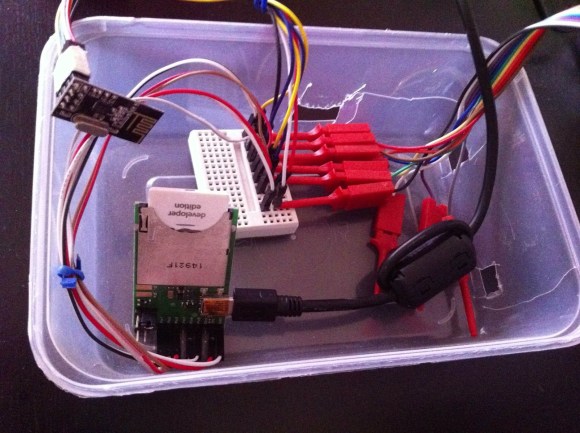
This project is a study in connecting several different families of hobby electronic hardware. The image above shows the Electric Imp side of things. It bridges its Internet connection with the RF connections of the rest of the project.

The Imp is a peculiar (intriguing?) piece of hardware. Take a look at [Brian Benchoff’s] hand’s on experience with the SD form factor hardware which is not an SD card at all. It’s an embedded system which uses light programming and a cloud-based software setup to bring wireless Internet to your projects.

In this case [Stanley Seow] started wondering if he needed multiple Imps to connect different parts of his setup. A bit of head scratching led him to the use of nRF24L01 modules which are cheap and easy to use Radio Frequency transceiver boards. He took a partially finished driver project and brought it home to play nicely with the Imp. Now he can use the system to communicate with other components which will eventually be used for home automation. Right now his proof of concept issues wireless commands to an Arduino driving a strip of LEDs.

Hackit: Researchers Wait 69-years To See Tar Move

69-year-science-experiement

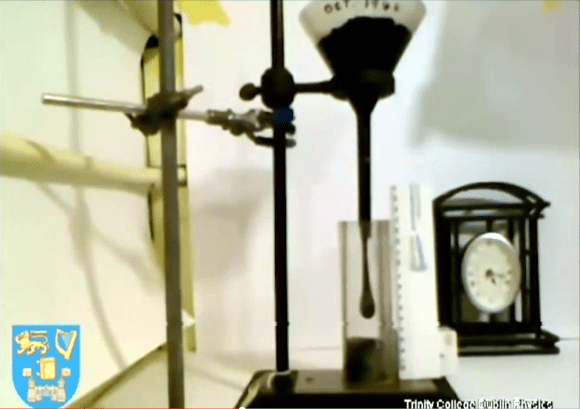
This experiment was started at Trinity College Dublin way back in 1944. Its purpose is to prove that tar flows, and indeed it does let go of a drop about every ten years. The thing is that nobody has ever seen that happen, bringing up the “if a tree falls in the forest” scenario. The Nature article on this event even mentions another experiment whose last drop was missed because the camera monitoring it was offline. This time around they did get some footage of the (un)momentous event which you can see below.

So here’s the challenge for clever hackers: What’s the easiest rig you can think of that won’t just continuously film the experiment but can also ensure that you get the goods on tape when a drop does fall? We see all kinds of high-speed shutter triggers — here’s one of the latest. But we don’t remember seeing an extremely slow version of the same. Let us know your idea by leaving a comment.

Continue reading “Hackit: Researchers Wait 69-years To See Tar Move”

Build Your Own Metal Detector

[Dzl] and his rather serious looking son are metal detector enthusiasts. But when they couldn’t find their store-bought metal detector earlier this summer they just went ahead and built their own. [Dzl] starts his write up with an explanation of how most oscillator based metal detectors work. This one differs by using an Arduino to read from the metal detecting coil.

The circuit starts with an oscillator that produces a signal of about 160 kHz which is constantly measured by the Arduino. When metal enters the coil it alters the frequency, which is immediately picked up the Arduino. Instead of that characteristic rising tone this rig uses a Piezo buzzer, issuing the type of clicks you’d normally associate with a Geiger counter.

The last part of the build was to find the best coil orientation. They settled on thirty turns around a metal bucket. An old Ikea lamp is the perfect form factor to host their hardware which seems to work like a charm.

Android Stick Mutates Into A Home Server

small-form-factor-home-server

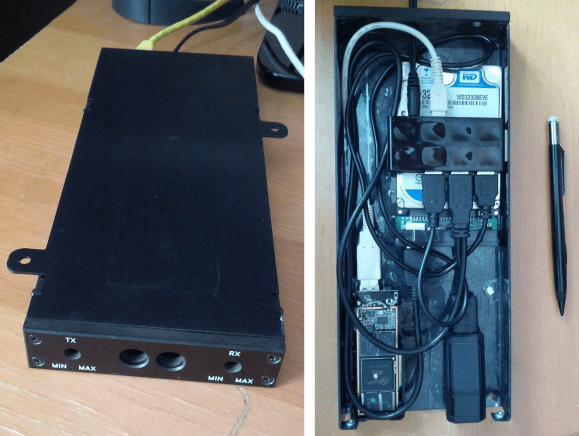
Kiss that energy hungry PC you’ve been using as a home server goodbye. [Vince Loschiavo] shows us how he squeezed a remarkable amount of functionality out of an inexpensive Android stick which manages his home’s digital empire.

He started off just wanting some network attached storage. For this he grabbed an MK802 Android Stick which you can get for a song if you find the right deal. To bend it to his will he said goodbye to the Android OS, installing Ubuntu for ARM instead. The stick (which is missing its case in the image above) connects to a USB hub in host mode, but does actually draw all of its power from the hub itself. This made it possible to attach a USB to Ethernet adapter to boost the speed which would have been limited by the WiFi connection. There’s a 320 gig USB hard drive for the storage. With that much space on hand it makes sense to add streaming media service as well which is simple since it’s running Linux. The last part of his work actually turns it into an Asterisk server by way of Google Voice and a SIP phone. An impressive outcome at a bargain price to be sure!