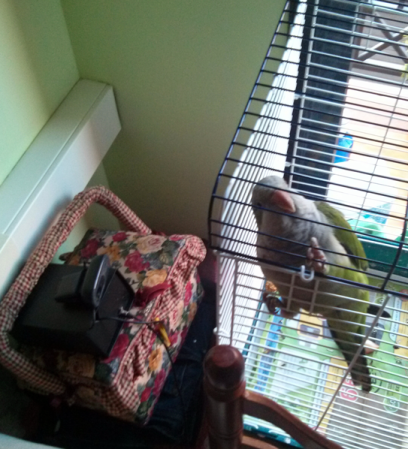
Monitoring A Sick Bird Using The Raspberry Pi

sick-bird-monitoring-with-rpi

[Jorge Rancé] was nursing a sick bird back to health. He found it on the street with a broken leg, which required a mini plaster cast for it to heal correctly. But felt bad when leaving the house for long periods. He grabbed some simple hardware and put his mind at easy by building an Internet connected bird monitoring system. It’s really just an excuse to play around with his Raspberry Pi, but who can blame him?

A webcam adds video monitoring using the Linux software called “motion” to stream the video. This is the same package we use with our cats when we travel; it provides a continuous live stream but can also save recordings whenever motion is detected. He added a USB temperature sensor and attached a water level sensor to the GPIO header. These are automatically harvested — along with a still image from the webcam — and tweeted once per hour using a bash script. He just needs to work out automatic food and water dispensing and he never needs to return home! Bird seed shouldn’t be any harder to dish out than fish food, right?
Cyclone PCB Factory: 3d Printable Circuit Board Mill

printable-cyclone-pcb-factory

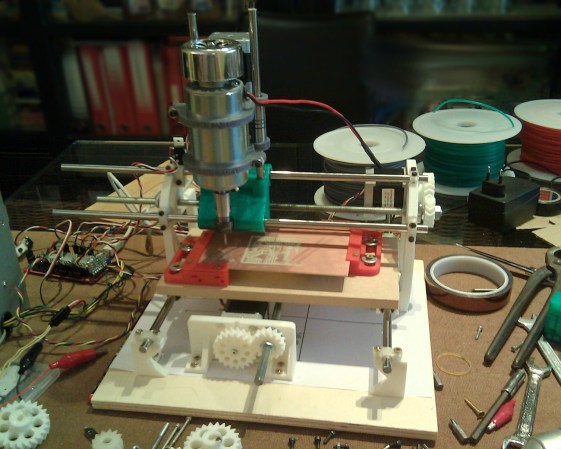
If you can 3D print most of the parts for another 3D printer, why not also for a PCB mill? That’s the question answered by the Cyclone PCB Factory. It will help you kiss those toner transfer or photo resist days goodbye.

Homemade circuit boards tend to be rather small, which really helps keep the cost and scope of this project down. Most of the mounting parts, as well as the gears, are 3D printed. Of course there’s the usual machine tool items which you pretty much have to purchase: the ball screws, precision rod, stepper motors, and a motor to spin the routing tool.

Check out the video below to see where the project is right now. One of the crucial aspects of PCB milling is to have a level build table. The cutter head tends to be ‘V’ shaped so cutting just a bit too deep can blow out the traces you’re trying to isolate. The demo shows that this can automatically calibrate the software to account for any variances in the height of the copper clad.

We remember seeing a snap-together PCB mill. But we’re pretty sure that that one used parts milled from HDPE rather than 3D printed components.

Continue reading “Cyclone PCB Factory: 3d Printable Circuit Board Mill”

Home Audio And Lighting Taken Over By The Raspberry Pi

687474703a2f2f7777772e6265616b61626c652e636f6d2f696d672f707265766965772d312e706e67

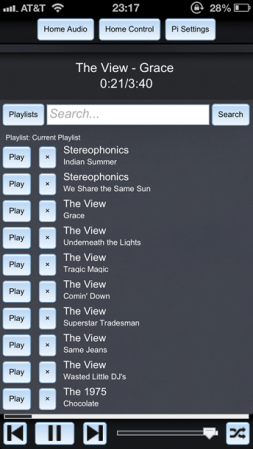
We’re beginning to see a lot of momentum building for using Raspberry Pi boards as the basis of your home automation. This latest offering from [Iain Hamilton] combines lighting and audio control through a single web interface. His frontend is run as a web page from the RPi board. It even includes separate layouts for mobile devices and computers in order to maximize use of the screen real estate.

Three buttons at the top of the interface allow him to configure the settings and switch between lighting and audio controls. This audio control screen issues commands to the Spotify client running on the Pi. The Mopidy package takes care of almost everything (as we’ve seen with other single-board computer Spotify servers). Future iterations will offer other streaming services like SoundCloud. [Iain’s] home lighting system uses X10 modules for control. He’s using a USB dongle to facilitate control of that system.

Continue reading “Home Audio And Lighting Taken Over By The Raspberry Pi”

Predator Suit For Monsterpalooza Includes Over-engineered Shoulder Cannon

off-the-hook-predator-suit

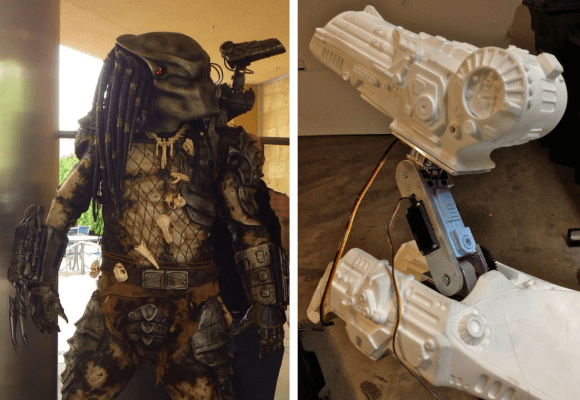
This Predator suit was premiered at this year’s Monsterpalooza conference. It’s nothing short of incredible. But the shoulder cannon is really what caught our attention. The thing is fully motorized and includes sound and light firing effects.

We saw a glimpse of what [Jerome Kelty] is capable of about two years ago. He was showing off an Arduino-based animatronics platform he put together for a Predator shoulder cannon that tracked based on where the predator’s helmet was pointing. But other than a video demonstration there wasn’t much info on the that actual build. This post makes up for that and then some.

A replica of this quality is rarely the work of just one person. A team of fans joined in to make it happen. After getting the molded parts for the backpack and canon from another team member [Jerome] set out to fit the support structure, motors, and control electronics into the space available. That meant a ton of milling, cutting, and shaping parts like the support arm seen above which integrates a servo motor into its rectangular outline. All of the controls fit in the backpack, with cables running to the helmet, as well as the cannon.

Continue reading “Predator Suit For Monsterpalooza Includes Over-engineered Shoulder Cannon”

Easy LCD Control For Arduino Mega

arduino-mega-easy-lcd-adapter

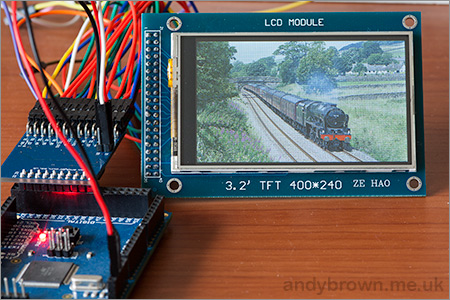
[Andy Brown] wrote in to show off the TFT LCD adapter he’s been working on for connecting inexpensive displays to an Arduino Mega.

These TFT LCD screens can be picked up on eBay for a few dollars. But they’re more suited for 16-bit microcontrollers which operate at 3.3V levels. His adapter board, which plugs directly into the Mega’s dual-row pin header, makes it easier to control these with an 8-bit chip that is running at 5V.

There’s a couple of things that make this happen. First off, he’s included level converter chips to managed the 3.3V/5V issues. Second, he uses latch chips to translate eight pins on the Arduino Mega to sixteen pins on the display. Those chips have a latch pin which holds the output values in memory while the input pins are changed. He manages to drive the latch on just one of the chips using the chip select (CS) line called for by the LCD protocol. This means you don’t lose any extra pins.

Another way to uses the displays with Arduino is to use a smart controller for TFT screens.

Continue reading “Easy LCD Control For Arduino Mega”

[Travis Goodspeed] Starts A Space Agency In Southern Appalachia

travis-goodspeed-space-tracker

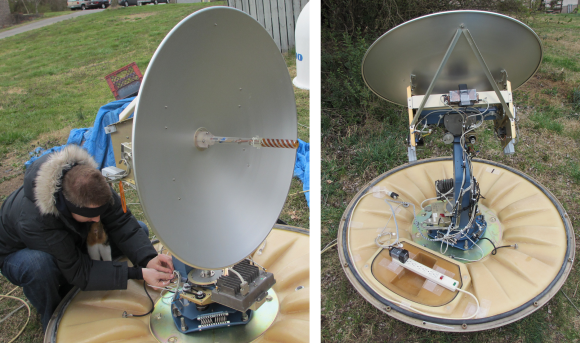
His space agency hardware might be in Southern Appalachia, but he can control it from anywhere in the world. That’s right, [Travis Goodspeed] started his own space agency — well kinda. The first piece of hardware operated by the organization is this dish for tracking moving targets in near space.

The main part of the build is a Felcom 82B dish which  was designed to be a satellite link for naval vessels. The image showing the back side of it exposes all of the extras he built into the system. Don’t worry though, a dome goes over the top to keep the weather out without encumbering its operation.He uses an SDR dongle to handle the radio communications. That connects to a BeagleBone which pipes the data to his handheld over the Internet.

It’s amazing to see this type of hobby project. It wasn’t that long ago that you needed an entire room of hardware to communicate with satellites.

Wooden Flatbed Truck Conversion

wooden-flatbed-truck-conversion

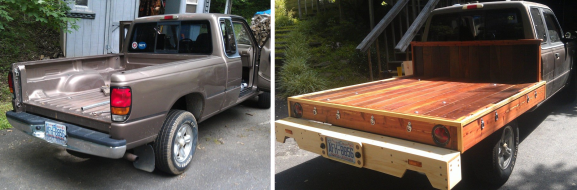
This pickup truck to flatbed conversion is very impressive. [Caswell_Etheredge] says he was channeling his inner redneck. That must mean rednecks in his area are craftsmen of the highest caliber.

He wanted a bit more flexibility on the size and shape of the cargo he was able to haul. Just six lag bolts held the original stamped steel bed on the truck. A bit of work with a pipe and a breaker bar did the trick. A mess of packed on mud and grime was there to greet him. After chipping, vacuuming, and power washing the underbody he gave it a fresh paint job using an undercoating product.

From there the wood flatbed build starts, and he’s not messing around with scrap wood. What you can see of the bed is fashioned from cedar and ipe. The underpinnings which fasten to the frame with those same six lag bolts are pressure treated 2×4 boards. The 4×6 bumper includes the license plate and lights for it. Brake and turn signals are built into the bed along with cleats for easy fastening of a tarp or to secure the cargo.

[via Reddit]