HDTV Antenna Of A Different Color

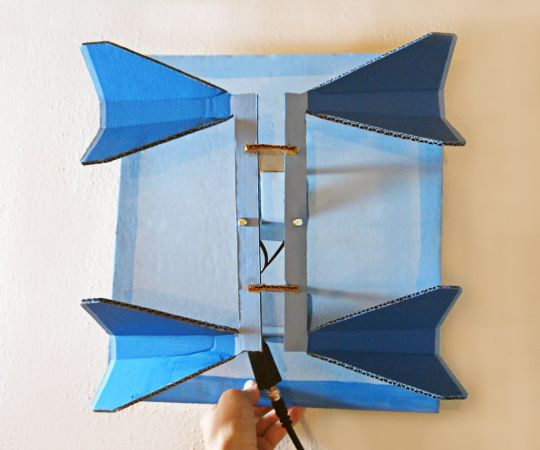
We’ve seen our share of commercially available HDTV antennas that work really poorly. For at least four years now we’ve gone without cable television, using a coat hanger antenna we made ourselves to record over-the-air broadcasts. But it’s a pretty ugly beast — we’re lucky enough to have an attic in which it can be hidden. If you’re in need of free television and don’t want an eyesore of a an antenna try building this foil and cardboard version. Even it if doesn’t work at all you’re only out about ten bucks.

The expensive part is the matching transformer which converts screw terminals to a coaxial cable connection so that it may be connected to your HDTV. You’ll need a few nuts and bolts, but we assume you can beg, borrow, or steal the tin foil, cardboard, and glue that round out the parts list. Glue, measure, cut, fold, fasten, finished! You’ll be watching horrible summer TV in no time!

If it doesn’t perform as expected just reuse that connector and try your luck with a fractal antenna.

Retrotechtacular: Vintage Computer Museum Playlist

vintage-computer-museum

Have you ever seen one of these SCELBI 8B computers? This is one of the first hobby computer kits which were sold starting in 1974.

This is just one of the many pieces of vintage computing hardware shown off in this playlist (the SCELBI is the fifth video). The collection is part of the Bugbook Historical Microcomputer Museum. [Dave Larsen], the curator of the collection, has been accumulating historic and often rare hardware for decades. More recently he’s been making video documentaries of the pieces and posting them for your enjoyment.

We love museums, but this is something different. [Dave’s] videos walk us through each exhibit, often filling in the story with anecdotes and insight from his own personal experience. It’s like a school field trip to the museum for those of us who can’t get enough of the moldy oldies.

We remember seeing at least one cool hack that used the 8008 processor also found in the computer pictured above. It was a clock built from a similar system.

Continue reading “Retrotechtacular: Vintage Computer Museum Playlist”

Thermocouple Vacuum Gauge Teardown

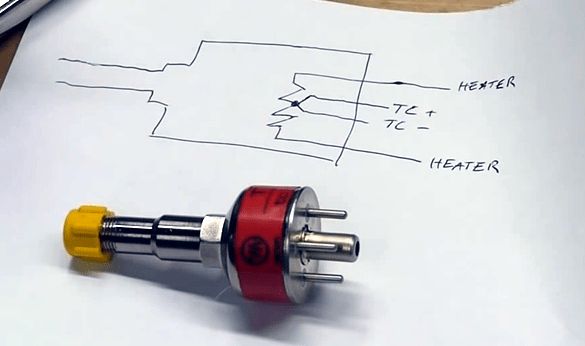
We don’t know how [Ben Krasnow] gets his hands on so much cool hardware. This time around is a bit of vintage tech: a thermocouple vacuum gauge.

The part seen above, and represented in the schematic, is the sensor side of things. This is interesting enough by itself. It has an air chamber with an electric heater element in it. When air is present it dissipates the heat, when under vacuum the heat builds and causes the thermocouple to generate some voltage on its connections.

Keep watching his presentation and things get a lot more interesting. The original unit used to measure the sensor is a throwback to the days when everything had sharp corners and if you were running with scissors you’d eventually teach yourself why that’s not such a good idea. The designers were rather cavalier with the presence of mains voltage, as it is barely separated from connections grounding the case itself.

Want to see some of the other cool equipment he’s got on hand? How about a CT scanner he built.

Continue reading “Thermocouple Vacuum Gauge Teardown”

MSP430 Alarm Clock Project

msp430-bedside-alarm-clock

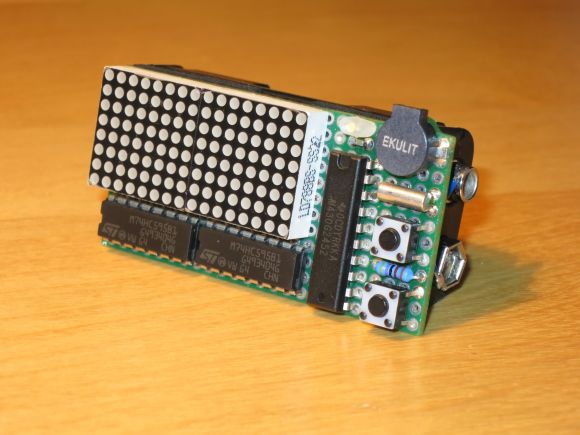
[Markus] turn his breadboard LED matrix tinkering into an alarm clock which wakes him each morning.

Don’t be fooled by how clean his assembly work is. That’s not a fabbed PCB, it’s a hunk of green protoboard which a lot of point-to-point soldering on the back side. It’s driven by the MSP430 G2452 which is oriented vertically in this image. The two horizonal ICs are 595 shift registers which drive the LED modules.

We already mentioned the cleanliness of his assembly, but there’s one other really cool design element. On the back of the unit is what looks like a battery holder for two AA cells. He’s using just one Lithium Iron Phosphate battery (3.2V) which is in the upper of the two cavities. This let him cut the lower part of the holder at an angle to act as a stand for the clock.

Don’t miss the video which walks us through the user interface. It has what you’d expect from an alarm clock. But there is a really bright white LED which mimics a sunrise clock and it does more than just buzz one note when the thing goes off.

Continue reading “MSP430 Alarm Clock Project”

Plastic Bottles Funnel Rain Into Rain Barrels

plastic-bottle-downspout

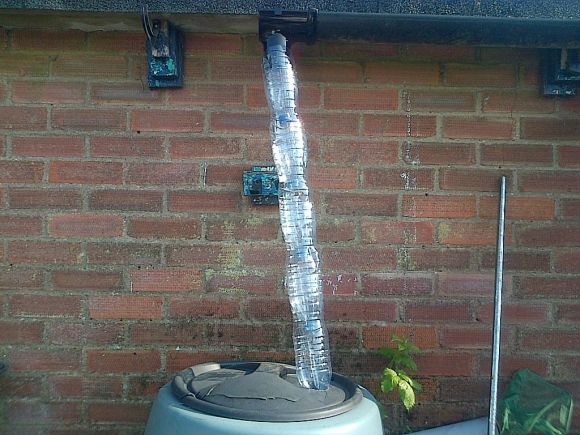
This is [Wombling’s] no-cost solution to getting rain from his gutters into a rain barrel. It is literally just a bunch of plastic water bottles chained together. At one end he uses the original cap with some holes punched in it as a sieve.

We like the concept, but find the execution a bit dubious. In heavy rain the holes in the cap will not be able to keep up and we figure your gutters are going to overflow. That may be okay depending on the grade of your landscaping, but those who value keeping their basement dry should avoid this route.

Just a bit of improvement could change all that though. We suggest making the rain barrel the sieve. Add a bowl shape to the lid with a large piece of screen in the bottom to filter out debris. Then form some type of spout on the front side of the lid to channel overflow away from the house.

The amount of waste generated by bottled water has always troubled us, which is part of the reason we featured this. We also liked seeing those plastic bottle skylights, and could swear we featured a floating plastic bottle island built in the ocean but couldn’t find the link. If you know what we’re talking about leave the goods in the comments section.

Copper Kettle Just For The Hipster Coffee Scene

04-copper-kettle

Handmade coffee is a feature we need to write. But for now we present this copper kettle which is designed to pour out the boiling water very slowly in order to achieve the perfect cup of slow-drip java.

[CHS] made the kettle for his friend [Nate]. The entire process starts off with an arc of flat copper sheet which makes a slightly conical cylinder when curved until the two ends meet. Getting a water tight seal on this seam is imperative and it took four or five tries to reach perfection.

To get the kettle in shape [CHS] improvised a mandrel out of a thin slice of railroad track. After polishing it smooth it goes on the inside of the copper and gives him something to hammer against. We think this step is magic… It’s kind of like the old sculpting adage that you remove everything that isn’t what you’re trying to end up with. The beauty of the piece really pops out as the final curves are hammered into the work.

Continue reading “Copper Kettle Just For The Hipster Coffee Scene”

Filtering Out Mains Hum From ADC Samples

Hum_filter

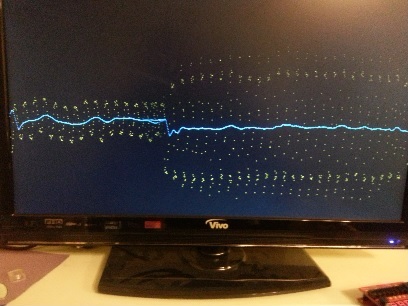
A little light reading means something different to us than it does to [Hamster]. He’s been making his way through a book called The Scientist and Engineer’s Guide to Digital Signal Processing written by [Steven W. Smith, Ph.D]. Being the hacker type, a million different uses for the newfound knowledge popped to mind. But as a sanity check he decided to focus on a useful proof of concept first. He’s come up with a way to filter out the mains hum from Analog to Digital Converter samples.

Mains hum is all around us; produced by the alternating current in the power grid that runs our modern lives. It’s a type of interference that can be quite problematic, which is on reason why we see EMF sensor projects from time to time. Now you can filter that ambient interference from your projects which take readings from an ADC. This would be quite useful for applications which measuring teeny signals, like ECG hacks.

[Hamster] did a pretty good job of presenting his demonstration for the uninitiated. He even provides examples for Arduino or FPGA projects.