MIDI Out For A Korg CX-3 Organ

midi-out-for-a-vintage-korg-cx-3-organ

[Michael] loves this old organ of his, but recently he wondered if it would be possible to add MIDI out without altering its original functionality. With a bit of research and more than a bit of hard work he accomplished his goal.

The nice thing about working on a quality piece of hardware like this is the resources you can find regarding how they work (which we bet is tailored for how to repair them when they break). [Michael] found a website with plenty of info on the circuit boards and how they work. From this he was able to locate a few chips which stream serial data regarding which keys have been pressed. Bingo!

Once he located the three signals he was after he built a board to translate them to the MIDI protocol. His circuit is based around an ATtiny2313. It is supported by a liner voltage regulator circuit as well as a buffer chip which converts the incoming signals to the 5V levels needed. His home etched board is clean and well mounted, and the success of the project can be heard in the clip after the jump.
Continue reading “MIDI Out For A Korg CX-3 Organ”

Video Player Built From Stellaris Launchpad

stellaris-launchpad-playing-video

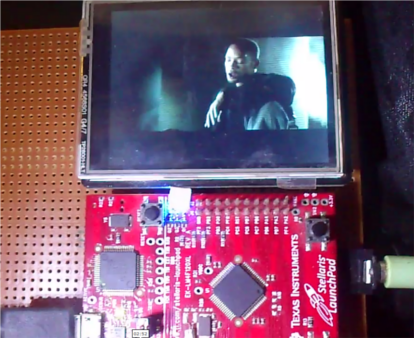
We think it’s pretty impressive to see a Stellaris Launchpad playing back Video and Audio at the same time with a respectable frame rate. It must be a popular time of year for these projects because we just saw another video playback hack yesterday. But for this project [Vinod] had a lot less horsepower to work with.

He’s using a 320×240 display which we ourselves have tried out with this board. It’s plenty fast enough to push image data in parallel, but if you’re looking for full motion video and audio we would have told you tough luck. [Vinod’s] math shows that it is possible with a bit of file hacking. First off, since the source file is widescreen he gets away with only writing to a 320×140 set of pixels at 25 fps. The audio is pushed at 22,400 bytes per second. This leaves him very few cycles to actually do anything between frames. So he encoded the clip as a raw file, interlacing the video and audio information so that the file can be read as a single stream. From the demo after the break it looks and sounds fantastic!

Continue reading “Video Player Built From Stellaris Launchpad”

Hand Placing Flash Die To Make USB Drives

SONY DSC

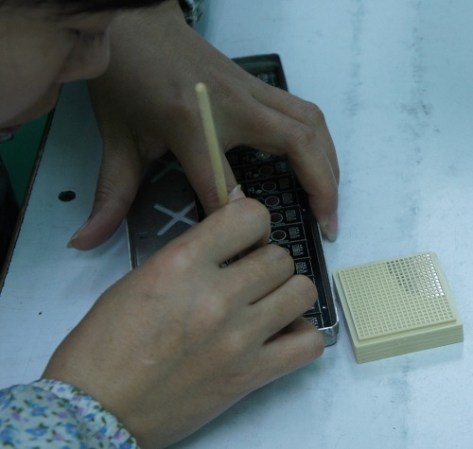
It’s a stretch to call this one a hack, but USB thumb drives are around us constantly and we always assumed that the boards inside were machine populated (like with a pick and place machine). [Bunnie] tells us otherwise. He recently had the chance to tour a factory where USB flash drives are made.

The image above shows a worker populating a set of boards with the flash memory dies. The waffle-grid to the right holds the dies. Each is a tiny glint of a component. The worker is not in a clean room, and is using a bamboo tool to pick up the pieces. [Bunnie] explains that he’s seen the tools before but doesn’t fully comprehend how they work. He figures that the hand-cut manipulator has just the right amount of grab to pick up the die, but will also release it when it touches down on the dot of glue applied to the landing zone on the board.

If you’re into this sort of thing you should check out the PCB factory tour we saw a couple of years back. The article link is dead but the embedded tour video still works.

[Thanks pl]

Old LED Marquee Turned Embedded Video Player

driving-led-marquee-with-rpi

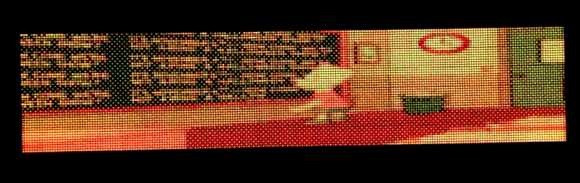
[Sprite_TM] is was sent an old LED Marquee by an anonymous fan of his hacking projects. The display isn’t full color, but it’s large — 224 by 48 pixels — and he figured he could render some okay images with the bi-color diodes. In the end, he replaced the controller and turned it into a video player.

The original system work well enough, but the 100 MHz 486 industrial style PC that drove the display seems a little comical these days. After giving it a spin and testing out how it drives the display [Sprite] hooked up an FTDI chip and managed to get it playing video from his computer. Above you can see part of the opening sequence of The Simpsons.

Now that he had learned its secrets he set out to give it an embedded controller. His first attempt was with a Carambola board which he’s worked with before. That proved to be a little slow for all the pixel data he was pushing so he upgraded to a Raspberry Pi and never looked back. You can see the demo video after the jump.

Continue reading “Old LED Marquee Turned Embedded Video Player”

Cube 3D Printer Hack Lets You Use Bulk Filament

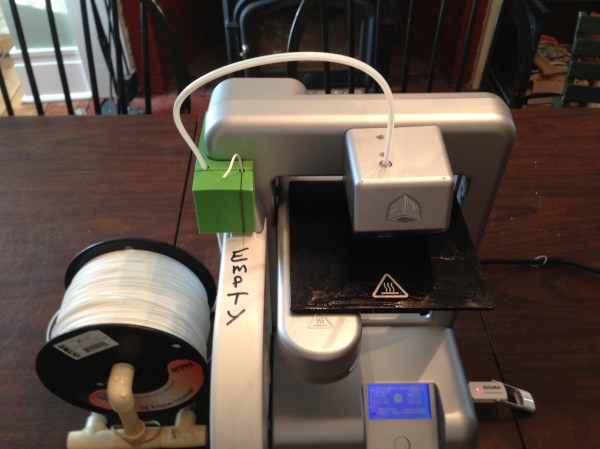
[Chris Nafis] crunched the numbers and found out he could get filament for his 3D printer in bulk for about one-fifth the cost of the cartridges the company sells. This led him to print a feeder for his Cube 3D printer.

We’re skeptical about the Cube 3D printer’s cartridges. They contain a spool of filament, but also include a chip which reports back the filament color and length remaining. We’re sure this provides some nice functionality for those looking to press a button and walk away. But we see it as an annoyance like the laser toner cartridges that stop working based on page count rather than remaining toner.

The solution [Chris] went with still uses the cartridges to ‘trick’ the machine into printing. Basically the interface will tell you that you don’t have enough filament left, but as long as there’s a cartridge in place you can tell it to print anyway. The green adapter he printed has a pass-through for the stock cartridge as well as the bulk spool you see to the left.

Foot-powered Lathe Is A Tour De Force Of Joinery Techniques

foot-powered-lathe

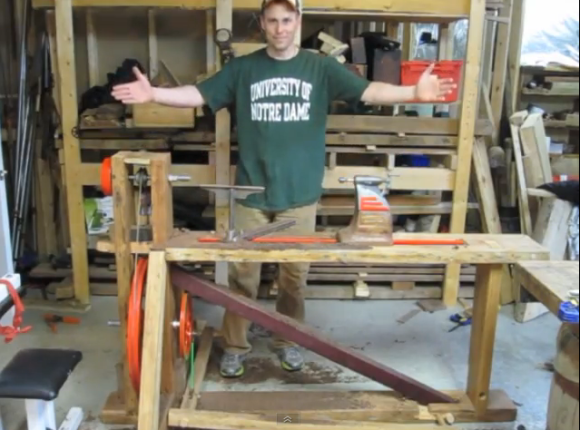
Meet [Quetico Chris]. He’s a master woodworker who likes to find his own alternatives to using power tools. Most recently, he was inspired by a fly-wheel from an old factory. He used it to build this foot powered wood lathe.

It works something like a foot powered sewing machine. There’s a lever for your foot which converts the downward force from your foot into a rotating force which drives the work piece. The mechanics of the lathe are pretty common, but we think the build techniques he uses are anything but. The video after the break shows each step [Chris] went through when crafting the human-power tool. His approach was to use wood as often as possible which includes foregoing modern fasteners for older joinery. He uses mortise and tenon, wood pinning, doweling, and a lot of puzzle-like tricks to get the job done.

We lack the skill and tools to replicate this kind of craftsmanship. We’re going to stick to letting a laser cutter form our wood connections.

Continue reading “Foot-powered Lathe Is A Tour De Force Of Joinery Techniques”

SDR As A Police And Fire Radio Scanner

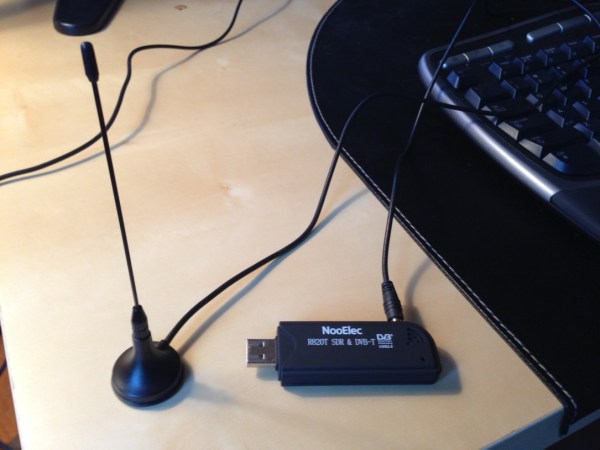
If you’ve lost interest in that DVB dongle you bought to give software defined radio a try you should bust it back out. [Harrison Sand] just finished a guide on how to use SDR to listen in on Police and Fire radio bands.

The project, which results in the crystal clear audio reception heard after the break, uses a whole lists of packages on a Windows box to access the emergency bands. SDRSharp, which has been popular with other DVB dongle hacks, handles the hardware work. In this case the dongle is a Newsky TV28T v2 module that he picked up for a few bucks. He’s also using some support programs including the Digital Speech Decoder which turns the data into audio.

We wonder how many areas this will work for. It was our understanding that law enforcement was moving to encrypted communications systems. But all we really know about it is that you can jam the system with a children’s toy.

Continue reading “SDR As A Police And Fire Radio Scanner”