DIY Pick And Place Seems Easy To Build

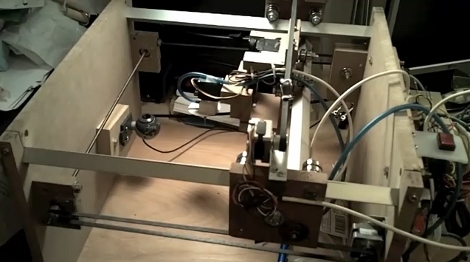
We’re not saying it’s a simple project, but the build methods that [Alan Sawula] used for this DIY pick and place are probably the easiest we’ve seen yet. As this is just a CNC machine, the methods he used would also work quite well for mills or other machines. Instead of using precision rods for the X and Y axes, he used square tubing. The tubing is oriented more like a diamond, with the ninety degree corners providing the travel surface. Two bearings with a shim between them provide a groove that rides along the corner, and since this is square and not just ‘L’ bracket, the sleds are secured both above and below the tube. Stepper motors provide the movement along X and Y, with a servo motor for Z and another one to rotate the medical grade needle that serves as the vacuum tip. Starting four minutes into the video you can see that this not only works, but it’s lightning fast!
Continue reading “DIY Pick And Place Seems Easy To Build”

Over-engineered Clock Finds Purpose As RSS Reader

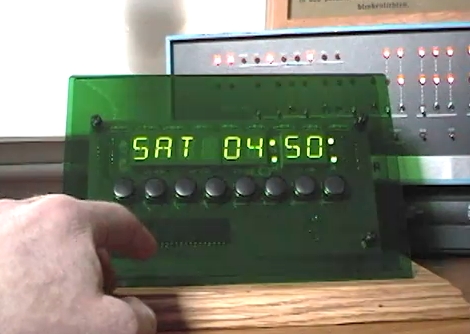
[Bob Alexander] admits that he over-engineered his clock, giving it eight control buttons, eight twelve-segment alpha-numeric display digits, a GPS module as a time source, and a beefy microcontroller to boot. But he’s found a way to get more for his money out of the device by adding RSS and weather features to it.

Since he’s using the PIC 18F4550 it’s a snap to add USB connectivity. From there he wrote a fantastic PC-side application for communicating with the display. Now he has the option of displaying time, RSS feeds, or weather by scrolling through the options with one of the buttons. Perhaps the best feature is the option to launch a browser on the PC and view the current story just by pressing a button on the display. Check out the two demos after the break; one shows the clock features and the other demonstrates the C# software.

Continue reading “Over-engineered Clock Finds Purpose As RSS Reader”

Hackaday Links: February 21, 2011

PCB Stand

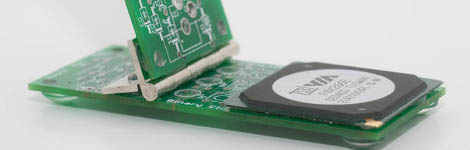
Part PCB, part old IC, and held together with hot glue. It doesn’t take much to make this electronics stand, but it’ll certainly add to the geek level of your desk.

Decorate with light

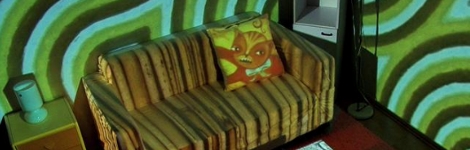
This busy living room is actually decorated all in white. The patterns that give it life are on lend from a projector and what we’d imagine is some fantastic software. [Thanks MDV]

Flashing butt on your bike

[Eli] sewed lights and flex sensor into her jeans. Now her butt flashes in heart-shaped patterns as she rides. She actually robbed one of the flex sensors from this project to complete that explosive high-five project.

Mini-rake’s progress

A lathe and some sand that needs tending is all that [Spatula Tzar] needed to get this zen garden rake under way. We like how she used a vacuum bag to infuse the wood with mineral oil.

Paper and electrons

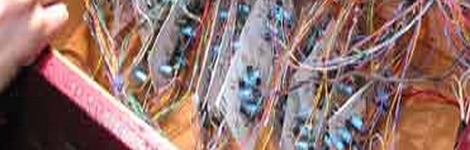
This collection of musical projects forsakes common substrates and builds the mess of circuit boards on pieces of paper. Not much information but the strangeness is worth a look.

Blinky Headgear

[Everett Tom] added some blinking LEDs to his visor while honing his PCB design skills at the same time. He started with the TI eZ430-F2013 for prototyping the blinking circuit along with its mode toggle buttons. Once this was worked out he used BatchPCB (a low-cost professional board fab option) to manufacture a board. The final design hosts an MSP430 F2013 microcontroller as well as the voltage regulator circuit that draws power from the 9V battery that hides inside the head band next to the board.

You guessed it, video after the break.

Continue reading “Blinky Headgear”

Arduino Levitation

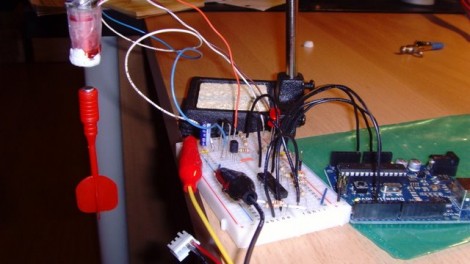
Here’s the proof that Arduino is a tool for serious prototyping and not just a toy. [Norbert Požár] built a magnetic levitation device that combines an Arduino with an electromagnetic driver circuit and a magnetic field sensing circuit. Unlike other other levitation setups that use optical sensing, this implementation uses a hall effect sensor on the electromagnet to maintain the distance between it, and the permanent magnet it is holding in midair. Check out the embedded video after the break and browse through the overview page so see how pleasing it is to do away with a frame around the floating object. This makes us wonder if it could be inverted in a way similar to that magnetic scale.

Continue reading “Arduino Levitation”

Motion Activated Monitor Wakeup

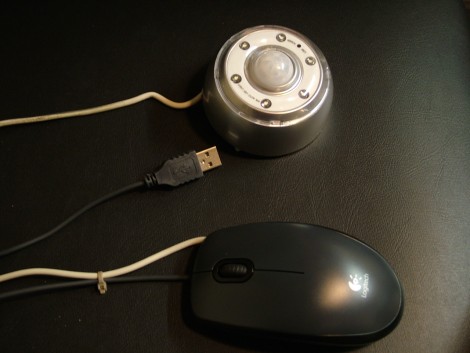
This hardware is used to keep a computer monitor awake when there is motion in the room. The monitor displays important information for firefighter in the vehicle bay, but only needs to be on when they are getting ready to go out on a call. The solution is a simple one, a PIR sensor combines with a mouse for motion sensitive input. When the PIR sensor detects motion it causes a mouse button click via a 2N3904 transistor. Now the monitor will not waste power or have burn-in over the long term, but whenever someone is in the room it will be displaying the information that the emergency workers need to know.

[Thanks Andy]

Three Digit Binary Clock

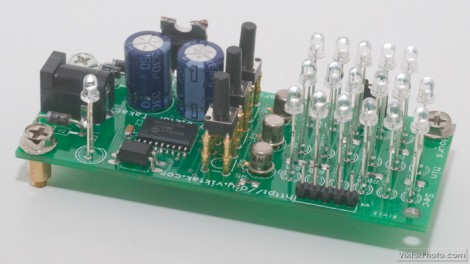
Here’s a three digit binary clock that [Viktor] designed. It uses a multiplexed display to drive one digit at a time with a PIC 16F628A. The video after the break shows it ticking away, display hours, minutes, and seconds in blue LEDs. You may be wondering why those LEDs are not flush to the board? [Viktor] took the project one step further than most binary clock projects, designing a PCB to fit into the enclosure of an old laptop PSU and then having the board manufactured. With options like DorkbotPDX groups orders its has become quite inexpensive to do this and it’s really good practice for when you need to design a highly complicated board for that super-fantastic project of the future.

Continue reading “Three Digit Binary Clock”