Brainwave-based Assistive Technology In The Home

eeg_smart_house

Amyotrophic lateral sclerosis (ALS) is a debilitating disease that eventually causes the afflicted individual to lose all control of their motor functions, while leaving their mental faculties intact. Those suffering from the illness typically live for only a handful of years before succumbing to the disease. On some occasions however, patients can live for long periods after their original diagnosis, and in those cases assistive technology becomes a key component in their lives.

[Alon Bukai and Ofir Benyamin], students at Ort Hermalin Collage in Israel, have been working hard on creating an EEG-controlled smart house for ALS patients under the guidance of their advisor [Amnon Demri]. The core of their project focuses around controlling everyday household items using brainwaves. They use an Emotiv EPOC EEG headset which monitors the user’s brainwaves when focusing on several large buttons displayed on a computer screen. These buttons are mapped to different functions, ranging from turning lights on and off to changing channels on a cable box. When the user focuses on a particular task, the computer analyzes the headset’s output and relays the command to the proper device.

As of right now, the EEG-controlled home is only a project for their degree program, but we hope that their efforts help spur on further advancements in this field of research.

Continue reading to see a pair of videos demonstrating their EEG-controlled smart house in action.

Continue reading “Brainwave-based Assistive Technology In The Home”
Hackaday Reader Throwdown: Electronic Dice

electronic_dice

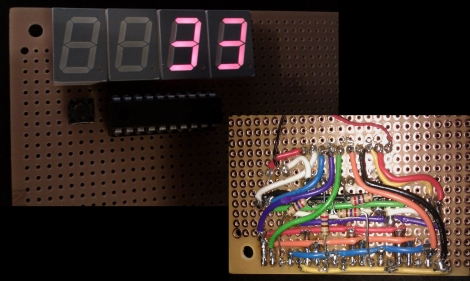
Hackaday reader [Daid] posted in our forums showing off a set of electronic dice he recently constructed. Back in January, we featured a similar set of electronic dice built with an Arduino that was way overpowered as far as [Daid] was concerned. Not satisfied with simply saying it could be done better, he put his money where his mouth is – something we would love to see more of.

He used an ATTiny2313 to provide the device’s logic, outputting the dice values on a set of four 7 segment displays. The whole setup is controlled by a single push button that serves triple duty rolling the dice, configuring how many sides the dice have, as well as selecting how many dice are being thrown.

He admits that the wiring job is a bit of a mess, but he was going for function over form, and it works just fine. He also says that he would have finished it far sooner if it hadn’t been for those meddling kids some broken 7 segment displays.

We think he did quite a nice job, though we’re all ears if you think you can do it better.

Growling Doorbell Lets You Know Guests Have Arrived

wireless_doorbell_hack

[Sean] was screwing around online looking for nothing in particular when he came across a mailbox hacked to notify the homeowner when the mail had been delivered. Since his mail is delivered via a slot in the door, he had no use for the hack as is, but something similar soon came to mind.

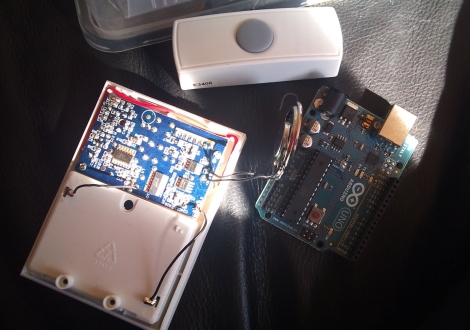
His dog isn’t too keen on visitors, and he figured that he could save himself a bit of grief (and a lot of unnecessary barking) if he were to wire up his doorbell to notify him of guests via his iPhone. He stopped by the local hardware store and picked up a wireless doorbell. It was quickly disassembled and wired up to an Arduino he had set aside for a different project. Tweaking some code he found online, he soon had the doorbell talking with the Arduino and was ready to interface it with his iPhone. He decided that he wanted to deliver notifications to his phone via Growl and found a Perl script online that was close to what he needed. A few tweaks later, and he had a Growling doorbell.

As you can see in the video below, it works, though there seems to be a bit of a delay in the notification. We don’t think that it would be enough to send his visitors packing before he made it to the door, but the lag can likely be reduced with a few small modifications.

As for the post that started this whole thing, we’re pretty sure this is it.

Continue reading “Growling Doorbell Lets You Know Guests Have Arrived”

Compost Heap Temperature Logger Helps Keep Things Hot

compost_temp_logger

HackHut user [lackawanna] is looking to start his own compost pile, but as many urban composters discover, things can get quite smelly if you don’t manage it properly. The process of composting is broken up into two phases, aerobic and anaerobic decomposition. The former is the first stage to occur and produces plenty of heat, but should be scentless. The latter gives off less heat and is more of a stink due to putrefaction. Carefully monitoring the temperature of the pile and restarting the aerobic phase when necessary helps to keep the process “healthy” and scent-free.

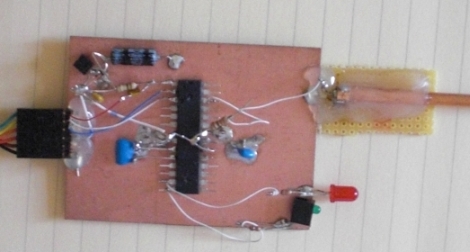
[lackawanna] built a simple temperature monitor that he plans on using to track the status of his compost pile once he gets started. It uses an ATmega328 as the brains of the operation and an old metal can transistor as his temperature sensor. Using relative measurements of the compost pile taken in 10 minute intervals, he can determine when the aerobic phase is underway, as well as when things begin turning anaerobic. At that point, the sensor alerts him that the pile needs to be turned.

The build is pretty simple, but leaves plenty of room for expansion. It should be relatively easy to add a more friendly notification interface as well as install multiple sensors to the pile for obtaining aggregate temperature data.

mobo_salvage

PCB Parts Salvaging Made Easy

Take a moment to think about how many old or damaged computer motherboards you have tossed away over the years. Sure we try to repurpose everything we can, but reclaiming electronic components from complex devices can be overly time consuming if you don’t have the proper means of doing so.

Ideally, if we were to try removing components from a motherboard, an old stove or an unused toaster oven would be great. If you didn’t have either item at your disposal, you could always attack the board with a soldering iron and some braid – but who has the time for that?

[Giorgos Lazaridis] over at PCBHeaven put together a quick video demonstrating his favorite technique for salvaging components after a motherboard has outlived its usefulness. Using a 2000W heat gun, a few hand tools, and couple of metal pans, he had the entire board stripped bare in about 30 minutes time. He talks about some of the best parts he has discovered while salvaging and points out a few hard-to-find items that can be easily obtained by tearing down a motherboard.

Sure his process might not be as easy as inverting a PCB in an oven, but his method is cheap, portable, and takes up very little space.

Keep reading to see [Giorgos’] video demonstration and don’t forget to check out some of the other cool stuff he has done in the past, such as his temperature-controlled soldering station, this acrylic bender, or this bench top function generator.

Continue reading “PCB Parts Salvaging Made Easy”

Light-sensing Circuit For Power Saving Applications

light_sensing_circuit

Instructables user [MacDynamo] was thinking about home security systems and wondered how much electricity is being wasted while such systems are powered on, but not activated. He pondered it awhile, then designed a circuit that could be used to turn a security system on or off depending on the time of day, but without using any sort of clock.

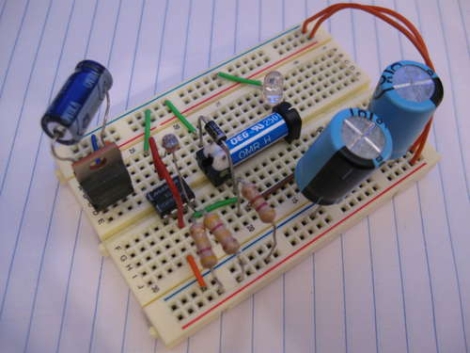
His system relies on a 555 timer configured as a Schmitt trigger, with a photoresistor wired to the reset pin. When the ambient light levels drop far enough, the resistance on the reset pin increases, and the 555 timer breaks out of its reset loop. This causes the circuit to power on whatever is connected to it. When the sun rises, the resistance on the reset pin drops and the 555 timer continually resets until it gets dark again. He notes that this behavior can be easily reversed if you were to put the photoresistor on the trigger pin rather than the reset pin.

We like the idea, though we are a bit wary about using this for any sort of real security system. An errant insect or debris could cause the system to be turned on, and we’d feel pretty foolish if someone disabled our alarm with a flashlight. That said, this sort of circuit still has plenty of practical, power-saving applications outside the realm of home security.

MIDI Drum Interface Helps You Step Up Your Game

rb_drum_trigger

[Dan] likes Rock Band, but playing it makes him feel as useful as a one-legged man in an ass-kicking a drumming contest. He says that even using his friend’s ION kit leaves him searching out excuses as to why he’s not as good as he should be on the drums.

Eventually, he decided that he would settle things once and for all. The final excuse he came up with was that it is too difficult to press the drum pedal rapidly without getting tired, as the Rock Band gear does not properly simulate real drum equipment. Bass pedals on professional kits are weighted and balanced to allow the drummer to exert the least amount of work for the most return, resulting in a less tiring experience.

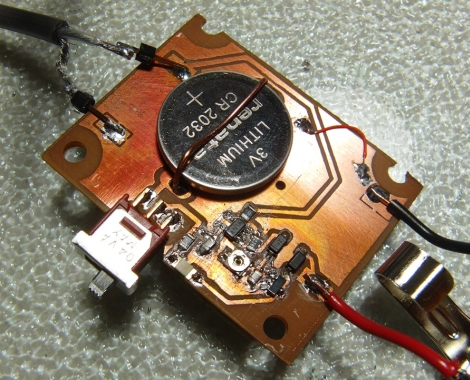
To give him a leg up while playing the game, he decided to rig a trigger to his Yamaha MIDI bass pedal, which is properly weighted. He consulted the Rock Band forums, and after looking at a couple of different circuit diagrams, he designed his own. He etched a PCB, mounted his SMD components, and was well on his way to becoming a drum legend.

He says that the pedal interface works quite well, and despite a couple of tiny soldering setbacks, he has yet to see any errant hits register in-game.

Be sure to check out the video below of his drum trigger undergoing some tests.

Continue reading “MIDI Drum Interface Helps You Step Up Your Game”