Automatic Dog Dish Filler Never Goes Dry

automatic_water_dish

[Avatar-X] has a Siberian Husky that gets a lot of exercise throughout the day, and as you would imagine, drinks a ton of water as well. We all suffer from memory lapses at one time or another, and while he is normally good about keeping the bowl filled, he occasionally forgets. He has tried a handful of various auto-filling dog dishes, but none of them seemed to work all that well, and they often rapidly built up healthy bacterial colonies.

With the help of some friends, he rigged up an automatic water dish filler, that ensures his pup always has a sufficient supply of water. He tapped into his kitchen water supply with a standard refrigerator hookup kit, and ran some tubing up into his cabinets, where he placed a garden irrigation valve. The valve is controlled using an Arduino which senses the bowl’s water level using a pair of wires.

The system looks like it works pretty well if the video embedded below is any indicator. [Avatar-X] provides code and schematics for the water control circuit on his site, free to anyone looking to build a similar system for their pets.

If you are interested in learning more about automating some of your pet’s care, be sure to check out these hacks we featured in the past.
Continue reading “Automatic Dog Dish Filler Never Goes Dry”

Reviving A Broken HSDPA Modem With A Bit Of Clever Investigation

hsdpa_modem

Hack-a-Day forum member [Necromant] was recently working on a router when he made a terrible mistake. He connected the wrong power brick to the router, causing a 2.5v over-voltage. The router itself was just fine, as it contained a good stepdown converter, but the HSDPA modem connected to the router’s USB port was not so lucky. It seems that the USB host is powered directly from the router’s power supply without any conversion – this meant his modem got a nice 7.5v zap when he used the wrong plug.

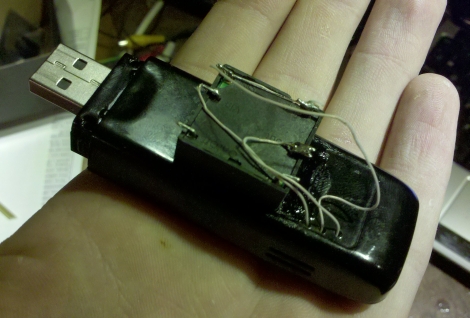
He assumed the modem was dead, so he figured there was no harm in disassembling it. He examined the modem’s circuit board and found that when plugged in, the onboard stepdown converter supplied 0 volts to the rest of the PCB. He couldn’t find any documentation for the converter online, so he employed a little bit of trial and error clever investigation to determine what sort of voltage the stepdown provided before being cooked.

After a bit of testing with his home-built low dropout regulator, he determined that the damaged stepdown provided 3.3v to the rest of the modem (that’s a 4.2v over-voltage for those of you who are keeping track). He added a linear voltage regulator to the board in place of the old stepdown, which worked for about 15 seconds before overheating.

In the end, he decided to add a pretty hefty 3.3v stepdown converter to the modem, throwing aesthetics to the curb. The result is one ugly, but quite functional HSDPA modem.

Direct To PCB Resist Printing Requires Minimal Additional Components

epson_inkjet

Printing PCBs using the toner transfer method works pretty well, but there are some downsides, such as incomplete trace transfers and the like. HackHut user [rucalgary] decided to go the inkjet route instead, and picked up an Epson printer on clearance at his local electronics shop. This method is not new by any means, but his printer conversion is one of the simplest we’ve seen as it does not rely on any additional sensors to function.

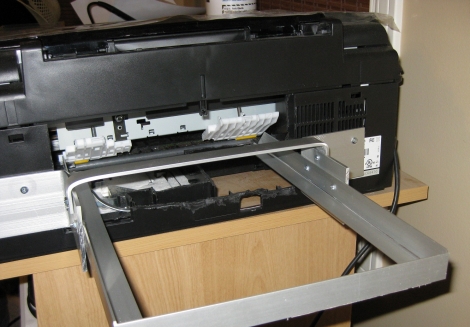
Once he got home, he tore the printer down immediately, removing the paper input and output trays as well as the scanner bed. After all of the extraneous parts were removed, he got to work raising up the printer head, as well as the printer head rest mechanism. He mentions that the latter component is absolutely crucial to proper functionality down the line. Once the print head and its associated components were relocated, he added a pair of aluminum rails for feeding his print tray into the machine.

With everything complete, he filled up a spare cartridge with ink (he says that MISPRO yellow works best) and ran some test boards through. He is quite pleased with how things turned out, and is more than happy to give you a quick tour of his completed printer via the video below.

Continue reading “Direct To PCB Resist Printing Requires Minimal Additional Components”

DIY Camera Dolly Frees Up Your Hands To Take Care Of The Important Stuff

diy_camera_dolly

Documenting your build process can sometimes be an incredible pain, as it’s quite difficult to take pictures or video while you are in the middle of soldering. Professionals who demonstrate things on TV for a living have the benefit of a camera crew and special rigs to catch the action from every angle – the rest of us don’t have that luxury.

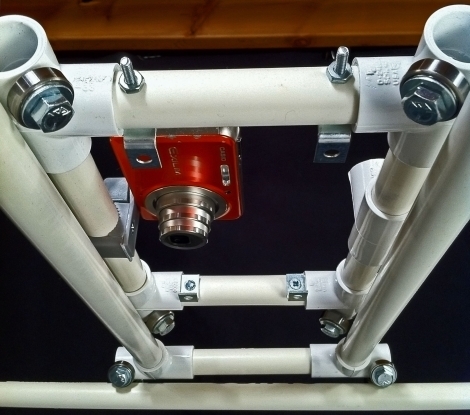
[Steve] felt the same frustrations as many of us do, and decided to do something about it. He built a movable camera dolly that can be suspended from the ceiling above his work surface for less than $30. The bulk of his camera dolly is built from PVC piping, with assorted bolts and washers holding things together. Skateboard bearings were used as rollers to provide smooth 2-axis motion for the entire rig, then he hung the entire apparatus from the ceiling joists over his workspace.

According to [Steve], the build process seems relatively easy and should take no more than an hour or so, and it can support pretty much any full-size DSLR camera you can find.

Stick around for a quick video tour of his camera dolly build.

[via Make]

Continue reading “DIY Camera Dolly Frees Up Your Hands To Take Care Of The Important Stuff”

Audiophile Quality Headphones At A Fraction Of The Price

diy_hifi_headphones

If you are in the market for a nice pair of Hi-Fi headphones, it is not uncommon to to find price tags in the range of $300-$500. [Stacy] loves her music, but she had no desire to pay that high a price for a pair of good portable cans. Instead, she upgraded a set of cheap, knock-off headphones to near-audiophile quality for less than $50.

She starts off by explaining the technology behind the expensive headphones you see in stores, and why the sound quality is so much better. She says the orthodynamic drivers used in these products produce far better sound due to the placement of the voice coils, and their lack of delay when producing sound.

She found a pair of orthodynamic drivers for $30 and fit them into her knock-off headphones with a reasonable amount of effort. A bit of insulation and supporting plastic was added to ensure proper mounting of the drivers, then the headset was painted and reassembled.

[Stacy] claims that the end result is easily comparable to far more expensive headsets, especially when connected to a proper amplifier. If you are looking to step up your audio game on the cheap, here’s your chance.

AV Test Box Meets The Incredible Shrink Ray

mini_avtester

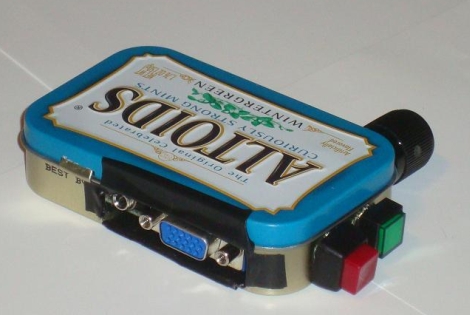
[Chris] recently finished building a miniscule AV Test Box, capable of fitting inside a standard Altoids tin. It is a revision of a project he constructed a few years ago. His previous test box worked well, but was large and cumbersome – definitely not something you would want to carry around from place to place with any frequency.

The new test box does everything its predecessor is capable of, which includes displaying an 800×600 VGA test pattern as well as generating sound signals for testing audio systems. He updated the circuit design a bit, employing a newer PIC processor to run the show, otherwise most of the design details have remained the same, form factor aside.

His build log is full to the brim with details as usual. You will find thorough descriptions of all the components he used, schematics, source code, as well as the theory behind the build.

Be sure to check out the video embedded below of his new AV tester in action.

Continue reading “AV Test Box Meets The Incredible Shrink Ray”

Lego Minifig Multimeter Makes Resistor Sorting A Lot More Fun

lego_minifig_multimeter

While there’s typically not much room on our work bench for toys, [David] over at Robot Room has put together a pretty cool multimeter for which we would make an exception.

His Lego Minifig multimeter is constructed using mostly standard off-the-shelf Legos, and a pair of Minifigs he modified to suit his needs. Translucent Minifig heads were sourced online to allow the neck-mounted LEDs to shine through, and each of the bodies were drilled out in several places to accommodate the wires he uses to take measurements.

The multimeter will display the resistance of any item from 10 – 10,000,000 Ω, as well as measure the voltage of any battery you can manage to fit under the Minifig’s metal wrench. The multimeter takes measurements using an ATmega168, and relays that data through a serial to USB converter connected to a nearby computer. The computer is host to a .NET application he wrote which displays and speaks both the resistance and voltage values.

Keep reading to see a quick video walkthrough and a demonstration of the multimeter at work.

Continue reading “Lego Minifig Multimeter Makes Resistor Sorting A Lot More Fun”