DIY Fizzy Fruit

co2inator

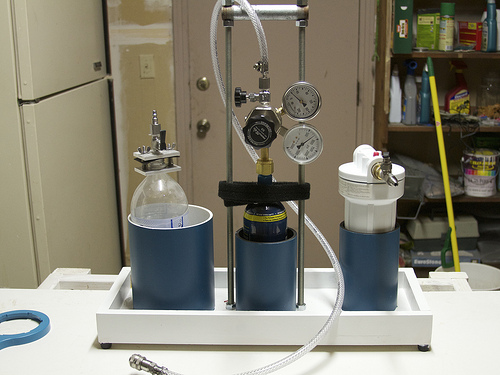
[Rich] over at Evil Mad Scientist Labs took it upon himself to make eating fruit a little more enjoyable for his kids by infusing it with CO2 using his CO2inator. Observing the same principles used in making soft drinks and force-carbed beer, he decided to build a CO2 pressure chamber for use in his kitchen. He gathered a handful of easy to find components to construct his rig, including a household water filter housing and a CO2 cylinder from a paintball gun. He has some helpful hints for those who are not familiar with the process, noting that refrigerated fruit absorbs the gas more quickly than warm, and that considering the water content of the fruit is important when selecting what to carbonate.

Once [Rich] had everything safely connected and checked for leaks, in went the fruit. After about half an hour to an hour, the fruit was carbonated, much to the delight of his children. This looks like a quick and fun project for adults and kids alike, that can easily fit into a busy weekend schedule.

[via Neatorama]
Punch Tape Musical Synth

synthanola

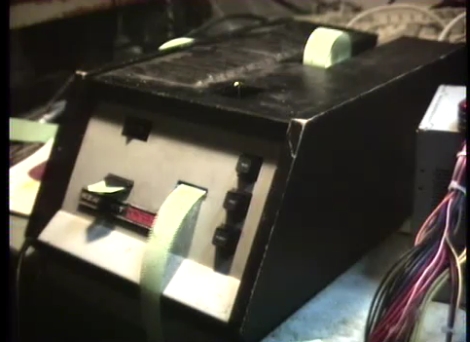
[Jeri Ellsworth] sent over a 555 design contest entry that struck her as particularly interesting. The Synthanola is a three-channel music synthesizer that accepts input from an old Heathkit paper tape reader. While this hack might seem overly retro, it’s actually an extremely appropriate use of technology, as the Heathkit H-10 and the 555 timer were both popular tech in the 70’s. This retro-focused synth uses fourteen 555 timers, twelve of which are dedicated to synthesizing audio. If this entry does not win the contest, it certainly must be a strong contender for most 555 timers used.

[Thrashbarg] gives a detailed explanation of the logic used to drive the music playback from the punch tape, as well as full circuit diagrams for his entry. So far he has encoded MP3s of Bach’s Invention and Fugue in D Minor to tape, with hopefully more to come. In order to truly appreciate his efforts, the Synthanola should be seen as well as heard. Stick around for a pair of videos of the synth in action.

If you’re interested in seeing more 555 contest entries, be sure to check out some of our previously featured projects.

Continue reading “Punch Tape Musical Synth”

Voice-controlled Rolling Robot

rolling_voice_controlled_robot

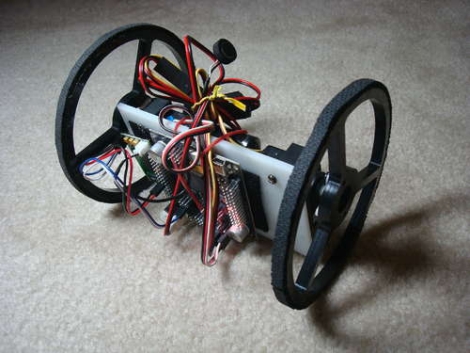
[societyofrobots] recently posted an Instructable on how to build a voice controlled robot in just a few hours time. This robot isn’t particularly cheap, weighing in at about $230, but it is a fun project if you have the means. The bot is driven around by a pair of servos, taking their directions from an Axon II MCU. A VRbot voice recognition module is used to listen for commands, enabling the user to record up to 32 custom triggers for directing the robot.

All of the source code for the robot is included, as well as instructions on how to get started programing the microcontroller. The code provides some basic functionality, but there’s likely plenty more that can be done with the powerful on-board ATmega460. While this robot would make for a great beginner/intermediate project as-is, it should be noted that [societyofrobots] manufactures and sells the Axon II, so this Instructable is half guide/half self-promotion. Have any of you had experience with the Axon II? Let us know what you think.

Keep reading to see a video of the build process as well as the robot doing its thing.

Thanks, [Bill Porter].

Continue reading “Voice-controlled Rolling Robot”

A-Z Of Electronics – Capacitors

a_to_z_electronics

[Jeri Ellsworth] recently released another video in her “A-Z of Electronics” series – this time Capacitors are the subject. As a penance for my boneheaded AC Capacitor suggestion yesterday (I swear it was lack of sleep talking), [Caleb] suggested that I be the one to write this article. Since I’m not an electrical engineer (I majored in Comp Sci), I enjoy watching these videos, and I share them with individuals who are new to electronics. [Jeri] always presents the subject matter in a clear and concise manner, so the subjects do not seem daunting or intimidating.

She briefly discusses the early development of capacitors, including Leyden Jars, then focuses on modern capacitors and their usage. She covers wiring capacitors in circuits, demonstrating the difference between series and parallel configurations, as well as how electrode distance affects capacitance.

If you have a spare minute, be sure to check out her current video as well as those she has previously released.

Screamer Doll Prank Toy

screamer_doll

While it is only the middle of February, it might be a good time to start thinking about your plans for April Fool’s day. [Dino’s] Screamer Doll is his submission to the upcoming 555 Contest.  This fun little circuit can be used to easily annoy your cube or house mates and is perfect for all of the April Fool’s day pranksters out there. He fit all the components into a small plastic toy, replacing the eyes and mouth of the doll with three photo cells, and swapping the nose out for a bright LED. When light hits the photo cells, a loud high-pitched squeal is emitted, and the LED blinks furiously until the light source is removed. Shielding the device from light will cause both the sound and LED to slow down, but the brightness of the LED ensures that the toy still makes noise when covered.

It would be great to see a version of this project that is completely silent in the dark, allowing it to be hidden at night, greeting its victims come morning.

If you want to see video of the device in action, read on – just be sure to keep your speaker volume at a reasonable level!

Continue reading “Screamer Doll Prank Toy”

Nimbus, The Wall-following Robot

nimbus_wall_following_robot

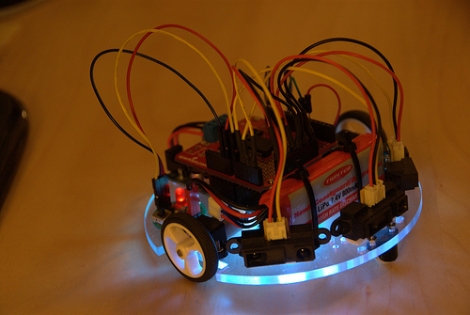
[Johannes] sent in the latest iteration of an ongoing project – Nimbus, the wall-follwing robot. Originally operating on a cardboard frame, the robot has undergone several revisions as you can see by reading through his blog. Nimbus started out as a simple, Arduino-powered robot, but the project has progressed nicely over time. The last revision simply avoided walls, using a Sharp IR proximity sensor to detect, then avoid obstacles. The most recent model sports a nice polycarbonate frame as well as two additional IR proximity sensors, allowing Nimbus to navigate quite well, following walls and avoiding obstacles with ease. It does get caught up from time to time on carpets and wires, but overall Nimbus is a great little robot. [Johannes] even added a small RGB status LED for the bottom of the bot, communicating its navigation status to the operator at all times. This is done by flashing various colors when objects have been discovered or have moved out of sight – it’s a really novel addition.

Keep reading for a video of Nimbus navigating his way around, and don’t forget to check out the Nimbus photo stream.

Continue reading “Nimbus, The Wall-following Robot”

IR-controlled Musical Alarm Clock

Music-Playing-Alarm-Clock

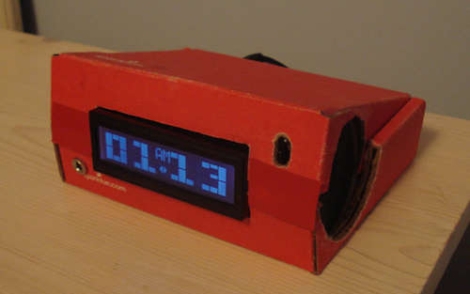
Forum user [Frank] shared with us his recent project, a musical alarm clock. More than just a simple alarm clock, his creation allows the user to load music onto a micro SD card, has alarm settings for each day of the week, and best of all, can be controlled using an IR remote. He uses a Teensy++ to control most of the clock’s functions including the display, delegating the time keeping to a DS1307 real-time clock. All of the audio playback is handled by a separate music decoder mounted on a breakout board.

His Instructables writeup is extremely detailed, with tons of annotations, pictures, diagrams, and source code available. He walks through each step in detail, making this a great learning guide for others looking to start in on AVR programming.

His final presentation is a great lesson in recycling, though unfortunately a bit lackluster, as the clock is packaged in an old SparkFun cardboard box. He does mention that there were some time constraints towards the end, which may explain this choice – it would be nice to see a revised version of this clock packaged in a nice plexi case.