diy_table_saw

DIY Table Saw Cuts Through Anything, Leaves No Room For Mistakes

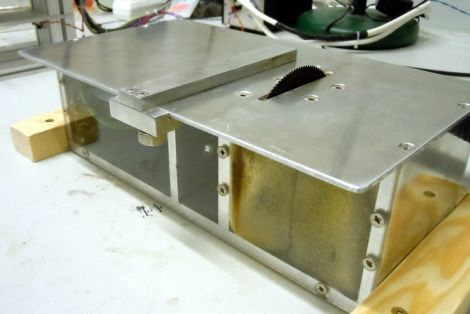
Students in the BASTLI lab at the Swiss Federal Institute of Technology Zurich had been stuck using underpowered and unreliable saws for quite some time. The saws often got stuck while cutting through PCBs and were generally a drag to use. When group member [Mario Mauerer] came across a big and powerful brushless motor in his basement, he decided it was time to upgrade the lab’s cutting tools.

Along with fellow student [Lukas Schrittwieser] he built a test rig to see how powerful the motor really was, and satisfied with the results, the pair set off to build their own table saw. The enclosure was wrapped up pretty quickly, leaving the pair to source a power supply. Rather than purchase one, they built a 700w monster switching PSU to power their saw.

As you can see in the video below the saw chews through most things with the greatest of ease, but the students added a “boost button” to the saw just in case they need to run it at full tilt.

While we can’t exactly overlook the lack of finger and eye protection in their demonstration, it does look like a great little tool to have around.

Continue reading “DIY Table Saw Cuts Through Anything, Leaves No Room For Mistakes”

Hacking And Rolling At The Red Bull Creation Challenge

red_bull_creation_challenge_badge

The crew over at the HarfordHackerspace used their wits and creativity to land a spot at the final round of Red Bull’s Creation challenge. The team arrived in Brooklyn just yesterday, ready to take on all comers in the 72-hour hacking challenge which kicked off earlier this morning.

Like any other hacker convention, the Red Bull challenge sports its own unique guest badges just begging to be poked, prodded, and otherwise fooled with. Once the team arrived in New York they were given theirs, and after the opening festivities came to a close, the hacking began. The badges were putting out what looked like Morse code messages via a single red LED, and while part of the team worked to record and decode the message, others started reverse engineering the badge’s on-board PIC.

They were successfully able to bypass the PIC’s fuses to read the code inside, and what they found was pretty funny. You will have to follow the link above to find out what it was, but rest assured, the Red Bull folks definitely have a decent sense of humor.

Play Dress Up With Kinect

kinect_virtual_dressing_room

While we have seen Kinect-based virtual dressing rooms before, the team at Arbuzz is taking a slightly different approach (Translation) to the digital dress up game. Rather than using flat images of clothes superimposed on the subject’s body, their solution uses full 3D models of the clothing to achieve the desired effect. This method allows them to create a more true to life experience, where the clothing follows the subject around, flowing naturally with the user’s movements.

Like many other Kinect hacks, they use openNI and NITE to obtain skeletal data from the sensor. The application itself was written in C# with Microsoft’s XNA game development tools, and uses a special physics engine to render the simulated cloth in a realistic fashion

[Lukasz] says that the system is still in its infancy, and will require plenty of work before they are completely happy with the results. From where we’re sitting, the demo video embedded below is pretty neat, even if it is a bit rough around the edges. We were particularly pleased to see the Xbox’s native Kinect interface put to work in a DIY project, and we are quite interested to see how things look once they put the final touches on it.

Continue reading “Play Dress Up With Kinect”

Use Bluetooth To Open Your Garage And Start Your Car Remotely

bluetooth_remote_garage_opener_and_car_starter

Instructables user [tcollinsworth] is a big fan of his Android smart phone. He practically carries it with him everywhere, so he figured it would be cool to integrate as many of his home electronics with the phone as possible. His garage door openers seemed like easy enough targets, and while he was in the garage, he decided to hack his car’s remote starter as well.

He put together a small circuit that allows him to trigger any device via an application called Daisy On/Off, made specifically for the Bluetooth board he selected. One set of pins were wired to the garage door opener’s terminals, and the other to his remote start key fob. Once he had everything connected up, he packaged his components in a project box courtesy of his MakerBot. With that finished, he put together a simple interface in the Daisy application which can start his car or open the garage with a single button press.

It should be mentioned that [tcollinsworth] works for Daisy, so the reasoning behind his choice of components and Android applications is an obvious one. That said, schematics for the Daisy Bluetooth board are available online and the device can be controlled using BlueTerm, so you can feel free to roll your own implementation if you wish.

Our only nagging thought is that the system should probably include a feedback circuit that relays messages to the phone, indicating that the door is indeed open and that the car has been started. Pocket dialing your car to start without opening the garage first would definitely be a bad thing.

Check out the video below to see the system in action.

Continue reading “Use Bluetooth To Open Your Garage And Start Your Car Remotely”

VFD Hacking

vfd_hacking

[Mostafa] was a bit bored and had a broken DVD player sitting around, so he decided to take it apart to see what made the machine’s LCD panel tick. Once he popped it open, he discovered it wasn’t an LCD panel at all, it was a VFD.

The seven segment display looked to be controlled by an ET16312n VFD driver, so he dug around online and found a datasheet for the chip. After looking at the documentation he was pretty confident he could get things working without too much trouble. He started tracing the board for the STB, CLK, Din, and Dout leads he needed to set up serial communications with the panel and was on his way in no time.

He hooked the panel up to the parallel port on his computer, and got busy hammering out some C code to write text to the display. Right now, the code lets you scroll text across the display, which is about as far as [Mostafa] cares to take it. It was done mostly as a proof of concept exercise, but since this VFD is compliant with the same NEC programming standard that most VFDs use, his code can likely be reused to drive any similar display with very little tweaking.

Moisture Control For A DIY Greenhouse

greenhouse_moisture_controller

[Clover] loves plant biology, and tends a small garden while she is at home during breaks from college. She says that her family is notoriously unreliable when it comes to caring for plants, so she decided to construct a greenhouse to ensure that her garden will still be around the next time she comes home.

With her raised bed garden built and her seeds planted, she started work on the greenhouse itself, which was constructed using PVC pipe and clear plastic sheeting. Satisfied with how the structure came out, she focused on the greenhouse’s watering system and moisture sensors. The watering system uses solenoids that are connected to a pair of Arduino regulated relays. The Arduino uses moisture sensors constructed from nails, triggering the water flow when things get too dry.

The controller along with its LCD status panel was mounted inside a bird house to protect it from the elements while keeping in line with the house’s decor. [Clover] seems pretty happy with the build, but we suspect she will be adding some temperature and regulation at some point, to facilitate longer growing cycles.

Check out the video below for a quick tour of her setup.

Continue reading “Moisture Control For A DIY Greenhouse”

Propeller-based Robot With Basic Object Avoidance

propeller_development_robot

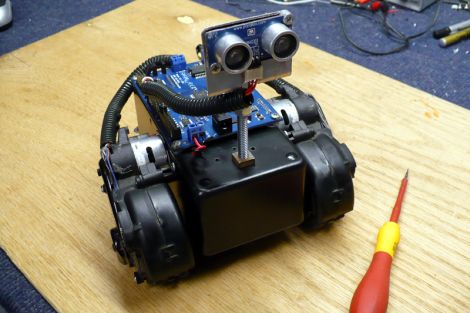
The Parallax Propeller is a pretty powerful MCU as [Dino] recently discovered in his latest Hack a Week installment. He wanted to build a simple robotics platform that he could use for testing out various sensors, and he figured he might as well learn about a different type of micro controller in the process.

He pieced together his robot using a pair of old Roomba motors he had sitting around, mounting them on a standard RadioShack project box. A Propeller MSR1 control board runs the show, and a Propeller PING sensor is used to get an idea of what the robot’s surroundings look like. He is an admitted newbie when it comes to using Propeller micro controllers, but [Dino] was able to give his robot some rudimentary object avoidance abilities fairly easily. A few small bugs aside, he had the robot up and running in short order, a testament to how easy it is to work with the Propeller platform.

Stick around to see a brief video covering the robot’s construction we have embedded below.

Continue reading “Propeller-based Robot With Basic Object Avoidance”