Robotic Schadenfreude – Quadrotor Blooper Reel

quadrotor_fail

While quadrotors might just become the killing machines of choice some time in the future, we’re pretty sure it will be awhile before they run amok and wipe humans off the face of the planet, if the following video is any indication.

The team over at UPenn’s GRASP Lab film everything they do when it comes to quadrotors for posterity’s sake. When your awesome job consists of directing quadrotors through all sorts of acrobatic hijinks however, mistakes are going to happen. Thankfully, the team doesn’t keep these a secret, and while we’re typically wowed by what these flying machines can do, it’s also pretty fun to see them fail in such spectacular fashion.

If you have a spare minute, kick back, fire up the video, and enjoy the mechanical mayhem that ensues. We certainly sleep better at night knowing that while these things are awesome, a well-placed hula hoop is all it takes to ensure continued human supremacy.

Continue reading “Robotic Schadenfreude – Quadrotor Blooper Reel”
Not Your Ordinary LED Book Light

diy_led_book_light

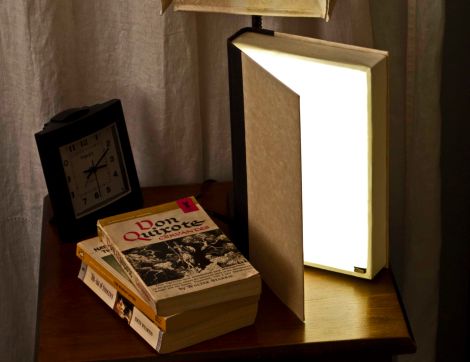
[Steve Hoefer] is not a huge fan of traditional table lamps, so he set off to build a reading light of his own that was more aesthetically pleasing than the standard fare. He thought it would be pretty appropriate to construct his reading lamp out of a book, and we’re inclined to agree.

He stripped the pages from an old book he found at the thrift store, then built a plywood frame to fill in the recently vacated area. A second frame was built inside the first to support the installation of some warm LED strips as well as the acrylic sheet he used to diffuse the light. A whisker switch was installed in the corner of the frame, which turns the lights on when the book is opened. The lamp puts out about the light equivalent of a 40W bulb, and can be “dimmed” by simply adjusting how far the cover is opened.

It looks great on his bedside table, and like some of his other book-related hacks, it’s quite useful as well!

Be sure to check out the video of the light’s construction we have embedded below.

Continue reading “Not Your Ordinary LED Book Light”

poor_mans_peltier_air_conditioner

Poor Man’s Peltier Air Conditioner

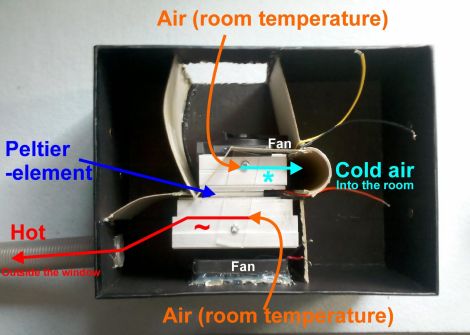
It’s summer in Germany, and [Valentin’s] room was getting hotter than he could handle. Tired of suffering through the heat, and with his always-on PC not helping matters any, he decided that he must do something to supplement his home’s air conditioner. The result of his labor is the single room poor man’s A/C unit you see above.

He had a spare Peltier cooler sitting around, so he put it to good use as the basis for his air conditioning unit. He sandwiched it between a pair of CPU heatsinks before cramming his makeshift heat pump into a shoe box. Warm air is drawn into the box and across the cold side of the Peltier before being blown back into the room. On the hot side of the box air is also pulled in by a fan, drawing heat away from the unit before being exhausted outdoors through his window.

While he hasn’t quantified the machine’s cooling power, he seems quite happy with the results. We have a spare Peltier kicking around here somewhere, perhaps we should try building one just for grins.

A MAME Cabinet Fit For A Doctor (Who)

tardis_mame_console

While many people would be satisfied leaving a MAME console on their desk, others take the time to put their MAME creations in a nice, authentic arcade cabinet. Some people like [Simon Jansen] take the craft to a whole new level, crafting a TARDIS from the ground up in order to house a MAME console.

It all started with a computer that had no real purpose. [Simon] decided it would be great to use as a MAME console, so he started brainstorming ideas for an enclosure. As he tells it, he was staring out a window looking for inspiration when his eye caught a giant billboard for [Dr. Who], complete with a TARDIS. The rest was history.

The MAME cabinet is about 3/4 the size of an on-set TARDIS, and crafted mostly from MDF. Plenty of time was spent analyzing the different TARDIS designs featured on the show over the years, paying special attention to even the smallest of details. Once the construction of the TARDIS was complete, [Simon] started work on the MAME portion of the project.

His MAME console was built to completely fit inside the TARDIS when closed, but it also had to take into account the box’s inward folding doors, which take up a good bit of space. The base was also made from MDF, and includes a durable white plastic panel in which the controls are mounted.

The final result is amazing – it does the TARDIS justice, and it looks like plenty of fun to play as well.

Boobie Board Powered Twitter Notifier

boobie_board_twitter_notifier

The team over at Archonix frequently challenge themselves to create a full working project in under 20 minutes. [Andrew Armstrong] put together a blog post detailing their most recent “Quickproject” – a simple Twitter notifier built using their Boobie Board.

They started by putting together a small notifier breakout module that could later be attached to their Boobie Board. The module is pretty simple and includes a trio of LEDs to alert you to activity across several online services, though only the Twitter notification module is currently complete. The notifier’s code was written in LUA, and primarily designed to interact with Linux desktops. They do not currently have a Windows compatible version of the code available, but they are more than happy to host it if someone desires to port their code over.

The notifier was put into an old candy tin with a plastic window, which is perfect fit for their project. All in all, the entire thing took them about 40 minutes, with half spent on hardware, half on code. The notifier does just what it was intended to do, but they have a healthy list of improvements that they would like to add, including the use of the other two notifier LEDs.

New Conductive Ink Allows Circuit Prototyping With A Pen And Paper

roller_ball_circuit_drawing

Why spend time etching circuit boards and applying solder masks when all you really need is a rollerball pen and some paper? That’s what University of Illinois professors [Jennifer Lewis and Jennifer Bernhard] were asking when they set off to research the possibility of putting conductive ink into a standard rollerball pen.

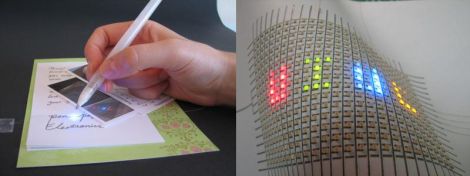
The product of their research is a silver nanoparticle-based ink that remains liquid while inside a pen, but dries on contact once it is applied to a porous surface such as paper. Once dry, the ink can be used to conduct electricity just like a copper trace on a circuit board, making on the fly circuit building a breeze.

Previous ink-based circuit construction was typically done using inkjet printers or airbrushing, so removing the extra hardware from the process is a huge step forward. The team even has some news for those people that think the writable ink won’t hold up in the long run. The ink is surprisingly quite resilient to physical manipulation, and they found that it took folding the paper substrate several thousand times before their ink pathways started to fail.

While we know this is no substitute for a nicely etched board, it would be pretty cool to prototype a simple circuit just by drawing out the connections on a piece of paper – we can’t wait to see this come to market.