Making Airsoft Guns Far More Potent

airsoft_laser_rifle

[Drake] wrote in to share his recent project, which involves repurposing an Airsoft rifle that was sitting around, collecting dust. Airsoft guns as a whole are not all that impressive, but convert your Airsoft gun into a laser rifle, and we’re all ears.

His laser blaster is honestly pretty straightforward as far as laser projects go, but we just couldn’t resist. He pulled apart the Airsoft gun, removing all of the “airy” bits, leaving just the trigger behind. He added a 9v battery and a linear power supply to the gun, wiring them up to a 700mW laser diode from what we hope was a broken Blu-ray burner.

In the obligatory “look at what I can destroy with my laser gun” video embedded below, [Drake] shows off his gun’s potency at various ranges, popping balloons from 35 feet away. He even shows off the laser’s usefulness as a light pen for glow in the dark surfaces.

While his modifications are nothing we haven’t seen before, his gun is far more accessible than others we have featured.

Have any cool high-powered laser projects of your own? Share them with us in the comments.

Continue reading “Making Airsoft Guns Far More Potent”

The Engineering Guy Explains Fiber Optics

engineering_guy_fiber_optics

[Bill the “Engineer Guy” Hammack] is back with another lesson in the science behind the technology we know and love, but might not fully understand. This time around he discusses fiber optic cabling and how it is used to relay data across distances both small and large.

He starts off by showing how laser light can be easily transmitted from one end of an audio-grade fiber optic cable to the other. To show us how this is accomplished, he sets up a simple table top demonstration involving a bucket, some propylene glycol, and a green laser pointer. The bucket has been modified to include a clear window at one side and a spout at the other. The laser is carefully lined up, and when the spout is unplugged, a steady stream of propylene glycol is released into a second bucket. As [Bill] explains, the laser stays within the stream of fluid due to total internal reflection, and can be seen shining in the second bucket.

[Bill] also discusses how fiber optics were employed in the first transatlantic telecommunications cable, as well as how pulse code modulation was used to send analog voice data over the undersea digital link.

As always, [Bill’s] video is as entertaining as it is enlightening, so be sure to check it out below.

Continue reading “The Engineering Guy Explains Fiber Optics”

Roomba Shares All Of Its Daily Activity On The Web

tweeting_roomba

Instructables user [matchlighter] wanted to see what he could program his Roomba to do, so he decided he would make his little cleaning machine report its status on Twitter whenever something happened.

He popped open the Roomba’s case to access its serial connector, crafting a simple interface cable from some spare Cat5 he had sitting around. He added a small voltage regulator between the Roomba and his Arduino in order to protect it from the high power output present while the Roomba is charging. Once the proper bits were in place, he hooked the Roomba’s serial interface to the Arduino and attached a SparkFun WiFly shield to allow for wireless communications. After a bit of coding, the Roomba was sharing its activities with the entire world on Twitter.

Not only did he want the Roomba to tweet, but he decided that he also wanted the ability to control it from the web. He created a simple interface using a handy library he found online and was sending cleaning commands to the Roomba in short order.

While there is no video of the Roomba in action, you can check out what it is up to here, and there’s plenty of code to be had on his Instructables page.

Turning Spotlights Into Soft LED Nightlights

led_spotlight_retrofit

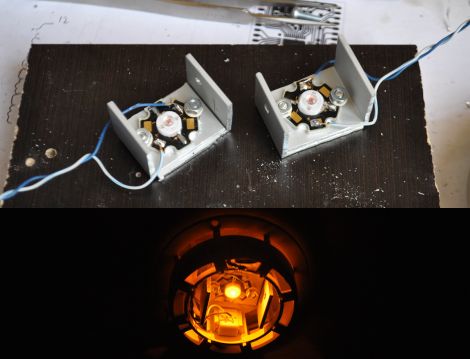
[Bob] had a couple of bright, 12V halogen spotlights in his hallway that didn’t get much use. Rather than toss them out or leave them sitting idle, he decided to replace the bright bulbs with dimmer LEDs that he could keep lit through the night.

He opened up the spotlights, removing the bulbs and the built in mirrors before fitting them with 350mA LED pucks. The pucks were mounted to a pair of L-shaped aluminum scraps, which serve as both a mounting plate and heatsink. When running, the underdriven LEDs barely heat the aluminum plates, so he is pretty confident that the lights are adequately cooled.

The orange LEDs provide a nice warm glow in his hallway, and he says they are perfect for late night trips to the fridge. They currently stay lit all the time, but [Bob] is considering adding a light sensor to turn them on them automatically, as well as a PIR sensor to increase the brightness as someone passes by.

DIY Softboxes Light Your Photos On The Cheap

diy_softboxes

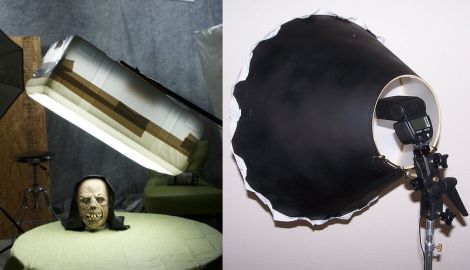
Softboxes are often considered a must-have piece of equipment when doing any sort of portrait or studio photography. While they are not the most expensive photography accessory, they can be built far cheaper than you would pay for an off the shelf model.

[Don] needed a softbox for his studio, and he ended up constructing a fairly nice one out of a styrofoam cooler. He mounted an outdoor light receptacle inside the cooler after laying down a reflective backing, bolting everything to a piece of plywood situated on the back of the cooler. He stretched some white cloth over the front to diffuse the light, and then mounted it on a light stand. You can see a video of the construction process below, as well as additional softbox-lit images on his site.

[Aud1073cH] had a similar need for a softbox, but went about his construction a bit differently. He grabbed a lampshade and a white dress shirt at a thrift store, stretching the shirt over the bottom opening before securing it with Velcro. He mounted the lampshade on a light stand, inserting his camera’s speed light through the smaller lampshade opening. As you can see in his photostream, the softbox does a great job at softening the shadows in his pictures.

Continue reading “DIY Softboxes Light Your Photos On The Cheap”

Salvaged Coil Magnetizes Tools On Demand

magnetizing_wand

When working in hard to reach areas, magnetized tools can mean the difference between wrapping things up quickly and spending way too much time blindly grasping for dropped screws. [Damir] wrote in to share a handy little contraption he built which allows him to magnetize and demagnetize his tools as needed.

While rubbing a magnet against the tip of a screwdriver will impart a weak and temporary magnetic field, he felt that a stronger more permanently magnetized tool was far more useful. It is pretty well known that subjecting metal to a direct current magnetic field will magnetize the item, and an alternating magnetic field will demagnetize the same object. [Damir’s] wand will perform either task with the simple flip of a switch.

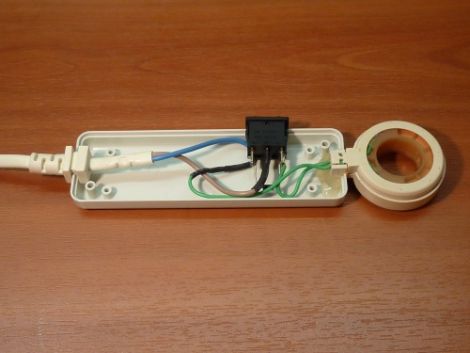
He salvaged the motor coil from a broken washing machine and mounted it in a project box, along with a single-pole changeover switch. A small diode is used to perform rectification on the AC input, providing the DC current required for magnetizing his tools.

Every once in awhile we find the need for magnetized tools, so we think this would be great to have around the workshop.

Check out a quick video demo of the magnetizing wand after the jump.

Continue reading “Salvaged Coil Magnetizes Tools On Demand”

Electronic Cufflinks For The Discerning Hacker

icufflinks

[Phillip Torrone] gave us a heads up about a project he and [Limor Fried] along with [Mike Doell] have just wrapped up. Their aptly-named “iCufflinks” softly pulsate with light the same way in which you see many Mac products do.

The cufflinks are made from machined aluminum and have the ubiquitous “power symbol” milled into the face. Inside the cufflinks, you will find a small circuit board and a battery, which powers the device for up to 24 hours. The team reverse-engineered the soft LED pulse found in Mac products in order to deliver the exact same visualization in their cufflinks.

Ignoring for a minute, the name and the inspiration for the product, we think they are pretty darn cool. There’s nothing like a set of softly glowing cufflinks to spark conversation at any social gathering.

Like anything else you’ll find on Adafruit.com, the cufflinks are completely open source, so you can feel free to tweak and remix the design any way you’d like.

Continue reading to see a video of the cufflinks in action.

Continue reading “Electronic Cufflinks For The Discerning Hacker”