Sinister Tone Generator Brings The Bass

sinster_tone_generator

[RichDecibels] wrote in to share a new device he built called the “Sinster Tone Generator”. It’s basically a bass drone synthesizer that uses two pairs of heterodyning oscillators to generate the output. If you swing by his site, he has a long audio demo of the device in action with a bit of reverb and filtering applied to enhance the sound. After listening, we agree that it sounds pretty sinister!

The device is relatively small and handsomely packaged in a plastic project box he had custom cut by Ponoko. [Rich] says that this particular unit is a one-off that he has produced for a charity auction, and that bidding is open through Sunday if you really want to get your hands on it. If you happen to have the time to build one yourself, he has uploaded schematics and layout files to his site (as usual), so feel free to stop by and grab a copy.

Radio Packets…from Spaaaace!

space_radio

[Bill Meara] was watching the International Space Station and the Shuttle Discovery pass overhead a few weeks ago, which rekindled an interest he gave up long ago – sending and receiving radio packets from space.

Years ago, he used to send APRS packets into space with a small rig powered by a 286 computer and HandiTalkie. These packets would drift off into space most of the time, but occasionally they would bounce back to Earth whenever the space station or PC Sat would fly by. The packets were often captured by other ham operators across the globe, who happened to be tuned to 145.825 MHz.

His interest renewed, he dug out his old HandieTalkie and Kantronics Terminal Node, aiming them towards the sky via an antenna situated in his back yard. When he returned 10 hours later, he found that he had collected all sorts of “space packets” from across the globe.

While not exactly a hack, it is definitely a neat exercise in ham radio operation. We can imagine slinging data packets off the space station would be an exciting experience for any budding operator (and OMs as well!)

A Keygen For The Real World

key_generator

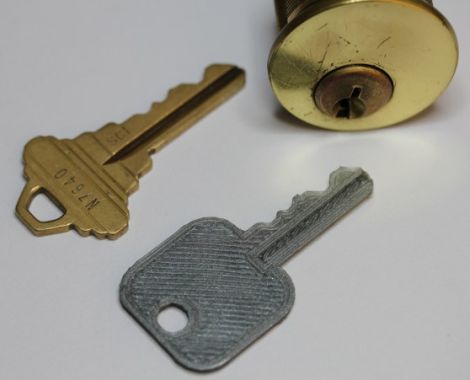
[Nirav] found that he rarely printed anything useful with his RepRap, so to shake things up, he decided he needed to work on a project that didn’t involve printing yet more RepRap parts.

The goal of his project was to create working replicas of house keys by simply using the code imprinted at the factory. He purchased a handful of used lock sets from eBay, then carefully measured the keys with a ruler and calipers to get the blank dimensions just right. After that was done, he looked around online and was eventually able to create an OpenSCAD model using a chart of pin depth specifications he located. By changing the last line in the model’s code he can print any coded key. For keys lacking a code, he can manually measure the height of each bit and print replicas that way as well. Once printed, he says that they keys are strong enough to turn most locks he has come across, including deadbolts.

This is undoubtedly a neat project in its own right, though we would be interested to see if someone could get it paired with a program like SNEAKEY to generate bit measurements by sight alone.

easytransfer_serial_arduino_communications_library

Library Makes Arduino To Arduino Serial Communications Dead Simple

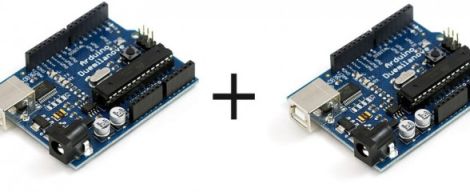
When [Bill Porter] works on a project, he says that he typically writes his own NMEA standard communications protocols to fit the job at hand. While it makes things easy to troubleshoot, he admits that his custom protocols are wasteful of both processor time and bandwidth. Binary communications on the other hand are more efficient, but a bit trickier to manage.

To make things easy for the common user, he wrote a library called EasyTransfer which abstracts packetized serial communications between two Arduino boards. The process is pretty simple – all one has to do is define a data structure on both Arduino boards so that they know what sort of data is coming over the wire, and EasyTransfer handles the rest. This allows users to worry less about communications protocols or transmission errors, and focus on their projects instead.

If you’re working on a project and searching for an easy way to get a pair of Arduinos talking, swing by his site and grab the library. It doesn’t get much easier.

Laser-powered DSLR Auto Focus Assist Light

laser_af_assist

[Adrian] uses his Canon 40D quite often in dark or low-light situations, and found the onboard auto focus assist functionality to be a bit frustrating. In certain focus modes, the auto focus assist light is programmed to turn off once focus has been achieved. He noticed that if his subject moves or the focus point changes before he snaps the picture, the AF light does not come back on to assist in refocusing the image.

To work around this problem, he decided to build a supplemental auto focus assist light that could be triggered at will. He purchased a cheap laser pointer with an adjustable lens, then cut it open to get at the good parts. He mounted it on top of his camera and tweaked the lens to produce an unfocused beam of light that measures about 6” x 12” at five feet.

The laser pointer did the trick – his images are coming out much nicer now that he can easily recompose his shots in low light. While it works great, he’s not completely satisfied with the build, especially with the fact that he has to manually trigger the laser pointer.

Version 2 is in the works however, which employs an old hot shoe to trigger the laser whenever he pushes the shutter release halfway down. According to his blog he is having some timing issues, causing him to capture the laser in most of the pictures he takes. [Adrian] is working hard to correct the problem, and we’re sure he’d appreciate any tips you might have.

reverse_engineering_firmware

Reverse Engineering Embedded Device Firmware

While not necessarily an easy thing to learn, the ability to reverse engineer embedded device firmware is an incredibly useful skill. Reverse engineering firmware allows you to analyze a device for bugs and vulnerabilities, as well as gives you the opportunity to add features if you happen to be so inclined. When it comes to things such as jailbroken iPhones, Android phones, and Nooks, you can guarantee that a close look at the firmware helped to move the process along.

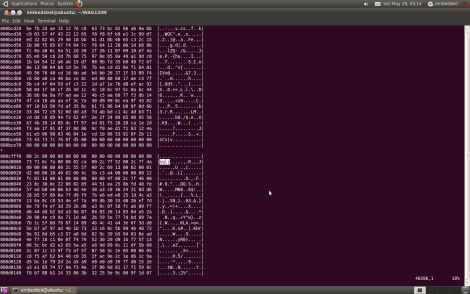
[Craig] works with embedded systems quite frequently and put together a detailed walkthrough demonstrating how he reverse engineers device firmware. The subject of his hacking was a new firmware package he obtained for a Linksys WWAG120 Wireless-N router.

His tutorial walks through some of the most common reverse engineering methods and tools, which allow him to slowly unravel the firmware’s secrets. When finished, he had a working copy of the router’s boot loader, kernel, and file system – all ready to be further analyzed. His writeup includes tons of additional details, so be sure to swing by his site if reverse engineering is something you are interested in.

Hackaday Links: Monday, May 30th

Huge, fully functional NES game pad replica
huge_nes_pad

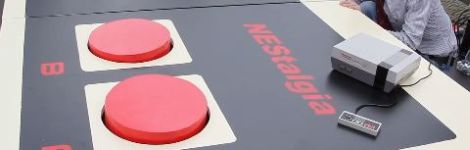
Students at Dutch TU Delft university recently built a huge replica of the original NES controller (Google Translation), which is fully functional and can be used to play games on a large display screen they also installed. How big is it, you ask? It’s about 6 meters wide – over 30 times the size of the original NES game pad and requires participants to jump on the buttons to play.


Convert any image to G-code
bitmap_to_gcode

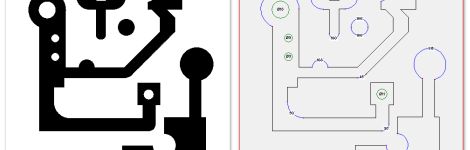
Members of [Forskningsavdelningen], a Swedish hackerspace, are working on software that will allow users to vectorize bitmap images in order to convert them to G-code files for CNC milling. A good portion of the project is complete, but there is still a bit of work to do, so you won’t see it in action for a while. When it’s ready, we’ll be sure to let you know.


Convert your lame Dead Space plasma cutter into a bonafide laser weapon

dead_space_laser

If you forked out big bucks for the special edition of Dead Space 2, you know how lame the included plasma cutter replica is. Check out this video, that shows you how to convert your LED toy to a dual laser, fire starting, laser pistol. The process is pretty simple, so what are you waiting for?


Synchronized, LED-lit juggling balls

led_balls

[Jonathan] wrote in to share a project he and some friends have just finished. He’s not sharing a ton of details at the moment, but he has put up a video showing off their wireless LED juggling balls. All we know is that they use bright RGB LEDS, Zigbees for communication, and that they are awesome. We can’t wait to hear more about them!


Water cooled PS3 Laptop

watercooled_ps3

[Pirate] recently unveiled his latest work, a water-cooled Playstation 3 laptop. It looks pretty sharp, and can undoubtedly rival some of Ben Heck’s work, even if it does have an external PSU. Obviously having a separate power component isn’t necessarily ideal, but when you are cramming all of that water cooling goodness into such a small package, something has to give!