In Praise Of Plasma TVs

I’m sitting in front of an old Sayno Plasma TV as I write this on my media PC. It’s not a productivity machine, by any means, but the screen has the resolution to do it so I started this document to prove a point. That point? Plasma TVs are awesome.

Always the Bridesmaid, Never the Bride

An Egyptian god might see pixels on an 8K panel, but we puny mortals won’t. Image “Horus Eye 2” by [Jeff Dahl]
The full-colour plasma screens that were used as TVs in the 2000s are an awkward technological cul-de-sac. Everyone knows and loves CRTs for the obvious benefits they offer– bright colours, low latency, and scanlines to properly blur pixel art. Modern OLEDs have more resolution than the Eye of Horus, never mind your puny human orbs, and barely sip power compared to their forbearers. Plasma, though? Not old enough to be retro-cool, not new enough to be high-tech, plasma displays are sadly forgotten.

It’s funny, because I firmly believe that without plasma displays, CRTs would have never gone away. Perhaps for that I should hate them, but it’s for the very reasons that Plasma won out over HD-CRTs in the market place that I love them.

What You Get When You Get a Plasma TV

I didn’t used to love Plasma TVs. Until a few years ago, I thought of them like you probably do: clunky, heavy, power-hungry, first-gen flatscreens that were properly consigned to the dustbin of history. Then I bought a house.

The house came with a free TV– a big plasma display in the basement. It was left there for two reasons: it was worthless on the open market and it weighed a tonne. I could take it off the wall by myself, but I could feel the ghost of OSHA past frowning at me when I did. Hauling it up the stairs? Yeah, I’d need a buddy for that… and it was 2020. By the time I was organizing the basement, we’d just gone into lockdown, and buddies were hard to come by. So I put it back on the wall, plugged in my laptop, and turned it on.

I was gobsmacked. It looked exactly like a CRT– a giant, totally flat CRT in glorious 1080p. When I stepped to the side, it struck me again: like a CRT, the viewing angle is “yes”. Continue reading “In Praise Of Plasma TVs” →

Supersized Calculator Brings The Whole Intel 4004 Gang Together

Though mobile devices and Apple Silicon have seen ARM-64 explode across the world, there’s still decent odds you’re reading this on a device with an x86 processor — the direct descendant of the world’s first civilian microprocessor, the Intel 4004. The 4004 wasn’t much good on its own, however, which is why [Klaus Scheffler] and [Lajos Kintli] have produced super-sized discrete chips of the 4001 ROM, 4002 RAM, and 4003 shift register to replicate a 1970s calculator at 10x the size and double the speed, all in time for the 4004’s 50th anniversary.

We featured this project a couple of years back, when it was just a lonely microprocessor. Adding the other MSC-4 series chips enabled the pair to faithfully reproduce the logic of a Busicom 141-PF calculator, the very first to market with Intel’s now-legendary microprocessor. Indeed, this calculator is the raison d’etre for the 4004: Busicom commissioned the whole Micro-Computer System 4-bit (MCS-4) set of chips specifically for this calculator. Only later, once they realized what they had made, did Intel buy the rights back from the Japanese calculator company, and the rest, as they say, is history.

Continue reading “Supersized Calculator Brings The Whole Intel 4004 Gang Together” →

The Simplest Ultrasound Sensor Module, Minus The Module

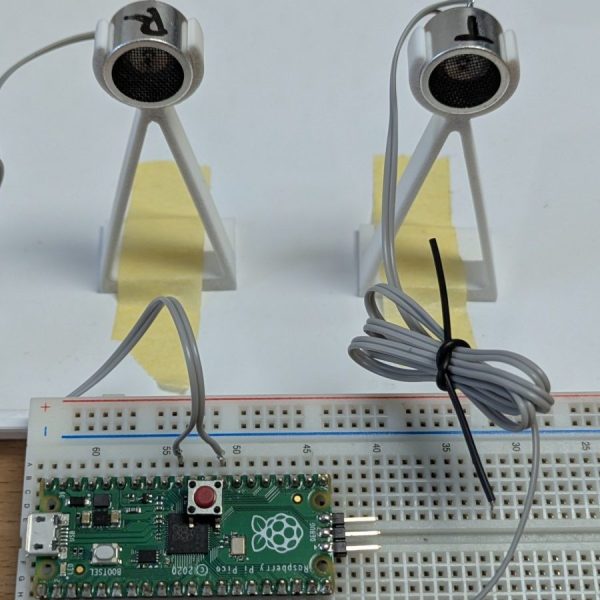
Just about every “getting started with microcontrollers” kit, Arduino or otherwise, includes an ultrasonic distance sensor module. Given the power of microcontrollers these days, it was only a matter of time before someone asked: “Could I do better without the module?” Well, [Martin Pittermann] asked, and his answer, at least with the Pi Pico, is a resounding “Yes”. A micro and a couple of transducers can offer a better view of the world.

The project isn’t really about removing the extra circuitry on the SR-HC0, since there really isn’t that much to start. [Martin] wanted to know just how far he could push ultrasound scanning technology using RADAR signal processing techniques. Instead of bat-like chirps, [Martin] is using something called Frequency-Modulated Continuous Wave, which comes from RADAR and is exactly what it sounds like. The transmitter emits a continuous carrier wave with a varying frequency modulation, and the received wave is compared to see when it must have been sent. That gives you the time of flight, and the usual math gives you a distance.

Continue reading “The Simplest Ultrasound Sensor Module, Minus The Module” →

The Fastest (68k) Macintosh Might Not Be An Amiga Anymore

Amiga and Atari fans used to lord over their Apple-eating brethren the fact that Cupertino never moved to the most advanced 68k processors — so for a while, thanks to 68060 accelerator cards, the fastest thing running Macintosh software was an Amiga (or Atari). After all these years, the Macintosh community is finally getting the last laugh, as [zigzagjoe] demonstrates an actual Macintosh booting with a 68060 CPU for the first time in a thread on 68KMLA. Video or it didn’t happen? Check it out below.

The Mac in question is a Quadra 650, which is a good choice since it was about the last thing Apple sold before switching to PowerPC, and ran the 68040 processor. [Reinauer] had already produced a 68040-to-68060 socket adapter (the two chips not being pinout compatible), so the hardware part of the battle was already set. Software, however? That was a different story, and where [zigzagjoe] put in the effort.

Continue reading “The Fastest (68k) Macintosh Might Not Be An Amiga Anymore” →

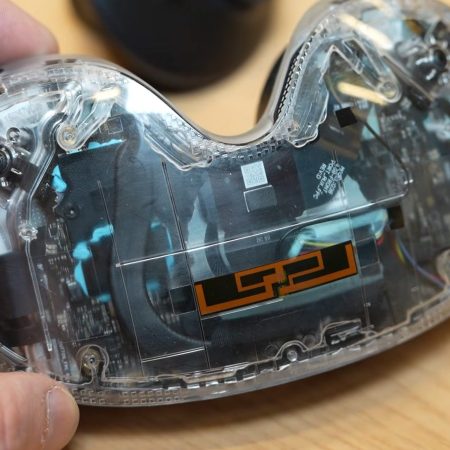
A closeup of a transparent-bodied example of the new Steam Frame VR headset

The Engineering Behind Valve’s New VR Headset

Valve’s new Steam Frame is what all the well-connected YouTubers are talking about, but most of them are talking about what it’s like to game on it. That’s great content if you’re into it, but not exactly fodder for Hackaday — with one exception. [Gamers Nexus] gives us a half hour of relatively-unedited footage of them just chatting with the engineers behind the hardware.

It’s great stuff right from the get-go: they start with how thermal management drove the PCB design, and put the SoC on the “back” of the chip, sandwiched betwixt heat pipes. We don’t usually think of taking heat through the PCB when building a board, so it’s a neat detail to learn about before these things get into the hands of the usual suspects who will doubtless give us teardown videos in a few months.

From there wanders to power delivery — getting the voltage regulators packaged properly was a challenge, since impedance requirements meant a very tight layout. Anyone who has worked on this kind of SBC might be familiar with that issue, but for those looking in from the outside, it’s a fascinating glimpse at electrical sausage being made. That’s just the first half.

The heat-regulation conversation is partially repeated the next conversation (which seems to have happened first) where they get into the cooling requirements of the LCD screens. This requires less than you might think, as they like to run warm for fast refresh. It’s really more about keeping your face cool. They also they discuss acoustic vibration — you don’t want your integrated audio shaking your IMUs apart — and why the prototype was being blasted with freakin’ laser beams to monitor it.

If you haven’t seen or read any other coverage on the Steam Frame, you’re going to miss some context here, but if you’ve not hid under a rock for that announcement, this is amazing detail to have. We’re hugely impressed that Valve let their engineers out of their cubicle-cave to talk to media.

Sure, it’s not an open-source VR headset, but compared to the deafening silence coming from the likes of Meta, this level of information is still awesome to have.

Continue reading “The Engineering Behind Valve’s New VR Headset” →

EVTOL For Everyone

While most of the world’s venture capital is off chasing anything with “AI” in the name in what many think looks increasingly like an inflated spherical film of soap molecules, in aviation all the hot money is betting on eVTOL: electric vertical take off and landing.

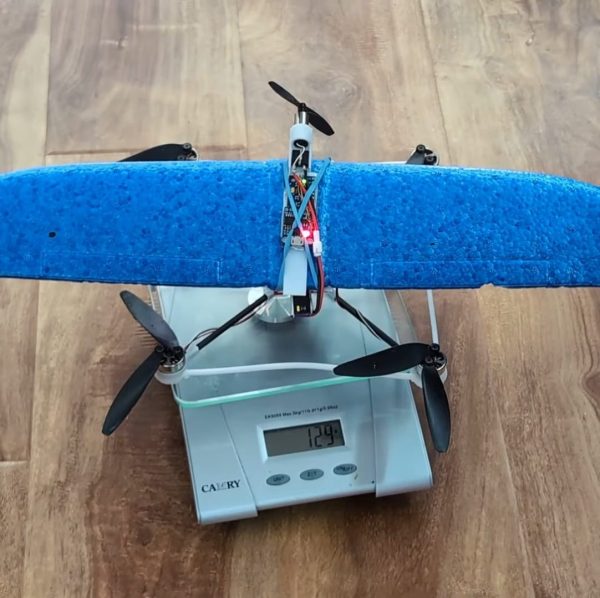
What if you want to get in on the eVTOL game but don’t have (or want) billionaire backing? Long-time contributor [spiritplumber] demonstrates how to do it on the cheap, with a low-cost quadcopter and a foam wing called Lift5. 

Most eVTOL isn’t just quadcopters, after all — multirotors are great for playing with in the back yard, but their thrust-based lift makes for short range, and the engine-out options are all bad. Add a wing, and you can get that sweet, sweet dynamic lift. Add an extra, forward facing motor, and you can get thrust in the direction you need it most. That’s what [spiritplumber] is doing here: strapping a foam wing to a cheap quadcopter. Specifically, his custom frame for an Eiele F120 drone kit.You can see it in action in the demo video embedded below.

The wing and its forward thrust motor are equipped with its own speed controller, so the concept should be adaptable to just about any little drone. Quadcopter flight computers are mostly going to be able to compensate for the added lift and thrust automatically, which is neat, considering that these forces would require some bizarre headwind/updraft very unlikely to be found in nature.

Now the wing does add a lot of drag during the lift phase, to be sure, so [spiritplumber] is working on folding or tilting it out of the way, but that version is apparently inordinately fond of trees. Once the control issues are worked out you’ll likely see it on his site and YouTube channel Robots Everywhere.

[spiritplumber] has been contributing hacks here at least since 2009, when he showed us how to make a Macbook right click.

Continue reading “EVTOL For Everyone” →

Intel GPUs On Raspberry Pi Is So Wrong It Feels Right

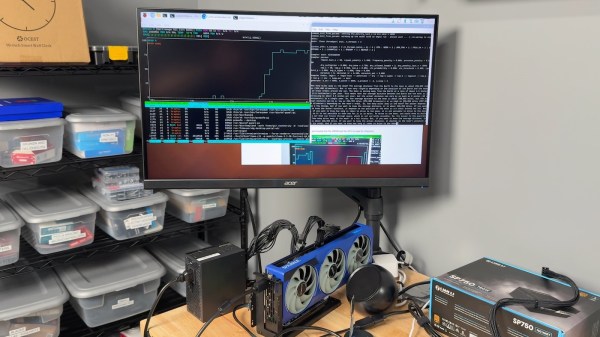
While you might not know it from their market share, Intel makes some fine GPUs. Putting one in a PC with an AMD processor already feels a bit naughty, but AMD’s x86 processors still ultimately trace their lineage all the way back to Intel’s original 4004. Putting that same Intel GPU into a system with an ARM processor, like a Raspberry Pi, or even better, a RISC V SBC? Why, that seems downright deviant, and absolutely hack-y. [Jeff Geerling] shares our love of the bizarre, and has been working tirelessly to get a solid how-to guide written so we can all flout the laws of god and man together.

According to [Jeff], all of Intel’s GPUs should work, though not yet flawlessly. In terms of 3D acceleration, OpenGL works well, but Vulkan renders are going to get texture artifacts if they get textures at all. The desktop has artifacts, and so do images; see for yourself in the video embedded below. Large language models are restricted to the not-so-large, due to memory addressing issues. ARM and RISC V both handle memory somewhat differently than x86 systems, and apparently the difference matters. Continue reading “Intel GPUs On Raspberry Pi Is So Wrong It Feels Right” →