Windows 95 On PlayStation 2 Works As Well As You Expected

When you hear “PS2” and “Windows 95,” you probably think someone forgot a slash and are talking about peripherals, but no — this hack is very much about the Sony PlayStation 2, the best-selling game console of all time. [MeraByte] walks us through the possibly ridiculous task of installing Windows 95 on the last hardware anyone at Microsoft would ever endorse in a video you can watch below.

Obviously, the MIPS-based Emotion Engine at the heart of the PS2 is not going to be able to handle x86 instructions Win95 is expecting, but that’s all solved by the magic of emulation. [MeraByte] is running a version of Bochs, an x86 emulator that has been built for PS/2 after trying and failing to install Windows (both 3.1 and 95) to an experimental DOSBox build.

As expected, it is not a smooth journey for [MeraByte], but the flailing about and troubleshooting make for entertaining viewing. Once loaded, it works surprisingly well, in that anything works at all. Unfortunately, neither the mouse nor Ultimate Doom 95 worked. We suppose that ultimately means that this hack fails since even Doom can run Doom. The mouse thing is also important, probably.

If you have a PlayStation 2, maybe skip Windows 95 and try running GoLang.  If you do have DOOM running on the PlayStation 2, send us a tip. There was never an official release for PS2, but after 26 years, someone must have done it by now. Continue reading “Windows 95 On PlayStation 2 Works As Well As You Expected” →

GEEKDeck Is A SteamDeck For Your Living Room

You know what the worst thing about the Steam Deck is? Being able to play your games on the go. Wouldn’t it be better if it was a screenless brick that lived under your TV? Well, maybe not, but at least one person thought so, because [Interfacing Linux] has created the GeekDeck, a Steam OS console of sorts in this video embedded below.

The hack is as simple as can be: he took a GEEKOM A5, a minicomputer with very similar specs to the Steam Deck, and managed to load SteamOS onto it. We were expecting that to be a trial that took most of the video’s runtime, but no! Everything just… sorta worked. It booted to a live environment and installed like any other Linux. Which was unexpected, but Steam has released SteamOS for PC. 

In case you weren’t aware, SteamOS is an immutable distribution based on Arch Linux. Arch of course has all the drivers to run on… well, any modern PC, but it’s the immutable part that we were expecting to cause problems. Immutable distributions are locked down in a similar manner to Mac OS (everything but /home/ is typically read-only, even to the superuser) and SteamOS doesn’t ship with package manager that can get around this, like rpm-ostree in Fedora’s Silverblue ecosystem. Actually, if you don’t have a hardware package that matches the SteamDeck to the same degree this GEEKOM does, Bazzite might be a good bet– it’s based on Siverblue and was made to be SteamOS for PC, before Steam let you download their OS to try on your PC.

Anyway, you can do it. Should you? Well, based on the performance shown in the video, not if you want to run triple-A games locally. This little box is no more powerful than the SteamDeck, after all. It’s not a full gaming rig. Still, it was neat to see SteamOS off of the ‘deck and in the wild.

Usually we see hacks that use the guts of the SteamDeck guts with other operating systems, not the other way around. Like the Bento Box AR machine we liked so much it was actually  featured twice.  The SteamDeck makes for a respectable SBC, if you can find a broken one. If not, apparently a Chinese MiniPC will work just as well.

Continue reading “GEEKDeck Is A SteamDeck For Your Living Room” →

Simulating Empires With Procedurally Generated History

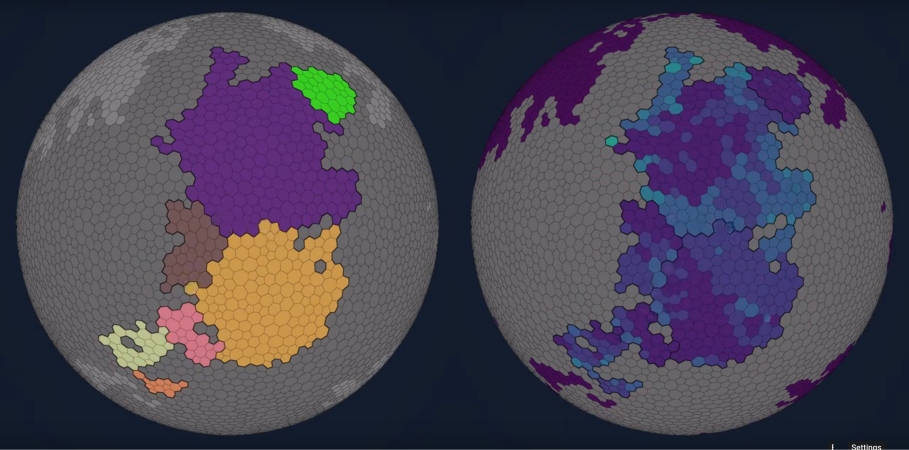
Procedural generation is a big part of game design these days. Usually you generate your map, and [Fractal Philosophy] has decided to go one step further: using a procedurally-generated world from an older video, he is procedurally generating history by simulating the rise and fall of empires on that map in a video embedded below.

Now, lacking a proper theory of Psychohistory, [Fractal Philosophy] has chosen to go with what he admits is the simplest model he could find, one centered on the concept of “solidarity” and based on the work of [Peter Turchin], a Russian-American thinker. “Solidarity” in the population holds the Empire together; external pressures increase it, and internal pressures decrease it. This leads to an obvious cellular automation type system (like Conway’s Game of Life), where cells are evaluated based on their nearest neighbors: the number of nearest neighbors in the empire goes into a function that gives the probability of increasing or decreasing the solidarity score each “turn”. (Probability, in order to preserve some randomness.) The “strength” of the Empire is given by the sum of the solidarity scores in every cell. Continue reading “Simulating Empires With Procedurally Generated History” →

Careful Design Lets 3D Print Emulate Kumiko

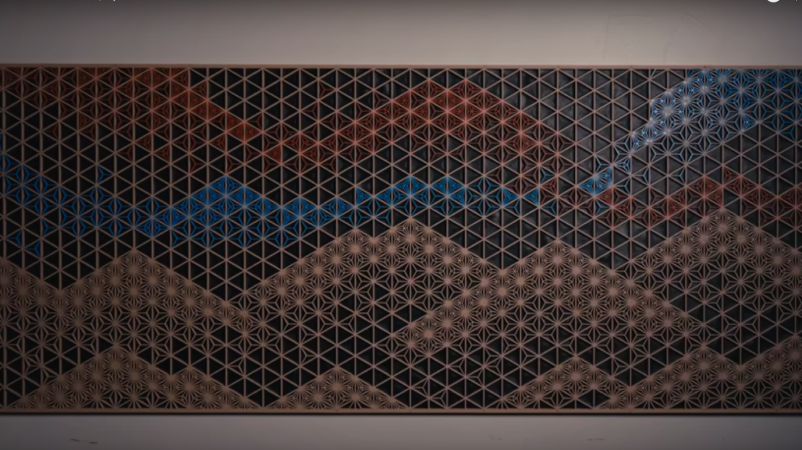
Kumiko is a form of Japanese woodworking that uses small cuts of wood (probably offcuts) to produce artful designs. It’s the kind of thing that takes zen-like patience to assemble, and years to master– and who has time for that? [Paper View] likes the style of kumiko, but when all you have is a 3D printer, everything is extruded plastic.

His video, embedded below, focuses mostly on the large tiled piece and the clever design required to avoid more than the unavoidable unsightly seams without excessive post processing. (Who has time for that?) The key is a series of top pieces to hide the edges where the seams come together. The link above, however, gives something more interesting, even if it is on Makerworld.

[Paper View] has created a kumiko-style (out of respect for the craftspeople who make the real thing, we won’t call this “kumiko”) panel generator, that allows one to create custom-sized frames to print either in one piece, or to assemble as in the video. We haven’t looked at MakerWorld’s Parametric Model Maker before, but this tool seems to make full use of its capabilities (to the point of occasionally timing out). It looks like this is a wrapper for OpenScad (just like Thingiverse used to do with Customizer) so there might be a chance if enough of us comment on the video [Paper View] can be convinced to release the scad files on a more open platform.

We’ve featured kumiko before, like this wood-epoxy guitar,  but for ultimate irony points, you need to see this metal kumiko pattern made out of nails. (True kumiko cannot use nails, you see.)

Thanks to [Hari Wiguna] for the tip, and please keep them coming!

Continue reading “Careful Design Lets 3D Print Emulate Kumiko” →

Is Box Turtle The Open Source AMS We’ve Been Waiting For?

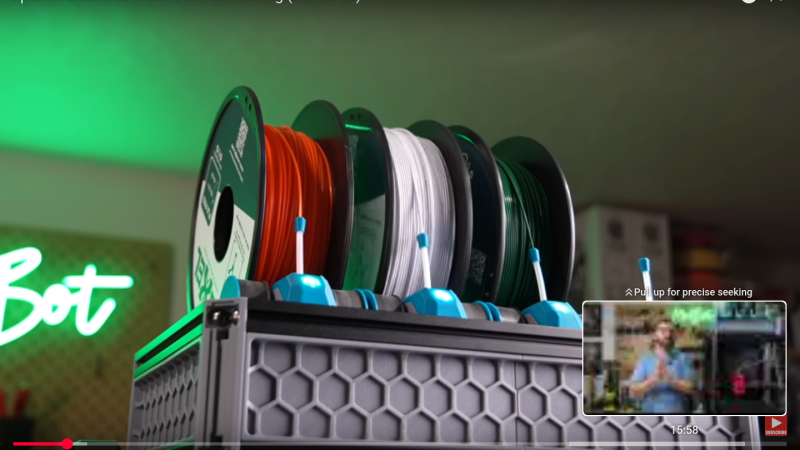
Multimaterial printing was not invented by BambuLabs, but love them or hate them the AMS has become the gold standard for a modern multi-material unit. [Daniel]’s latest Mod Bot video on the Box Turtle MMU (embedded below) highlights an open source project that aims to bring the power and ease of AMS to Voron printers, and everyone else using Klipper willing to put in the work.

A 3d Printed panda with black and white filament
This isn’t a torture test, but it’s very clean and very cute.

The system itself is a mostly 3D printed unit that sits atop [Daniel]’s Voron printer looking just like an AMS atop a BambuLab. It has space for four spools, with motorized rollers and feeders in the front that have handy-dandy indicator LEDs to tell you which filament is loaded or printing. Each spool gets its own extruder, whose tension can be adjusted manually via thumbscrew. A buffer unit sits between the spool box and your toolhead.

Aside from the box, you need to spec a toolhead that meets requirements. It needs a PTFE connector with a (reverse) boden tube to guide the filament, and it also needs to have a toolhead filament runout sensor. The sensor is to provide feedback to Klipper that the filament is loaded or unloaded. Finally you will probably want to add a filament cutter, because that happens at the toolhead with this unit.  Sure, you could try the whole tip-forming thing, but anyone who had a Prusa MMU back in the day can tell you that is easier said than done. The cutter apparently makes this system much more reliable.

Continue reading “Is Box Turtle The Open Source AMS We’ve Been Waiting For?” →

Keep Track Of The Compost With LoRaWAN

Composting doesn’t seem difficult: pile up organic matter, let it rot. In practice, however, it’s a bit more complicated– if you want that sweet, sweet soil amendment in a reasonable amount of time, and to make sure any food-born pathogens and weed seeds don’t come through, you need a “hot” compost pile. How to tell if the pile is hot? Well, you could go out there and stick your arm in like a schmuck, or you could use [Dirk-WIllem van Gulik]’s “LORAWAN Compostheap solarpowered temperaturesensor” (sic).

The project is exactly what it sounds like, once you add some spaces: a solar-powered temperature sensor that uses LoRaWAN to track temperatures inside (and outside, for comparison) the compost heap year round. Electronically it is pretty simple: a Helltech CubeCell AB01 LoraWAN module is wired up with three DS18B20 temperature sensors, a LiPo battery and a solar panel. (The AB01 has the required circuitry to charge the battery via solar power.) Continue reading “Keep Track Of The Compost With LoRaWAN” →

Head To Print Head: CNC Vs FDM

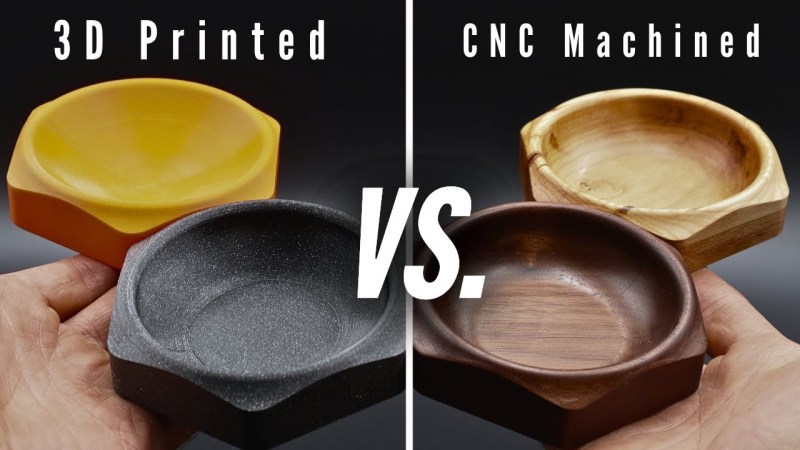
It’s a question new makers often ask: “Should I start with a CNC machine or a 3D Printer?”– or, once you have both, every project gets the question “Should I use my CNC or 3D printer?” — and the answer is to both is, of course, “it depends”. In the video embedded below by [NeedItMakeIt] you can see a head-to-head comparison for one specific product he makes, CRATER, a magnetic, click-together stacking tray for tabletop gaming. (He says tabletop gaming, but we think these would be very handy in the shop, too.)

[NeedItMakeIt] takes us through the process for both FDM 3D Printing in PLA, and CNC Machining the same part in walnut. Which part is nicer is absolutely a matter of taste; we can’t imagine many wouldn’t chose the wood, but de gustibus non disputandum est–there is no accounting for taste. What there is accounting for is the materials and energy costs, which are both surprising– that walnut is cheaper than PLA for this part is actually shocking, but the amount of power needed for dust collection is something that caught us off guard, too.

Of course the process is the real key, and given that most of the video follows [NeedItMakeIt] crafting the CNC’d version of his invention, the video gives a good rundown to any newbie just how much more work is involved in getting a machined part ready for sale compared to “take it off the printer and glue in the magnets.” (It’s about 40 extra minutes, if you want to skip to the answer.) As you might expect, labour is by far the greatest cost in producing these items if you value your time, which [NeedItMakeIt] does in the spreadsheet he presents at the end.

What he does not do is provide an answer, because in the case of this part, neither CNC or 3D Printing is “better”. It’s a matter of taste– which is the great thing about DIY. We can decide for ourselves which process and which end product we prefer. “There is no accounting for taste”, de gustibus non disputandum est, is true enough that it’s been repeated since Latin was a thing. Which would you rather, in this case? CNC or 3D print? Perhaps you would rather 3D Print a CNC? Or have one machine to do it all? Let us know in the comments for that sweet, sweet engagement.

While you’re engaging, maybe drop us a tip, while we offer our thanks to [Al] for this one.

Continue reading “Head To Print Head: CNC Vs FDM” →