Lunar Rover Is No Toy

When you think of Tomy — more properly, Takara Tomy — you think of toys and models from Japan. After all, they have made models and toys as iconic as Transformers, Thomas, Jenga, Boggle, and Furby. They also made figures associated with Thunderbirds and Tron, two favorites in our circles. However, their recent design for SORA-Q is no toy. It is a tiny lunar rover designed at the request of JAXA, the Japanese space agency. The New Yorker recently posted about how this little rover came about.

The SORA-Q looks a bit like a modern Star Wars drone or — if it could fly — a training drone from some of the older movies. The rover caught a lift from a SpaceX Falcon 9 towards the moon with the Hakuto-R M1 lander. Another SORA-Q is scheduled to touch down later this year.

Continue reading “Lunar Rover Is No Toy”

NASA Help Wanted: Telescope Optional

If you’ve ever wanted to work for NASA, here’s your chance. Well, don’t expect a paycheck or any benefits, but the Agency is looking for volunteers to help process the huge amount of exoplanet data with their Exoplanet Watch program. If you have a telescope, you can even contribute data to the project. But if your telescope is in the back closet, you can process data they’ve collected over the years.

You might think the only way to contribute with a telescope is to have a mini-observatory in your backyard, but that’s not the case. According to NASA, even a six-inch telescope can detect hundreds of exoplanet transits using their software. You might not get paid, but the program’s policy requires that the first paper to use work done by program volunteers will receive co-author credit on the paper. Not too shabby!

Continue reading “NASA Help Wanted: Telescope Optional”

Dead Washer Lives Again With ATTiny

We aren’t saying that appliances are a scam, but we have noticed that when your appliances fail, there’s a good chance it will be some part you can no longer get from the appliance maker. Or in some cases, it’s a garden-variety part that should cost $2, but has been marked up to $40. When [Balakrishnan] had a failure of the timer control board for a Whirlpool washing machine, it was time to reverse engineer the board and replace it with a small microcontroller.

Of course, this kind of hack is one of those that won’t help you unless you need exactly that timer board. However, the process is generally applicable. Luckily, the motherboard chip was documented and the timer control board used a simple ATmega88, so it was easy to see that the devices were communicating via I2C.

Reading the I2C  bus is easy with a logic analyzer, and this revealed the faulty device’s I2C address. The board that failed was only for display, so a simple program that does nothing other than accept I2C data put the washer in working order. Once it was working with an Arduino, an ATTiny45 did the work with a lot less space and cost.

If you don’t want to reverse engineer the washing machine, you could just replace all the controls. That even works if the old washer wasn’t electronic to start.

Variable Width 3D Printing The Hard Way

The problem: you want to produce varying line thicknesses when 3D printing. The solution, if you are the Liqtra company, appears to be to put seven print heads together and enable one for thin lines, all of them for thick lines, and something in between for everything else. The technical details are scant, but from the video below and some pictures, you can get a general idea.

There are some obvious benefits and drawbacks. You’d expect that for the right kind of part, this would be fast since you are essentially laying down seven tracks at once. The downside is your track width varies in pretty course steps, assuming you have to use the maximum width of each nozzle to prevent gaps. New slicing software is a must, too.

The demos and pictures show multiple filament colors because it photographs well, but you’d assume in practice that you would use seven spools of the same material. The good thing is that you could print with a single nozzle where that’s important. We assume all the nozzles are the same size, and that will control the practical layer height, but that’s a small price to pay.

The company claims a much faster print, but as we mentioned, this will depend on the specific printed part. They also claim inter-layer strength increases as well, although we found that surprising. This is probably overkill for home users, but we imagine this would be an interesting technology for people trying to run production quantities through a printer.

We don’t remember seeing this approach with a homebrew printer, although having multiple extruders into one or multiple nozzles isn’t unusual anymore. It seems like you could experiment with this kind of technology pretty readily. Of course, there’s more than one way to speed up production.

Continue reading “Variable Width 3D Printing The Hard Way”

Salty Refrigeration Is Friendly To The Environment

Widespread use of refrigerators is a hallmark of modern society, allowing people to store food and enjoy ice and cold beverages. However, a typical refrigerator uses gasses that are not always good for the environment. Now the Berkeley National Lab says they can change that using ioncaloric cooling, a new technique that uses salt as a refrigerant.

The new technique involves using ions to drive a solid-to-liquid phase change which is endothermic. Unlike some similar proposals, the resulting liquid material would be easy to pump through a heat exchanger. In simple terms, it is the same process as salting a road to change the melting point of ice. In this case, an iodine-sodium salt and an organic solvent combine. Passing current through the material moves ions which changes the material’s melting point. When it melts, it absorbs heat. When it resolidifies, it releases heat.

Continue reading “Salty Refrigeration Is Friendly To The Environment”

Is It A Game? Or A Calculator?

If you are a certain age, you probably remember the Mattel Football game. No LCD screen or fancy cartridges. Just some LEDs and a way to play football when you should be in class. While these might seem primitive to today’s kids, they were marvels of technology in the 1970s when they came out. [Sean Riddle] looks, well, not exactly at the games, but more like in them. As it turns out, they used chips derived from those made for calculators.

[Sean’s] post is a glimpse into this world of over four decades past. Football was actually the second electronic game from Mattel. The first one was Auto Race. There were also games called Space Alert, Baseball, and Gravity. Inside each are quad in-line packages with 42 pins, a Rockwell logo, and a custom part number.

Continue reading “Is It A Game? Or A Calculator?”

PCB Gets Weighty Assignment

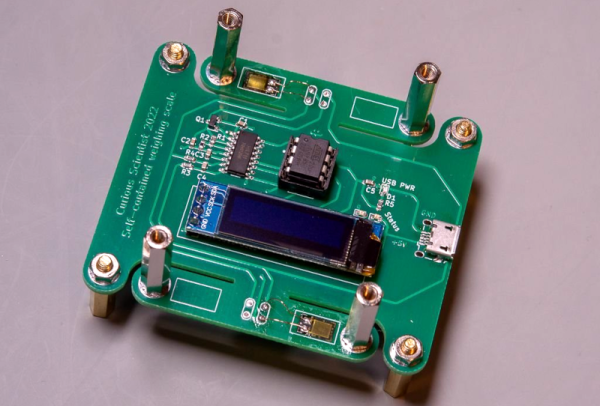
[Curious Scientist] tried building an integrated strain gauge on a PCB, but ran into problems. Mainly, the low resistance of the traces didn’t show enough change under strain to measure easily. Even placing a proper strain gauge on the PCB had limitations. His new design uses a bridge design to make the change in the gauges usefully large. You can see a video of the project below.

Bridging strain gauges isn’t a new idea. However, the novelty of this design is that the PCB has cantilever beams that facilitate the weighing. Standoffs mount a plate to the beams so that weight on the plate cause deformation on the beam that the strain gauges can measure.

Continue reading “PCB Gets Weighty Assignment”