Mazda Patents Spinning Dorito To Extend EV Range

OK, so a Wankel engine doesn’t really use a Dorito as its cylinders, but it sure looks like one. The company has announced it will offer a range extender rotary engine for the MX-30 electric “crossover” vehicle, but [CarBuzz] dug into the patent papers to find out that it has some interesting twists.

The MX-30 is an EV with a relatively small 35.5 kWh battery. Like a hybrid vehicle, the car includes a small internal combustion engine that can charge the battery. It does not, however, directly drive the wheels at any time. The Wankel has several improvements, including a secondary port that allows more air into the combustion chamber when the engine has to produce high power. But there’s a problem…

The secondary port is great when you are pushing hard, but at low speed, it produces inefficiency. To combat that, Mazda includes a valve to seal off the second port when it doesn’t make sense to open it. But that’s not the strange part. The strange part is that the engine also has its own electric assist motor that runs off the main battery.  That’s right. The battery you are charging provides some energy to operate the electric assist motor to help the engine that is charging the battery. If that makes your head spin like the Wankel’s rotor, you aren’t alone.

The assist motor can assist or retard the output shaft during the intake stroke. This can optimize the intake to the combustion chamber. Of course, this will cause odd movement in the engine’s output, but since it doesn’t drive the car, who cares? The battery isn’t going to mind if the output isn’t smooth.

The Wankel shows up in a lot of odd places. We’ve seen Wankel air compressors. Despite detractors, there have been many improvements in the design over the years.


Ask Hackaday: Will Your 2030 Car Have AM Radio?

Car makers have been phasing out AM radios in their cars for quite some time. Let’s face it, there isn’t much on AM these days, and electric vehicles have been known to cause interference with AM radios. So why have them? For that matter, many aftermarket head units now don’t even have radios at all. They play digital media or stream Bluetooth from your phone. However, a U.S. Senator, Edward J. Markey, has started a letter-writing campaign to the major car makers urging them to retain the AM radio in their future vehicles.

So does that mean AM lives? Or will the car makers kill it off? The letter requests that the companies answer several questions, including if they plan to discontinue AM or FM radios in the near future and if they support digital broadcast radio.

Continue reading “Ask Hackaday: Will Your 2030 Car Have AM Radio?”

Build A Better Mousetrap… But It Better Be Better!

As creative problem solvers, we like to “think outside the box,” and we should strive for that. But what happens if your strange idea isn’t kept in check by cooler heads? There is a real danger — especially if you work alone — to falling so in love with your idea, that you lose sight of what it really means to be better.

Case in point. The self-parking car. Well, not the modern variant, which seems to work pretty well. But did you know that the self-parking car was invented in the 1930s and used an extra fifth wheel? Hard to imagine? See the video below. History tells us that the idea didn’t catch on.

Continue reading “Build A Better Mousetrap… But It Better Be Better!”

Transparent Metal (Hydroxide) Without Mr. Scott

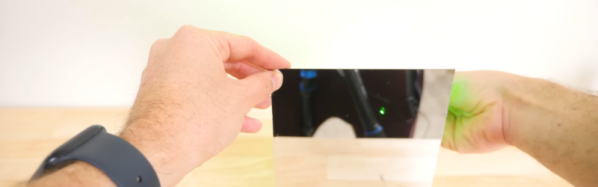
There’s a famous scene in one of the Star Trek movies where Scotty, who has traveled to the past, teaches a metal company to create the transparent aluminum he needs to bring some whales back to the future. But [The Action Lab] shows that we already have see-through metal, just not aluminum. You can see a video about why metals are normally opaque.

The metal in question is sodium. Normally, it isn’t transparent, but molten sodium hydroxide does turn transparent after it — well, sort of explodes. Of course, sodium hydroxide isn’t really a metal, but then neither is the aluminum oxide that’s been touted as real transparent aluminum. Aluminum oxide also makes transparent gemstones like rubies. However, there is some — kind of — transparent aluminum at the end of the video.

Continue reading “Transparent Metal (Hydroxide) Without Mr. Scott”

Microscopic Metal 3D Printing With Gels

Everyone wants to 3D print with metals, but it is a difficult task. You need high temperatures and metals with high thermal conductivity make the problem even worse. Researchers at Caltech have a way of printing tiny metal structures. The trick? They don’t print metals at all. Instead, they 3D print a hydrogel and then use it as a scaffold to form metallic structures. You can read the full paper, if you are interested in the details.

Hydrogels are insoluble in water and made from flexible polymer chains. If you’ve ever handled a soft contact lens, that’s a hydrogel. Like resin printing, UV light triggers chemical reactions in the hydrogels, causing them to harden in the desired pattern.

What about the metal? They infuse the hydrogel with a metallic salt dissolved in water.  This saturates the hydrogel. Burning in a furnace causes the hydrogel to burn away but leaves the metal. The furnace also causes the structure to shrink, so this is a good method for very tiny pieces. The team has made prints with feature sizes around 40 microns.

By altering the metal salts, you can work with different metals or even mix different metals. The team has produced parts using copper, nickel, silver, and several alloys.

Printing small structures is a big research goal with many different approaches. We’ve even seen a tiny welder.

The 10 Kinds Of Programmers That Use Calcutron-33

It is interesting how, if you observe long enough, things tend to be cyclical. Back in the old days, some computers didn’t use binary, they used decimal. This was especially true of made up educational computers like TUTAC or CARDIAC, but there was real decimal hardware out there, too. Then everyone decided that binary made much more sense and now it’s very hard to find a computer that doesn’t use it.

But [Erik] has written a simulator, assembler, and debugger for Calcutron-33, a “decimal RISC” CPU. Why? The idea is to provide a teaching platform to explain assembly language concepts to people who might stumble on binary numbers. Once they understand Calcutron, they can move on to more conventional CPUs with some measure of confidence.

To that end, there are several articles covering the basic architecture, the instruction set, and how to write assembly for the machine. The CPU has much in common with modern microprocessors other than the use of decimal throughout.

There have been several versions of the virtual machine with various improvements and bug fixes. We’ll be honest: we admire the work and its scope. However, if you already know about binary, this might not be your best bet. What’s more is, maybe you should understand binary before tackling assembly language programming, at least in modern times. Still, it does cover a lot of ground that applies regardless.

Made-up computers like TUTAC and CARDIAC were all the rage when computer time was too expensive to waste on mere students. There was also MIX from computer legend Donald Knuth.

In My Neighborhood, We Played Asteroids…with Real Asteroids

There was a comedian in the 1980s who always said he grew up in a tough neighborhood. He claimed they played cops and robbers with real cops. They played gin rummy with real gin. Well, maybe if he knew about [Neal Agarwal]’s asteroid launcher simulation website, he would have said they played asteroids with real asteroids.

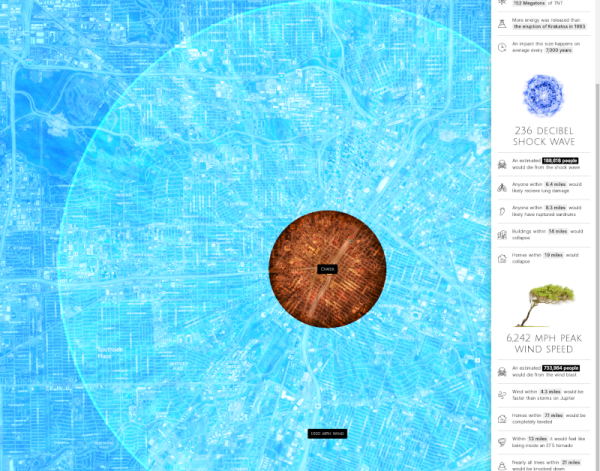
If you ever wondered what would happen if a 1,500-foot stone or iron asteroid hit your hometown going at 38,000 mph, now you can find out.  Apparently, I live far enough in the suburbs that even a 1 mile-wide iron asteroid hitting the center of Houston wouldn’t put a crater under my house. The 17-mile-wide and 2,608-foot-deep crater would release the equivalent of 399 Gigatons of TNT, but it wouldn’t reach me.

The 29-mile-wide fireball would be a different story. Oh, and the 244 dB shockwave would almost certainly reach me. So if the clothes catching on fire resulting in second- and third-degree burns didn’t get me, perhaps the shockwave would. The simulation says that zone will have 99% fatalities, and even further out, people will get severe lung damage. Eardrums burst even further away. Homes would collapse almost to the Mexican border.

The 1,000-mile-per-hour wind might present problems, too. While we are well-situated for hurricanes in this area, that’s about five times more wind than even a big hurricane generates. And we are not well prepared for earthquakes, much less the magnitude 70 quake that would occur.

Pretty bleak. On the plus side, a strike like that happens about once every 2.6 million years. If you try it yourself, be sure to scroll down the right panel to see the graphical representation of the different effects.

Maybe NASA is on to something when they tell us they want to learn to deflect asteroids. Even private foundations are getting into the business of finding them.