Ugliest Airplane Ever Built Predicted The Future

The airplane that many called “the flying barrel” is also widely considered the ugliest plane ever built. However, [Dark Skies] in the video you can see below argues that the Stipa-Caproni was the direct predecessor of the turbofan engine. Either way, it is an interesting and unique part of aviation history.

The plane was built in the days when inventors were experimenting with many different ways to improve aircraft utility and performance. In this case, the inventor built an “intubated propellor” which used a prop to draw air through a venturi tube in an effort to improve engine efficiency. The 570kg vehicle had a wingspan of just over 14 meters and was a bit more than 6 meters long. It could reach about 72 knots and climb to over 3 km.

Continue reading “Ugliest Airplane Ever Built Predicted The Future”
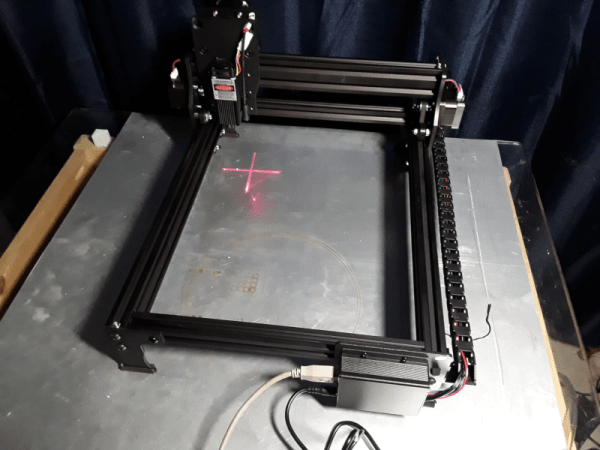
$60 Laser Makes The Cut With New Controller

If you are reading the Lightburn forums, you probably already have a laser cutter of some kind.  But, if you are like most of us, you can always be tempted into another “deal.” [Dkj4linux] has a post where he bought a $79 laser engraver  (now selling for between $59 and $65, we noticed). Like most of these cheap engravers, the machine takes a proprietary controller with Windows-only software. No surprise that [Dkj4linux] would want to use…um… Linux. The answer? Rip the board out and replace it with an old spare.

The machine looks well constructed, as you can see in the video below. For that price, you get a 3-watt laser head (that is likely way less than that in terms of optical power), and a build area of 220x290mm. The controller was in a small metal enclosure, and it was easy to simply unplug the two axis and the laser control cable.

Continue reading “$60 Laser Makes The Cut With New Controller”

You Can’t Be Too Rich Or Too Thin — A 2mm Thick Computer

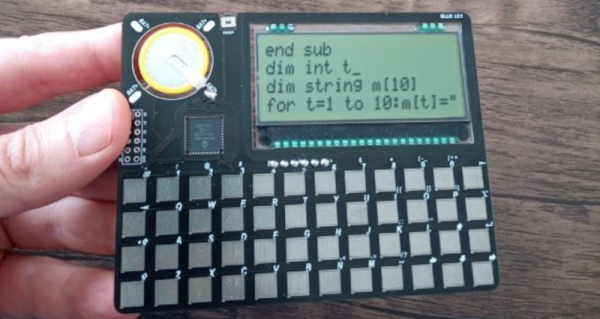
We’ve seen credit card-sized computers before, but [Kn/vD] shows us a PIC18-based computer with 9 components that is only 2 mm thick! With 13 K of RAM and 128 K of flash, you can’t do much with it, but a built-in BASIC interpreter can use half the flash like a disk drive and operate with the 20×4 LCD display and the PCB touch-panel keyboard.

The whole thing only has eleven parts, but that’s only because it needed ancillary components like decoupling capacitors and the battery along with a physical reset switch. All the real functions are in the CPU and the LCD display. The schematic is online, but we didn’t see the files for the PCB or the interpreter yet, but it sounds like they are forthcoming. Meanwhile, we wonder if anyone is up to the challenge of going even thinner.

[Kn/Vd] loves small computers. There are plans for a few other versions of the board with AVR and PIC24 processors. The last time we saw a tiny module from [Kn/vD] it ran C. If you check out other Hackaday.io projects on the account, there are several tiny computers there. If you want a business card that can run Linux, you might need to go a little bit thicker.

Measuring Impedance Virtually

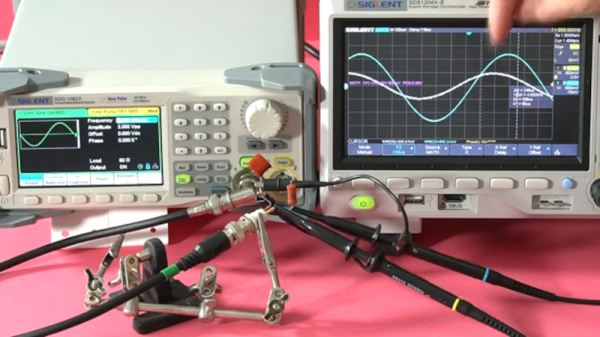
We always enjoy a [FesZ] video and we wonder if the “Z” stands for impedance? That’s the topic of his latest video series: measuring impedance with LTSpice. Of course, he also does his usual thorough job of mapping the virtual world to the real one. You can see the video below.

It is simple enough. Impedance is very similar to resistance. That is to say, we have a ratio of voltage and current. However, since it is an AC quantity, you need a complex number to represent it and there is an associated phase shift.

Continue reading “Measuring Impedance Virtually”

Linux Fu: Atomic Power

People are well aware of the power of virtual machines. If you want to do something dangerous — say, hack on the kernel — you can create a virtual machine, snapshot it, screw it up a few times, restore it, and your main computer never misses a beat. But sometimes you need just a little shift in perspective, not an entire make belive computer. For example, you are building a new boot disk and you want to pretend it is the real boot disk and make some updates. For that there is chroot, a Linux command that lets you temporarily open processes that think the root of the filesystem is in a different place than the real root. The problem is, it is hard to manage a bunch of chroot environments which is why they created Atoms.

The system works with several common distributions and you install it via Flatpak. That means you can launch, for example, a shell that thinks it is running Gentoo or Centos Linux under Ubuntu.

Continue reading “Linux Fu: Atomic Power”

A Spreadsheet For The Python Hacker

You can write a Python program or use a Jupyter Notebook to do almost anything. But you can also get a lot of things done quickly using a spreadsheet. Grist is a “hacker’s” spreadsheet that merges these worlds. It looks like a spreadsheet, but underneath are SQLite tables and the formula language is Python.

The code is open source and if you want it hosted, there are free and paid plans. You can even try it out without even logging in and either start with a blank screen or use a template. You can see an introductory video below.

Continue reading “A Spreadsheet For The Python Hacker”

For The ESP’s Next ESP Trick…

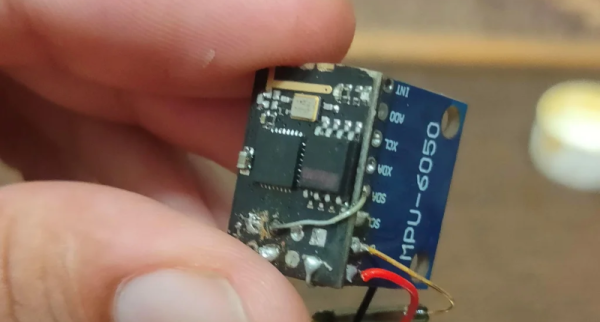
It is a pretty stale dad joke to tell someone you have ESP when you mean you have an ESP8266 or ESP32 in your hand. However, [Naufil Metkar] uses an ESP device to pretend — via a magic trick — that he does have ESP. The trick requires a bit of 3D printing, an MPU6050 gyro sensor, and a lot of showmanship.

We hate to spoil an illusion, but you can probably figure it out from the list of things you need. The die has a gyro in it and uses a small ESP module to transmit its current orientation out to a display. There is a small reed switch that lets you turn off the device with a magnet. Without it, the battery dies quickly.

Continue reading “For The ESP’s Next ESP Trick…”