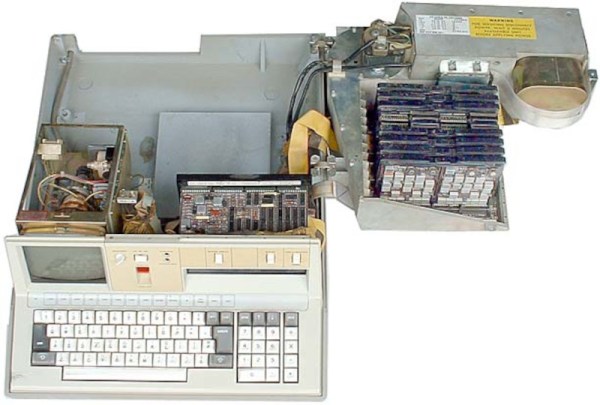
IBM’s Early PC Attracts Time Travelers

It wasn’t long ago I was nostalgic about an old computer I saw back in the 1980s from HP. It was sort of an early attempt at a PC, although price-wise it was only in reach for professionals. HP wasn’t the only one to try such a thing, and one of the more famous attempts was the company that arguably did get the PC world rolling: IBM. Sure, there were other companies that made PCs before the IBM PC, but that was the computer that cemented the idea of a computer on an office desk or at your home more than any computer before it. Even now, our giant supercomputer desktop machines boot as though they were a vintage 1981 PC for a few minutes on each startup. But the PC wasn’t the first personal machine from IBM and, in fact, the IBM 5100 was not only personal, but it was also portable. Well, portable by 1970s standards that also had very heavy video cameras and luggable computers like the Osborne 1.

The IBM 5100 had a brief three-year life from 1975 to 1978. A blistering 1.9 MHz 16-bit CPU drove a 5-inch CRT monitor and you could have between 16K and 64K of RAM along with a fair amount of ROM. In fact, the ROMs were the key feature and a giant switch on the front let you pick between an APL ROM and a BASIC ROM (assuming you had bought both).
Continue reading “IBM’s Early PC Attracts Time Travelers”

Soviet-Era Test Gear Defects To YouTube

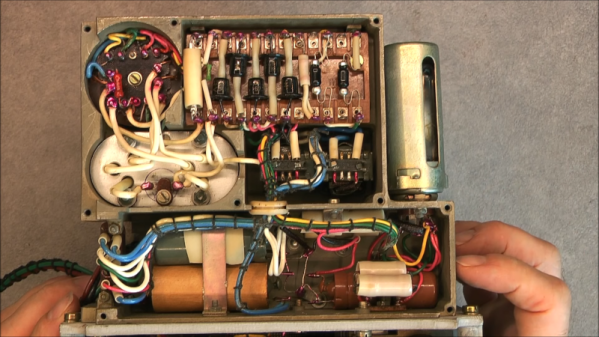
If you want to work on communication gear — especially in the 1960s — you probably wanted a VTVM (a vacuum tube voltmeter), a way to generate frequencies, and a way to measure frequencies and power. The Soviet military had a piece of portable gear that could do all of this, the IK-2, and [msylvain59] shows up how one looked on the outside and the inside in the video below. Be warned, though. The video is hard to stop watching and it runs for over an hour, so plan accordingly.

We don’t read Russian, but based on the video, it looks like the lefthand piece of gear is a frequency generator that runs from 20 to 52 MHz and a power meter. The right-hand instrument is a VTVM that has some way to measure frequency and the center section is a quartz crystal frequency standard.

Continue reading “Soviet-Era Test Gear Defects To YouTube”

Magic Mirror Isn’t Transparent Metal

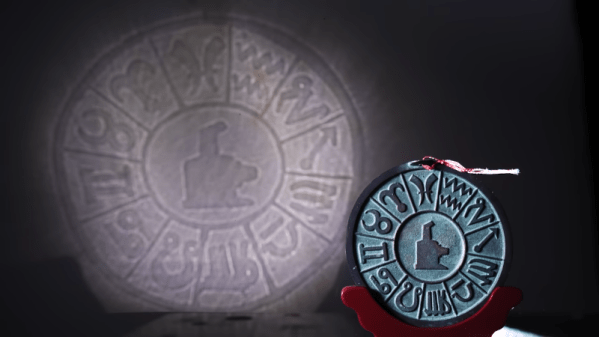
One of the Star Trek movies has a McGuffin called “transparent aluminum.” While magic mirrors aren’t really transparent, it appears that way to a casual observer. If you haven’t seen one of these, they are polished metal mirrors with a pattern embossed on the back. When you shine a point source of light on the mirror, however, the reflection matches what is on the back of the mirror. Is it transparent? No, and the video by [Steve Mould] below explains what’s really going on.

The reality is that very subtle variations of the surface produce the image. You need some understanding of optics and calculus to fully understand what’s going on.

Continue reading “Magic Mirror Isn’t Transparent Metal”

SSB In Your Pocket

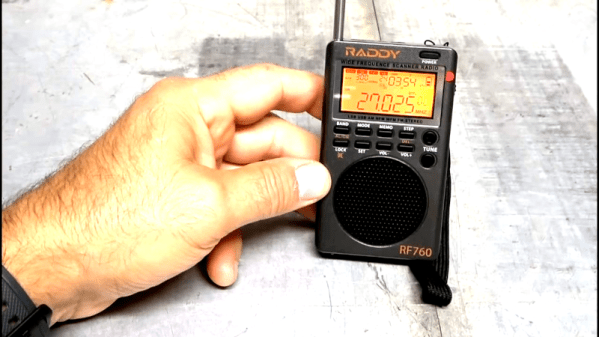
In the old days, a shortwave radio was a major desk fixture. These days, you can get truly diminutive radios. However, most of them only have AM capability (that is, no simple way to receive single-sideband or SSB signals)  and — maybe — the ability to pick up FM broadcast.  Small radios also often have no provision for an external antenna which can be crucial for shortwave radios. [Farpoint Farms] shows off the Raddy RF7860 which is a palm-sided radio, but it has the elusive sideband modes and an external antenna port and wire antenna. It even has a rechargeable battery.

Reading the comments, it appears this is a rebadged version of a HanRongDa HRD 747 radio. Of course, there are other smaller radios with sideband reception like the Tecsun PL368, but they aren’t this small.  If you are in the market for a really tiny shortwave radio, this might be the thing for you.

Of course, the question is what you want to listen to on the shortwave bands these days. There are fewer and fewer broadcasters on shortwave, especially those that broadcast to a general audience. However, if there is something you want to hear, pairing this radio with a good portable antenna, would do the job.

Continue reading “SSB In Your Pocket”

Better 3D Printing Via Chemistry?

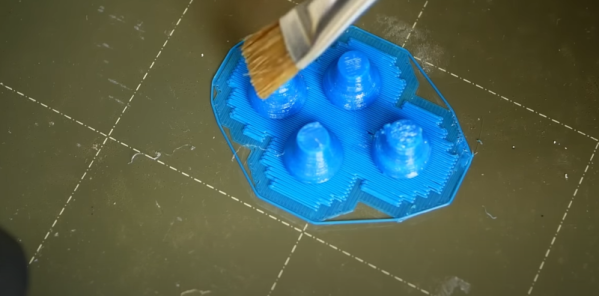
If you have problems getting a 3D print to stick to the bed, you might consider using glue to — hopefully temporarily — attach the print to the bed. In addition, some plastics glue together well if you use a solvent. [Stefan] asks the question: What if you use solvent to glue each layer of a 3D print to the previous layer? The answer is in the video below.

If you know [Stefan], he is always meticulous, so the first test was with normal ABS parts. Then he used a solvent to glue two broken parts together to show how a single layer does with bonding.  Then he moved toward trying the solvent for each layer.

Continue reading “Better 3D Printing Via Chemistry?”

Batteries Get Tiny

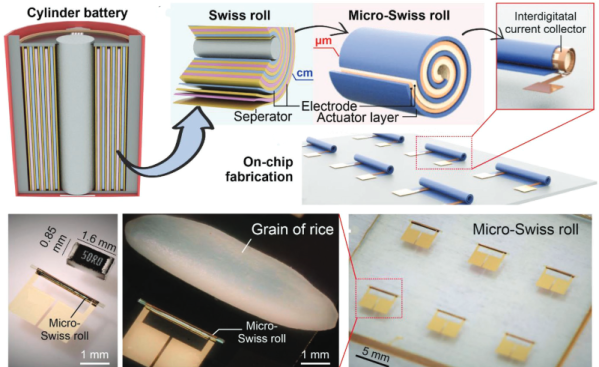
Steve Martin had a comedy routine that focused on the idea of “getting small.” That probably didn’t inspire the researchers at the Institute for Integrative Nanoscience when they set out to create a sub-square-millimeter microbattery. As you might expect, you won’t be starting your car with a battery the size of a grain of sand anytime soon, but these batteries do have a surprising capacity.

The key is creating what they call “micro-swiss rolls” where the electrodes are wrapped in a tiny cylinder. This isn’t a new idea. However, creating workable rolls at the scale where a grain of rice looks huge isn’t trivial.

Continue reading “Batteries Get Tiny”

I’m Your Overlord, May I Take Your Order?

If you’ve ever been at an eatery and thought the server was a bit robotic, you should try San Francisco’s Mezli. The restaurant claims to be the first one to be totally automated. There are no humans in there. The restaurant serves Mediterranean grain bowls. Honestly, it is hard to decide if Mezli is a restaurant or a very sophisticated vending machine.

Then again, that makes sense. Only in science fiction do you have androids flying spaceships. In real life, the robot probably is the spaceship. Obviously, someone is still loading ingredients into the machine — some precooked — but that’s about it. Some restaurants let you order from a computer while a human makes your food and we’ve seen a few automated chefs, but nothing with this degree of mechanization.

Continue reading “I’m Your Overlord, May I Take Your Order?”