Liberated E-Ink Shelf Labels Turned 10×2 Display

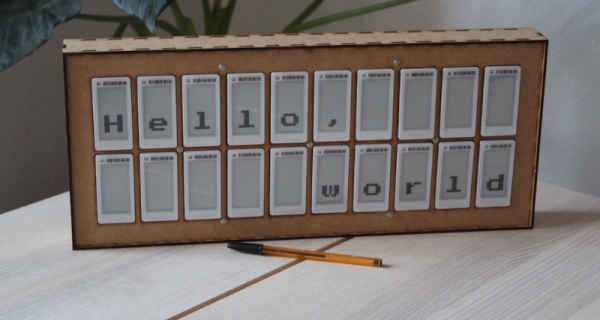
How expensive is it to make a panel that uses e-ink technology? That might depend on how flexible you are. [RBarron] read about reverse engineering point-of-sale shelf labels and found them on eBay for just over a buck apiece. Next thing you know, 20 of them were working together in a single panel.

The panels use RF or NFC programming, normally, but have the capability to use BLE. Naturally you could just address each one in turn, but that isn’t very efficient. The approach here is to use one label as a BLE controller and it then drives the other displays in a serial daisy chain, where each label’s receive pin is set to the previous label’s transmit pin.
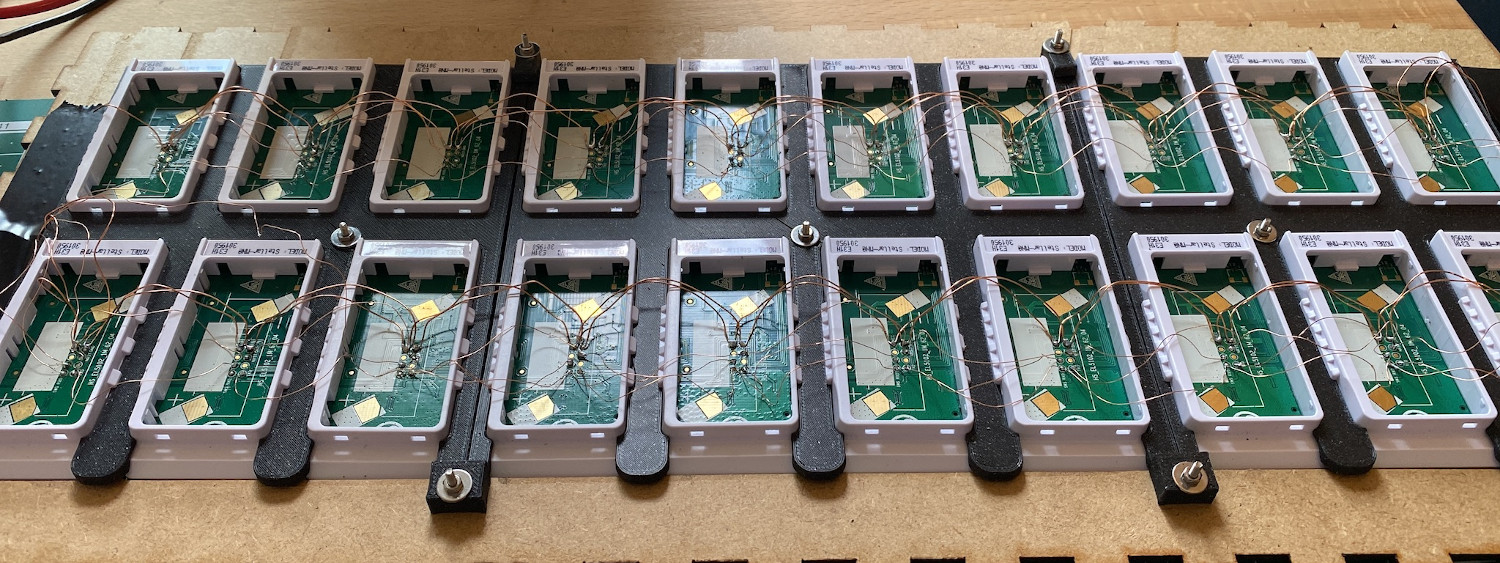
That allows a simple piece of code to read incoming messages and process the ones addressed to that label. Anything else just gets sent out the serial port. Only the BLE node has special firmware. At first, we thought each label would need an address and we wondered how it would be set other than having unique firmware for each one since there doesn’t appear to be a handy way to do a hardware-based configuration.

The actual solution is clever. Each message has a hop counter that each node decrements before passing the message along the chain. When the hop count is zero, the message is at its destination. Simple and very easy to configure. In theory, you could replace any of the labels after the first one with any other label and the system would still work correctly.

Even the wiring is clever, with a jig to bend the wire to ensure even spacing of each element on the panel. A laser-cut box finishes the project off nicely. The code is all available on GitHub. We’ve seen these kinds of tags used for things like weather stations. Not to mention conference badges.

Next Floor: Geosynchronous Satellites, Orbiting Laboratories

On Star Trek, if you want to go from one deck to another, you enter a “turbolift” and tell it where you want to go. However, many people have speculated that one day you’ll ride an elevator to orbit instead of using a relatively crude rocket. The idea is simple. If you had a tether anchored on the Earth with the other end connected to a satellite, you could simply move up and down the tether. Sound simple, so what’s the problem? The tether has to withstand enormous forces, and we don’t know how to make anything practical that could survive it. However, a team at the International Space Elevator Consortium could have the answer: graphene ribbons.

The concept is not new, but the hope of any practical material able to hold up to the strain has been scant. [Arthur C. Clarke] summed it up in 1979:

How close are we to achieving this with known materials? Not very. The best steel wire could manage only a miserable 31 mi (50 km) or so of vertical suspension before it snapped under its own weight. The trouble with metals is that, though they are strong, they are also heavy; we want something that is both strong and light. This suggests that we should look at modern synthetic and composite materials. Kevlar… for example, could sustain a vertical length of 124 mi (200 km) before snapping – impressive, but still totally inadequate compared with the 3,100 (5,000 km) needed.

Continue reading “Next Floor: Geosynchronous Satellites, Orbiting Laboratories”

Ham Radio Hacking: Thinking Inside The Box

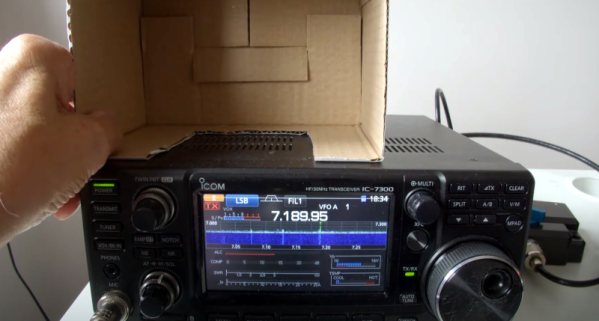
There are two ways to deal with improving ham radio receivers, or — for that matter — any sort of receiver. You can filter and modify the radio frequency including the radio’s intermediate frequency, or you can alter the audio frequency output. Historically, RF and IF techniques have been the most valued because rejecting unwanted noise and signals early allows the rest of the radio to focus on the actual signal of interest. However, audio filters are much easier to work with and until recently, DSPs that could handle RF frequencies were expensive and uncommon. However, [watersstanton] shows us how to make what could be the cheapest audio enhancer ever. It is little more than a modified cardboard box, and you can see and hear the result in the video below.

On the one hand, you shouldn’t expect miracles. On the other hand, you probably have box laying around and can try it in the next three minutes so why not give it a go? You can hear a bit of difference when using the box and not using the box.

Continue reading “Ham Radio Hacking: Thinking Inside The Box”

Never Too Rich Or Thin: Compress Sqlite 80%

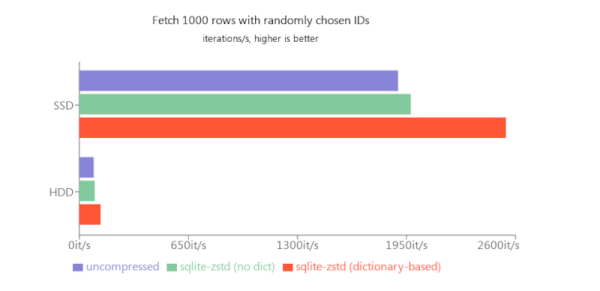
We are big fans of using SQLite for anything of even moderate complexity where you might otherwise use a file. The advantages are numerous, but sometimes you want to be lean on file storage. [Phiresky] has a great answer to that: the sqlite-zstd extension offers transparent row-level compression for SQLite.

There are other options, of course, but as the post mentions, each of these have some drawbacks. However, by compressing each row of a table, you can retain random access without some of the drawbacks of other methods.

Continue reading “Never Too Rich Or Thin: Compress Sqlite 80%”

When [Carl] Says Jump, PCBs Say “How High?”

We’ve noticed that [Carl Bugeja] likes flexible PCBs. His latest exploit is to make PCB-based springs that combine with some magnets to create little devices that jump. We aren’t sure what practical use these might have, but they are undeniably novel and you can see them — um — jumping around, in the video, below.

[Carl] did many experiments with the spring construction and design. You can see several of the iterations in the video, not all of which worked out well. A PCB coil in the base becomes magnetized when current flows and this repels or attracts the magnets at the other end of the spring. What can you do with a PCB spring? We aren’t sure. Maybe this is how your next microrobot could climb stairs?

Adding stiffeners produced springs too stiff for the electromagnet to attract. We wondered if a different coil design at the base might be more effective. For that matter, you might not have to use a flat PCB coil in that position if you were really wanting to optimize the jumping behavior.

Usually, when we are checking in with [Carl] he is making PCB-based motors. Or, sometimes, he’s making PCB heaters for reflow soldering. We’ve seen jumping robots, before, of course. we will say the magnets seem less intense than using compressed air.

Continue reading “When [Carl] Says Jump, PCBs Say “How High?””

Testing Antennas With WSPR

There are many ways to test HF antennas ranging from simulation to various antenna analyzers and bridges. However, nothing can replace simply using the antenna to see how it works. Just as — supposedly — the bumblebee can’t fly, but it does so anyway, it is possible to load up some bed springs and make contacts. But it used to be difficult — although fun — to gather a lot of empirical data about antenna performance. Now you can do it all with WSPR and [TechMinds] suggests a moderately-priced dedicated WSPR transmitter to do the job. You can see a video about the results of this technique below.

While WSPR is often cited as taking the fun out of ham radio, it is perfect for this application. Connect the transmitter and a few hours later, visit a web page and find out where you’ve been heard by an objective observer. If you had a few of these, you could even examine several antennas at similar times and conditions.

Continue reading “Testing Antennas With WSPR”

Calculus Made Easy In The Car

If you had the traditional engineering education, you’ve made your peace with calculus. If you haven’t, you may have learned it on your own, but for many people, calculus has a reputation for being super difficult. While some of the details can be very tricky, the core concepts are actually simple and [Mathologer] has a very simple explanation along with some good graphics that can help you get started on calculus mastery if you’ve been putting it off. Using a car on the highway as the prototypical example, he covers quite a bit of ground in the 30 minute video that you can see below.

Of course, this isn’t a unique idea that calculus is actually simple. The video credits the great book “Calculus Made Easy” that we’ve talked about before. That 100-year-old (and then some) book has a similar approach to the topic.

Continue reading “Calculus Made Easy In The Car”