3D Printed Shoes Make Bigfoot Tracks

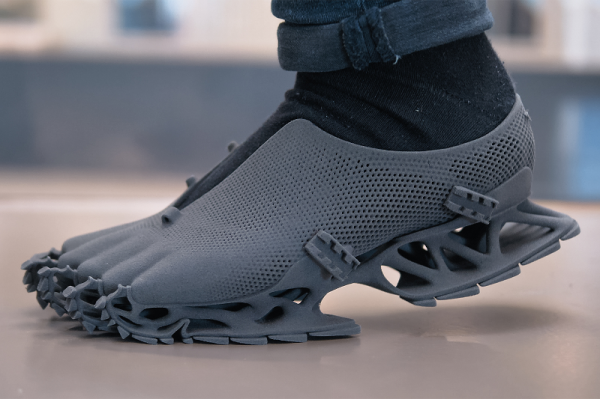
[Stephan Henrich] is probably going to set off a wave of bigfoot sightings if his new shoe, the Cryptide sneaker takes off. The shoe is completely 3D printed in flexible TPE using a laser sintering printer from Sintratec. The shoe takes a name from cryptozoology and, in fact, would leave a puzzling footprint due to its articulated toes and scaly-looking sole.

Judging from the look of the sole, it should be pretty cushy and we presume if you were 3D printing these, you’d scan or precisely measure the intended foot for a perfect fit. You can see a video about the shoe below.

Continue reading “3D Printed Shoes Make Bigfoot Tracks”

Human Power, Past And Future

We will assume you’ve seen The Matrix — it was from 1999, after all. The surprise, at the end, was that humans were being used as human batteries to power a civilization of intelligent machines. But aside from just putting out some heat, the idea does have some precedent. After all, humans powered machines like mills, sewing machines, and pumps for centuries before there were good alternatives.

History

Galley ship
Reconstruction of a squadron of ancient Greek galley ships.

Early machines used hand cranks, treadwheels, treadles, and even pedal power to harness energy from humans. Consider, for example, an ancient galley ship with many oarsmen providing an engine. This wasn’t a great use of human power. An oarsman on a galley used his arms and back but didn’t much use his legs. The legs, though, have larger muscles and are often stronger. A pedal boat or racing shell would have been much more efficient, but without mass production of strong metal parts, it would have been difficult to build and maintain such machines in ancient times.

There was a time when pedals or treadles operated lots of machines from sewing machines to lathes. There were even old radios able to transmit and receive with no external power thanks to pedals as late as the 1940s.

Continue reading “Human Power, Past And Future”

Art of 3D printer in the middle of printing a Hackaday Jolly Wrencher logo

3D Printering: Giants

Newton famously said, “If I see further than others, it is by standing upon the shoulders of giants.” For 3D printing, though, it might be the reverse. If a printer prints larger than others, it is probably using work developed for smaller printers. There are a variety of very large 3D printers out there now and you frequently see claims in the press of “world’s largest 3D printer.” Roboze, for example, makes that claim with a build volume of 1 meter on each axis.

Continue reading “3D Printering: Giants”

$60 PC Oscilloscope Review

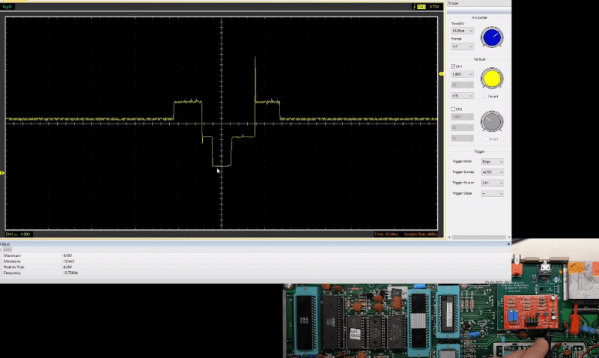
Owning an oscilloscope is a real gamechanger and these days, scopes are more capable and less expensive than ever before. However, there is a big difference between scopes that cost several hundred dollars which are usually quite good and many of the very inexpensive — below $100 — instruments that are often — but not always — little more than toys. [Adrian] looks at a PC-based scope from Hantek that costs about $60. Is it a toy? Or a useful tool? He answers the question in the video below.

The Hantek 6022BE sports two channels with a 20 MHz bandwidth and 48 million samples per second. The device included probes, too. Of course, you also need a PC, although there is apparently third-party software for Android if you don’t want to lug a laptop around.

Continue reading “$60 PC Oscilloscope Review”

3D Printed CPU Bracket Reduces Temperatures

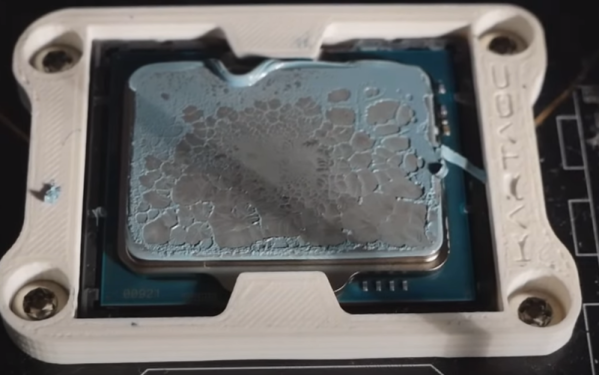
What do you do when your motherboard bends your CPU? If you’re [Karta] or [Luumi], you 3D print a new retaining bracket to fix the problem. [Karta] originated the design, and [Luumi] also tried it and produced the video you can see below.

We think we find flat surfaces all the time, but it is actually very difficult to create something truly flat. You usually learn this when you try to maximize heat transfer between two surfaces. Getting two supposedly flat surfaces to touch is quite hard. CPU brackets use a combination of pressure and some sort of thermal media or paste to fill in any gaps between the CPU case and the heat sink. Intel’s LGA1700 bracket is an example, but there’s been a problem. Apparently, with recent CPUs, the bracket is a little too tight, and it bends the CPU’s case. It doesn’t hurt the CPU, but it does inhibit thermal transfer.

Others have “fixed” this problem by adding some washers to slightly raise the bracket. In both cases, there has been some very small improvement in CPU temperatures. [Luumi] says part of the problem is his water cooling block is not completely flat and needs to be lapped. [Karta], however, reported a 7 degree drop in temperatures, which is pretty significant.

We love seeing how 3D printing can fix or improve things you own. They talk a lot about lapping in the video, and, in some cases, people actually risk lapping the IC die itself to make it flatter. It can help, but the risk is relatively high and the gain is relatively low.

Continue reading “3D Printed CPU Bracket Reduces Temperatures”

Pixelating Text Not A Good Idea

People have gotten much savvier about computer security in the last decade or so. Most people know that sending a document with sensitive information in it is a no-no, so many people try to redact documents with varying levels of success. A common strategy is to replace text with a black box, but you sometimes see sophisticated users pixelate part of an image or document they want to keep private. If you do this for text, be careful. It is possible to unredact pixelated images through software.

It appears that the algorithm is pretty straightforward. It simply guesses letters, pixelates them, and matches the result. You do have to estimate the size of the pixelation, but that’s usually not very hard to do. The code is built using TypeScript and while the process does require a little manual preparation, there’s nothing that seems very difficult or that couldn’t be automated if you were sufficiently motivated.

Continue reading “Pixelating Text Not A Good Idea”

Levitating With Light

The University of Pennsylvania has a team that did a little light research. Well, not light in the usual sense of that phrase. They used very strong light to levitate Mylar disks in a vacuum chamber.

Of course, it is no secret that light can exert pressure. That’s how solar sails work and some scientists have used it to work with aerosols and the like. But this appears to be the first time light lifted a large item against gravity. The team claims that their tests showed that a sunlight-powered flying vehicle might carry up to ten milligrams of payload. That doesn’t sound like much, but it’s impressive and the paper mentions that since the lift is not from aerodynamic forces, there might be applications in flying at very high altitudes.

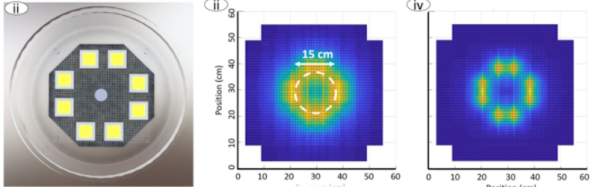
The Mylar disks were 500 nanometers thick and had a 300 nanometer layer of carbon nanotubes beneath. The nanotubes absorb light, make the disks more rigid, and improve the Mylar’s surface-gas characteristics. The light source had a strong center beam and an even stronger ring around the center beam that causes the disk to remain over the center beam. The LED system used eight arrays, each consuming 100 watts of input power.

Preparing the disk might be difficult, but the LED power isn’t that hard. Even if you do like the researchers did and use water cooling.