Linux Fu: The Ultimate Dual Boot Laptop?

I must confess, that I try not to run Windows any more than absolutely necessary. But for many reasons, it is occasionally necessary. In particular, I have had several laptops that are finicky with Linux. I still usually dual boot them, but I often leave Windows on them for one reason or another. I recently bought a new Dell Inspiron and the process of dual booting it turned out to be unusually effective but did bring up a few challenges.

If you ever wanted a proper dual-booting laptop, you’ll be interested in how this setup works. Sure, you can always repartition the drive, but the laptop has a relatively small drive and is set up very specifically to work with the BIOS diagnostics and recovery so it is always a pain to redo the drive without upsetting the factory tools.

Since the laptop came with a 512 GB NVMe drive, I wanted to upgrade the drive anyway. So one option would have been to put a bigger drive in and then go the normal route. That was actually my intention, but I wound up going a different way.

Continue reading “Linux Fu: The Ultimate Dual Boot Laptop?”

Laptop keyboard with strange characters on the keys

But Think Of The (World Wide) Users!

History is full of stories about technology that makes sense to the designer but doesn’t really fit the needs of the users. Take cake mixes. In 1929, a man named Duff realized that he could capitalize on surplus flour and molasses and created a cake mix. You simply added water to the dry mix and baked it to create a delicious cake. After World War II General Mills and Pillsbury also wanted to sell more flour so they started making cakes. But sales leveled out. A psychologist who was a pioneer in focus groups named Dichter had the answer: bakers didn’t feel like they were contributing to the creation of the cake. To get more emotional investment, the cake mixes would need to have real eggs added in. Actually, Duff had noticed the same thing in his 1933 patent.

It is easy to imagine a bunch of food… scientists? Engineers? Designers?… whatever a person inventing flour mixes in the 1930s was called… sitting around thinking that making a mix that only requires water is a great thing. But the bakers didn’t like it. How often do we fail to account for users?

From Cake Mix to Tech

Apple has made a business of this. Most of us don’t mind things like arcane commands and control key combinations, but the wider pool of global computer users don’t like those things. As the world continues to virtually shrink, we often find our users are people from different lands and cultures who speak different languages. It is, after all, the world wide web. This requires us to think even harder about our users and their particular likes, dislikes, and customs.

Continue reading “But Think Of The (World Wide) Users!”

Wireless LEDs Aren’t Really Magic

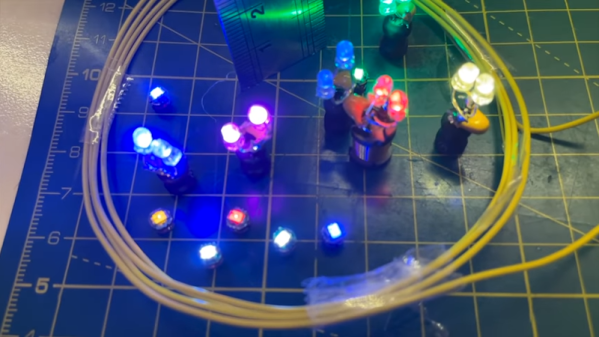
[Atomic14] bought some wireless LEDs that receive power from a base station. They were very neatly packaged, but — we like it — he took one apart and made his own versions. They may not look as polished, but they work and they are undeniably cool.

The LEDs work by receiving power from an induction coil. Once you have power, lighting up an LED is no big deal. Reverse engineering found the transmitter sends 217 kHz into a 2.2 mH inductor. A capacitor resonates the coil and drives the attached LED.

Continue reading “Wireless LEDs Aren’t Really Magic”

Ham Radio Gets Brain Transplant

Old radios didn’t have much in the way of smarts. But as digital synthesis became more common, radios often had as much digital electronics in them as RF circuits. The problem is that digital electronics get better and better every year, so what looked like high-tech one year is quaint the next. [IMSAI Guy] had an Icom IC-245 and decided to replace the digital electronics inside with — among other things — an Arduino.

He spends a good bit of the first part of the video that you can see below explaining what the design needs to do. An Arduino Nano fits and he uses a few additional parts to get shift registers, a 0-1V digital to analog converter, and an interface to an OLED display.

Unless you have this exact radio, you probably won’t be able to directly apply this project. Still, it is great to look over someone’s shoulder while they design something like this, especially when they explain their reasoning as they go.

The PCB, of course, has to be exactly the same size as the board it replaces, including mounting holes and interface connectors. It looks like he got it right the first time which isn’t always easy. Does it work? We don’t know by the end of the first video. You’ll have to watch the next one (also below) where he actually populates the PCB and tests everything out.

Continue reading “Ham Radio Gets Brain Transplant”

Perovskites Understood

The usual solar cell is made of silicon. The better cells use the crystalline form of the element, but there are other methods to obtain electric energy from the sun using silicon. Forming silicon crystals, though, can be expensive so there is always interest in different solar technologies. Perovskite is one of the leading candidates for supplanting silicon. Since they use lead salts, they are cheap and simple to construct. The efficiency is good, too, even when the material is not particularly well ordered. The problem is every model science has on what should make a good solar cell predicted that orderly compounds would perform better, even though this is not true for perovskite. Now scientists at Cambridge think they know why these cells perform even in the face of structural defects.

Perovskites take their name from a natural mineral that has the same atomic structure. In 2009, methylammonium lead halide perovskites were found to act as solar cells. Conversion rates can be as high as 25.5% according to sources and — apparently — the cells could be as much as 31% efficient, in theory. Solar cells top out — again, in theory — at 32.3% although in the real world you are lucky to get into the high twenties.

Continue reading “Perovskites Understood”

Build Your Own HP41C

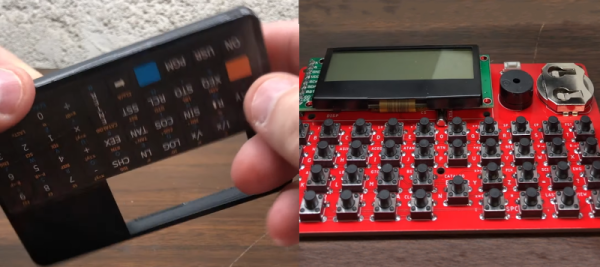
There was a time when engineers carried slide rules. Then there was a time when we all carried calculators. Sure, calculators are still around, but you are more likely to use your phone. If you really need serious number crunching, you’ll turn to a full computer. But there was that awkward time when calculators were very important and computers were very expensive that calculators tried to be what we needed from full-blown computers. The HP41C was probably the pinnacle of that trend. If you’ve ever had one, you know that is a marvel of the day’s technology with alphanumeric capabilities and four plug in ports for more memory or ROMs. It really was a little hand-held computer. Didn’t have one? Don’t worry, you can now build your own. In fact, the HP emulator will also act like an HP15C or 16C, if you prefer.

You can see the device in action in the video below. As you might expect, this version uses a through-hole ATMEGA328 and even at 8 MHz, the emulation is faster than the original calculator. The machine also has over double the memory the original calculator had along with a real-time clock built-in. The display is also backlit, something we all wanted in the original.

Continue reading “Build Your Own HP41C”

DIY High Flow 3D Printing Nozzle

Sometimes advances happen when someone realizes that a common sense approach isn’t the optimal one. Take radio. Success in radio requires bigger antennas and more power, right? But cell phones exist because someone realized you could cram more people on a frequency if you use less power and smaller antennas to limit the range of each base station. With FDM 3D printing, smaller nozzles were all the rage for a while because they offer the possibility of finer detail. However, these days if you want fine detail you should be using resin-based printers and larger nozzles offer faster print times and stronger parts. The Volcano hotend started this trend but there are other options now. [Stefan] over at CNC Kitchen decided to make his own high flow nozzle and he claims it is better than other options.

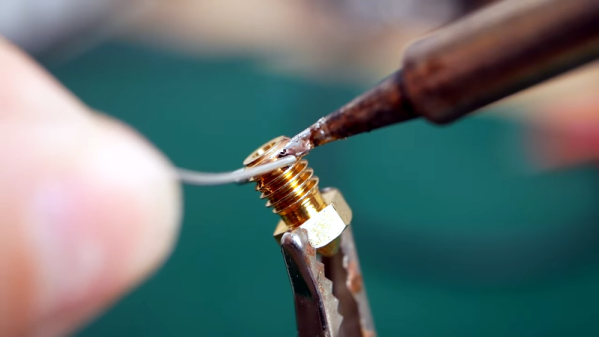
Don’t get too carried away with the DIY part. As you can see in the video below, he starts with a standard nozzle, so it is really a nozzle conversion or hack. The problem with high flow isn’t the hole in the nozzle. It is melting the plastic fast enough. The faster the plastic moves through the nozzle, the less time there is for it to melt.

Continue reading “DIY High Flow 3D Printing Nozzle”