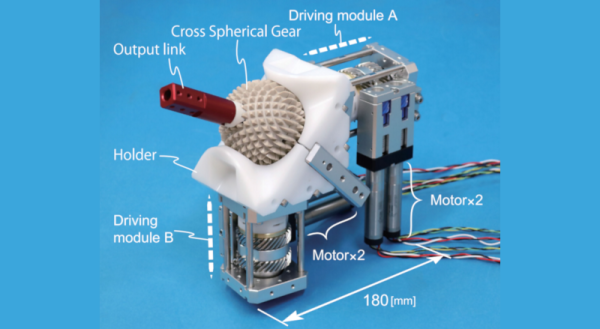
A common CAD operation is to take a 2D shape and extrude it into a 3D shape. But what happens if you take a gear and replicate it along a sphere and then rotate it and do it again? As you can see in the video below, you wind up with a porcupine-like ball that you can transfer power to at nearly any angle. There’s a paper describing this spherical gear as part of an active ball joint mechanism and even if you aren’t mechanically inclined, it is something to see.
The spherical gear — technically a cross spherical gear — is made from PEEK and doesn’t look like it would be that difficult to fabricate. There’s also a simpler version known as a monopole gear in the drive system that provides three degrees of freedom.
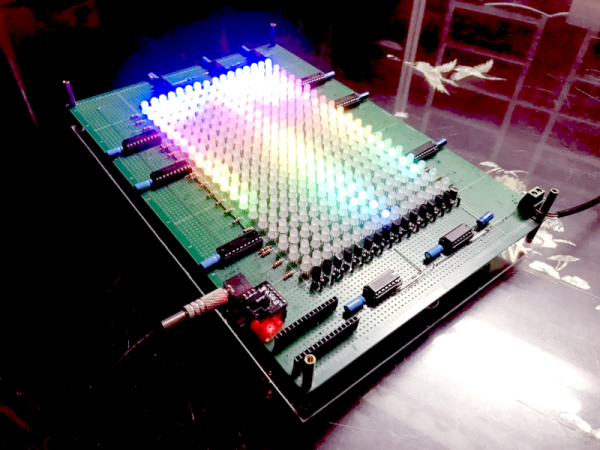
You would think the hard part about creating a spectrum analyzer using a pint-sized ATTiny85 would be the software. But for [tuenhidiy], we suspect the hard part was fabricating an array of 320 LEDs that the little processor can drive. The design does work though, as you can see in the video below.
The key is to use a TPIC6B595N which is an 8-bit shift register made to drive non-logic outputs. With all outputs on, the driving FETs can supply 150 mA per channel and the device can handle 500 mA per channel peak. At room temperature, the part can go over 1W of total power dissipation, although that goes down with temperature, of course. If you need higher power, there’s a DW-variant of the part that can handle a few hundred milliwatts more.
You don’t often turn on a light and think, “That power company is sure on the ball!” You generally only think of them when the lights go out without warning. I think the same is true of search. You don’t use Google or DuckDuckGo or any of the other search engines and think “Wow! How awesome it is to have this much information at your fingertips.” Well. Maybe a little, but it is hard to remember just how hard it was to get at information in the pre-search-engine age.
I were thinking about this the other day when I read that Ruth Freitag had died last year. Ruth had the unglamorous but very important title of reference librarian. But she wasn’t just an ordinary librarian. She worked for the Library of Congress and was famous in certain circles, counting among her admirers Isaac Asimov and Carl Sagan.
Ruth Freitag in 1985
You might wonder why a reference librarian would have fans. Turns out, high-powered librarians do more than just find books on the shelves for you. They produced bibliographies. If you wanted to know about, say, Halley’s comet today, you’d just do a Google search. Even if you wanted to find physical books, there are plenty of places to search: Google Books, online bookstores, and so on. But in the 1970s your options were much more limited.
Turns out, Ruth had an interest and expertise in astronomy, but she also had a keen knowledge of science and technology in general. By assembling comprehensive annotated bibliographies she could point people like Asimov and Sagan to the books they needed just like we would use Google, today.
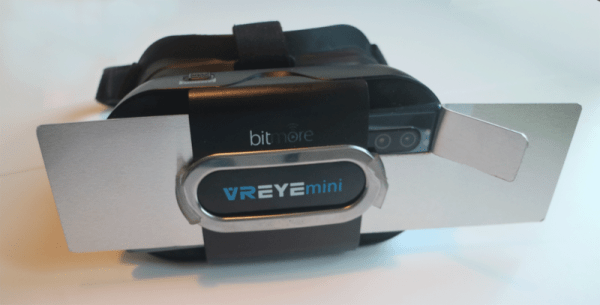
Our first thought was that having big fins coming out of your VR goggles might not look very cool. But then we realized if you are wearing VR goggles, that’s probably not your biggest concern. (Ba-doom, tss.) Seriously, though, high-intensity graphics can cause your phone or device to get pretty toasty up there pressed against your face, so [arfish] set out to make a heatsink.
The build isn’t very hard. Some 0.8 mm aluminum sheet is easy to shape and cut. Thermal pads from the PC world help with heat transfer.
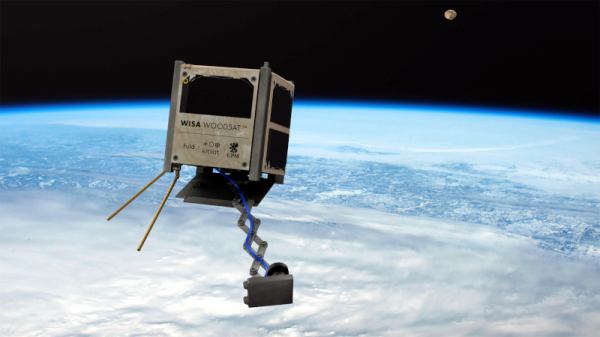
Wood products have a long history in aviation even though modern materials have eclipsed them in many areas. But lately we’ve noticed several plywood satellites, including this one the ESA plans to launch. The WISA Woodsat is a test of WISA plywood, a particular brand made in Finland to show how it can withstand the orbital environment.
Why not? Plywood is cheap and easy to form. You probably don’t want to make a pressure vessel with it, but most satellites don’t need that anyway.
Sometimes we do things because “that’s the way we’ve always done them.” Screws, for example, had slotted heads in the 1500s and slotted heads are notoriously bad, but despite Robertson in 1907 and Phillips in the 1930s, it took decades for slotted screw heads to become uncommon and they still lurk in a few areas. Many Linux tools we use every day are direct descendants from Unix tools that have been around for almost half a century. We’ve looked at a few more modern alternatives before, and [ibraheemdev] has a GitHub collection of many such tools that’s worth checking out.
Of course, modern doesn’t always mean better. However, the tools in the list do have great features including things that were uncommon in the old days such as the use of color, text-based graphics, and things like git integration.
Smart watches are pretty common today, but how many people do you know with a smart hat? [Oliver] built Wilson which he bills as “the IoT hat.” We wonder if the name was inspired by the Home Improvement character of the same name who only appeared as a hat above the fence line. You can see a video of the project, below.
The project is pretty straightforward for hardware. An LED strip, an Arduino, and a Bluetooth module. Oh. And a hat. The software, as you might expect, is a bit more complex. It allows you to display SMS messages to your hat.