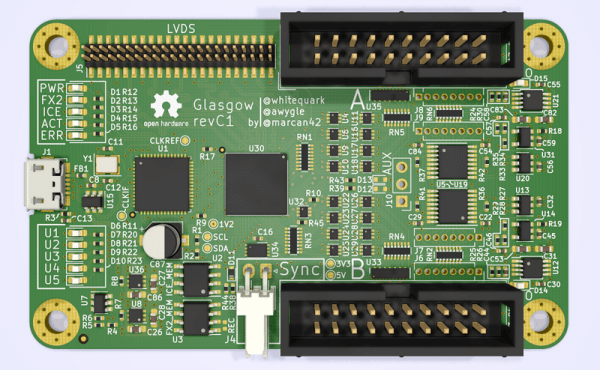
Glasgow Uses An FPGA As An Embedded Systems Multitool

Everyone who builds embedded systems wants tools to help build and debug systems faster, so it isn’t uncommon to see boards outfitted with various tools like serial port sniffers. We’ve seen a few incarnations and the latest is Glasgow. The small board uses an FPGA and claims to do the following:

  • UART with automatic baud rate determination
  • SPI or I2C
  • Read and write common EEPROMs and flash chips
  • Read and write common EPROMs including a data rescue function
  • Program AVR chips via SPI
  • Play back JTAG SVF files
  • Debug ARC and some MIPS CPUs
  • Program XC9500LX CPLDs
  • Communicate to several wireless radios and CPUs
  • Do sound synthesis
  • Read raw data from floppy drives

The revC board is the first to be relatively functional and sports 16 I/O pins operating at up to 100 MHz, although the documentation hints that 6 MHz might be the top of what’s easily accomplished. The software is written in Python and the iCE40 FPGA toolchain that we’ve talked about many times in the past.

This already looks like a useful tool and the reconfigurable nature of FPGAs makes it a good platform to expand. The documentation discusses the difficulty in debugging things for the board, so the base software offers support such as a built-in logic analyzer to help.

We have seen dev boards become bench tools, like using the iCEstick as a logic analyzer. It’s nice to see dedicated tools like this one built up around the speed and versatility of FPGAs.

Continue reading “Glasgow Uses An FPGA As An Embedded Systems Multitool”
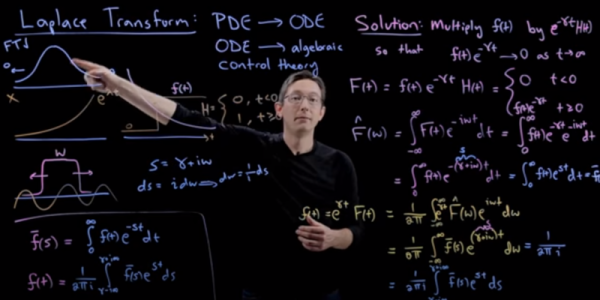
Talking Head Teaches Laplace Transform

Most people who deal with electronics have heard of the Fourier transform. That mathematical process makes it possible for computers to analyze sound, video, and it also offers critical math insights for tasks ranging from pattern matching to frequency synthesis. The Laplace transform is less familiar, even though it is a generalization of the Fourier transform. [Steve Bruntun] has a good explanation of the math behind the Laplace transform in a recent video that you can see below.

There are many applications for the Laplace transform, including transforming types of differential equations. This comes up often in electronics where you have time-varying components like inductors and capacitors. Instead of having to solve a differential equation, you can perform a Laplace, solve using common algebra, and then do a reverse transform to get the right answer. This is similar to how logarithms can take a harder problem — multiplication — and change it into a simpler addition problem, but on a much larger scale.

Continue reading “Talking Head Teaches Laplace Transform”

A Shell? A Programming Language? Relax! It’s Both!

Every time we publish a Linux hack that uses a shell script, someone will chime in about how awful it is to program shell scripts. While we like the ubiquity and efficiency, we can’t disagree that the shell is a bit of a hack itself. [Axel Lijencrantz] wants to change your shell to be a full-blow programming language called Crush.

On the face of it, it looks like a shell. Want to see the contents of the current directory? Simple: ls.

The difference is underneath. In Crush, ls is a built-in and it returns data in rows like a database. You can manipulate that database with SQL-like commands: ls | where {type=="directory"}.

Continue reading “A Shell? A Programming Language? Relax! It’s Both!”

Virtual Software Defined Radio

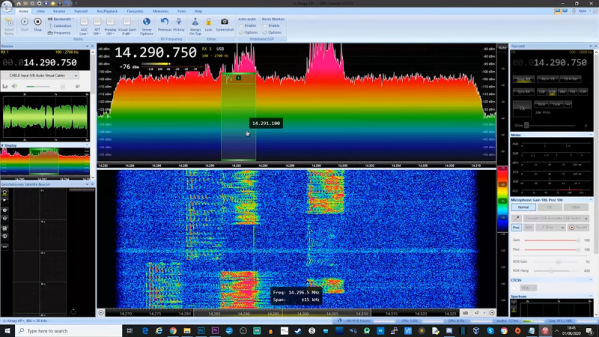
Software defined radio or SDR has changed the radio landscape forever. But to use one you need to buy some kind of hardware right? Maybe not. As [Tech Minds] shows in a recent video there are plenty of SDRs publically available on the Internet. We know that isn’t news, but the video does cover several different methods of finding and using SDR receivers including many that run totally in the browser.

Of course, there are a lot of reasons you might want to borrow an alien radio receiver, even if you have your own hardware. Maybe you don’t have a great antenna or maybe you want to hear a signal — maybe even your own — from a different location.

Continue reading “Virtual Software Defined Radio”

IRobot Makes Learning Robot More Affordable

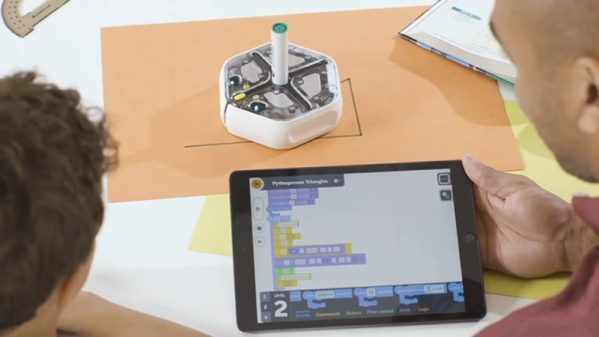
When you think of iRobot, you probably think of floor cleaning or military robots. But they also have a set of robots aimed at education. The Root robot — an acquisition the company made in 2019 — originally targeted classrooms and cost about $200 each. A new version costs about $130 and is a better fit for home users.

The original version  — Root rt1 — is still available, but the rt0 version has several missing features to hit the desired price. What’s missing? Apparently, the rt1 can stick to a whiteboard using magnets, but that feature is missing on the rt0. There are also no “cliff” sensors or color scanner.

Continue reading “IRobot Makes Learning Robot More Affordable”

[NileRed] Makes Superconductors

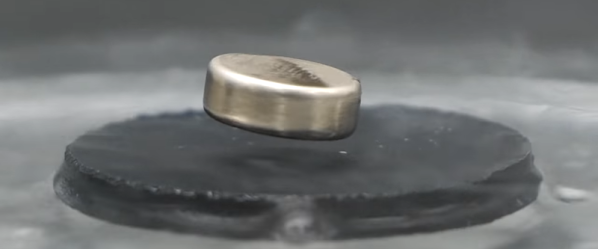
We always enjoy [NileRed’s] videos. His latest shows how he made some relatively high-temperature superconducting ceramic. After finding what appeared to be some really good instructions on the Internet, [NileRed] found there were some things in the paper that didn’t make sense. You can watch the video, below.

The superconductor was YBCO, sometimes known as 123 because of the ratio of its components. Turns out that most of the materials were available online, except for one exotic chemical that he had to buy from a more conventional source.

Continue reading “[NileRed] Makes Superconductors”

Linux-Fu: Help Messages For Shell Scripts And Here Documents

Imagine that you want to output multiple lines of text in Bash, or any shell script. Maybe it’s for a help string for a particularly convoluted shell script you’re writing. You could have a separate echo command for each line.  Or you could use the “here document“.

The “here document” construction takes the text between two delimiters and passes it, as if it were piped, to a command.

if [[$# == 0 ]] || [[ "$1" == "-h" ]]; then
cat << EOF
This is my help message. There are many like it but this one is mine.
My help message is my best friend.
EOF

All of the text, as written, with line breaks and spaces and all, get passed to cat and your helpful formatted message is printed to the user.

Continue reading “Linux-Fu: Help Messages For Shell Scripts And Here Documents”