What’s In A Name For A Tool Battery Pack?

Power tools have come a long way. It used to be you needed extension cords or a generator for your tools, but now you can get just about anything with a nice rechargeable battery pack. As it turns out, most of those packs are made by the same company, and [syonyk] wanted to see how similar two different Makita packs and a Rayovac pack were. What he found was surprising. The outsides were very similar, but what was on the inside?

The Rayovac pack was easy to open and had a controller, a thermal cutoff device, and two layers of 18650 batteries. The similar Makita pack looked identical from the outside until he tried to take it apart. The maker had plugged one screw hole and used security screws instead of the Phillips heads like on the Rayovac.

Continue reading “What’s In A Name For A Tool Battery Pack?”
Two Perspectives On James Clerk Maxwell And His Equations

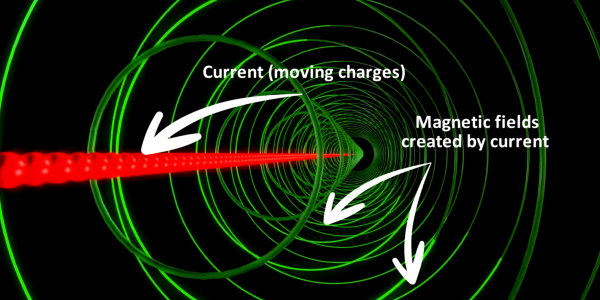
We are unabashed fans of [The History Guy’s] YouTube channel, although his history videos aren’t always about technology, and even when they are, they don’t always dig into the depths that we’d like to see. That’s understandable since the channel is a general interest channel. However, for this piece on James Clerk Maxwell, he brought in [Arvin Ash] to handle the science side. While [The History Guy] talked about Maxwell’s life and contributions, [Arvin] has a complementary video covering the math behind the equations. You can see both videos below.

Of course, if you’ve done electronics for long, you probably know at least something about Maxwell’s equations. They unified electricity and magnetism and Einstein credited them with spurring one of his most famous theories.

Continue reading “Two Perspectives On James Clerk Maxwell And His Equations”

Automating Hand Sanitizer — If You Can Find Any

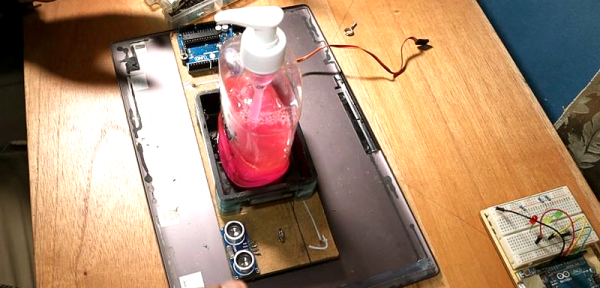
We once saw a Romeo and Juliet production where the two families were modern-day mob families with 3-piece suits and pistols. If they made King Richard III set in this week, the famous line might be: “Hand sanitizer, hand sanitizer, my kingdom for hand sanitizer!” Even if you have a supply stashed in your prepper cache, you have to touch the bottle so you could cross-contaminate with other users. Public places often have automatic dispensers to combat this, and now you can too. [Just Barran] shows the device in a video, you can see below.

Sourcing parts for projects is sometimes a problem, but right now we are betting the hand sanitizer will be the hardest component. Of course, the Internet is ripe with homemade brews that may or may not be effective based on beer, grain alcohol, or a variety of other base materials.

Continue reading “Automating Hand Sanitizer — If You Can Find Any”

Table Held Up By Strings Teaches Physics

If you’ve never heard of a tensegrity structure, you should stop now and watch the video below. In it, [The Action Lab] shows a 3D printed table that is held up only with strings. We didn’t say suspended by strings but held up. Or so it appears. The model is from Thingiverse, but it is one of those things you have to see to believe.

The basic idea is pretty simple. Strings have a lot of tensile strength but collapse under the slightest compressive force. The arrangement of strings puts the force on the center string which is essentially hanging — the force is pulling the string down. The other three strings aren’t just for show, though, they keep the structure from tipping over in any one direction.

There are actually real-life examples of these kinds of structures. The video shows the Skylon at the Festival of Britain as one example and an Australian bridge. The video also makes the point that the human body uses tensegrity, since tendons are very similar to the strings in the model.

This would be a great experiment for a homeschooler or even kids cooped up in quarantine. The print itself doesn’t look very challenging, although the assembly might be a bit tricky.

This isn’t the first structure like this that we’ve seen. If the talk about tendons makes you think this might be useful in robotics, you’d be correct.

Continue reading “Table Held Up By Strings Teaches Physics”

Cesium Clock Teardown, Or Quantum Physics Playground

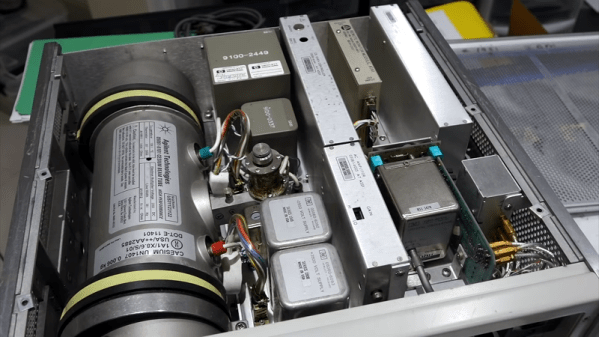
Half the fun of getting vintage test equipment is getting to open it up. Maybe that’s even more than half of the fun. [CuriousMarc] got an HP 5061A Cesium clock, a somewhat famous instrument as the model that attempted to prove the theory of relativity. The reason? The clock was really the first that could easily be moved around, including being put on an airplane. You can watch the video below.

According to the video, you can simplify special relativity to saying that time slows down if you go fast — that is known as time dilation. General relativity indicates that time slows down with increasing gravity. Therefore, using airborne Cesium clocks, you could fly a clock in circles high up or fly at high speeds and check Einstein’s predictions.
Continue reading “Cesium Clock Teardown, Or Quantum Physics Playground”

Another PC Power Supply Project

Economy of scale is a wonderful thing, take the switch-mode power supply as an example. Before the rise of the PC, a decent multi-voltage, high current power supply would be pretty expensive. But PCs have meant cheap supplies and sometimes even free as you gut old PCs found in the dumpster. [OneMarcFifty] decided to make a pretty setup for a PC supply that includes a very nice color display with bargraphs and other niceties. You can see the power supply in action in the video below.

The display is a nice TFT driven by an Arduino Nano. The project uses ACS712 current sensor modules, which are nice Hall effect devices that produce a linear output for current and have over 2 KV of voltage isolation.

Continue reading “Another PC Power Supply Project”

Quantum Sensor Receives From 0 Hz To 1000 GHz

Although it isn’t that uncommon to have broadband radio coverage in a single device, going from 0 Hz to 1000 GHz with one antenna and receiver is a bit much. But not for the US Army it seems, because they’ve developed a quantum sensor that can cover that range.

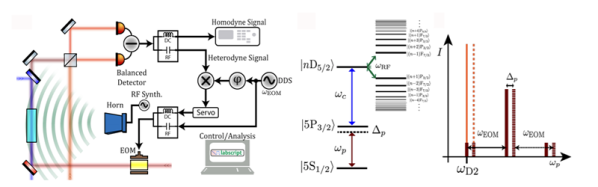
The technology uses Rydberg atoms, which are atoms with a highly excited valence electron. They’ve been used for a variety of sensing applications before, such as reading the cosmic microwave background radiation. However, until the Army’s work there has been no quantitative analysis of using them for wide-spectrum communications.

Continue reading “Quantum Sensor Receives From 0 Hz To 1000 GHz”