Another Blinky Light Project — With A COVID-19 Twist

It seems all anyone is talking about right now is the virus scare that has most of us with a little extra time on our hands. [Paul Klinger] — a name we’ve seen before — built a blinking LED project to pass the time. So what? Well, the lights are made to look like a SARS-CoV-2 virus and the LEDs blink the virus RNA code. You can see the results in the video below.

This isn’t very surprising when you consider we’ve seen [Paul] make tiny things and even blink out his own DNA, so he’s clearly got some specific interests in this area.

Continue reading “Another Blinky Light Project — With A COVID-19 Twist”

MIT Ventilator Designed With Common Manual Resuscitator; Submitted For FDA Testing

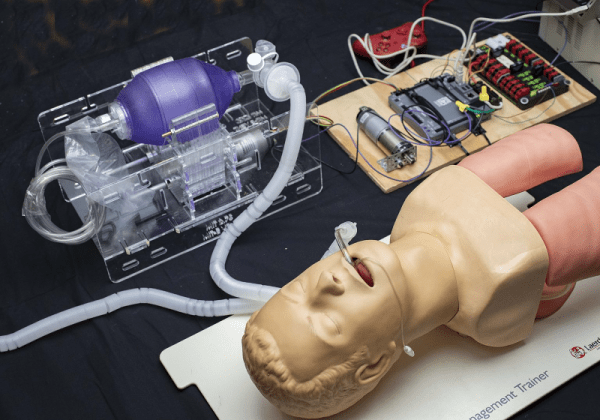
In many parts of the world the COVID-19 pandemic is causing shortages in hospital space, staff, medical supplies, and equipment. Severe cases may require breathing support, but there are only so many ventilators available. With that in mind, MIT is working on FDA approval of an emergency ventilator system (E-Vent). They have submitted the design to the FDA for fast track review. The project is open source, so once they have approval the team will release all the data needed to replicate it.

The design is actually made simple by using something that is very common: a manual resuscitator. You have doubtlessly seen these on your favorite medical show. It is the bag someone squeezes while the main character struggles valiantly to save their patient. Of course, having someone sit and squeeze the bag for days on end for thousands of people isn’t very practical and that’s where they’ve included an Arduino-controlled motor to automate the process.

Continue reading “MIT Ventilator Designed With Common Manual Resuscitator; Submitted For FDA Testing”

ESP32-S2 Samples Show Up

The ESP8266 is about six years old now and the ESP32 is getting more mainstream every day. Unsurprisingly, Espressif is developing even newer product and the ESP32-S2 was in the hands of some beta testers last year. Now it is finally landing as “final silicon” samples in people’s hands. [Unexpected Maker] got a few and a prototype development board for the chip and shared his findings in a recent video.

The ESP32-S2 has a single core LX7 running at 240 MHz along with a RISC-V-based coprocessor. Onboard is 320K of RAM and 128K of ROM. You might notice this is less than the ESP32. However, the device can support up to 128MB of external RAM and up to 1GB of external flash. It also supports USB, although the prototype module appears to have an external USB chip on it.

Continue reading “ESP32-S2 Samples Show Up”

Linux Fu: Mapping Files

If you use C or C++, you have probably learned how to open a file and read data from it. Usually, we read a character or a line at a time. At least, it seems that way. The reality is there are usually quite a number of buffers between you and the hard drive, so your request for a character might trigger a read for 2,048 characters and then your subsequent calls return from the buffer. There may even be layers of buffers feeding buffers.

A modern computer can do so much better than reading using things using old calls like fgetc. Given that your program has a huge virtual address space and that your computer has a perfectly good memory management unit within it, you can ask the operating system to simply map the file into your memory space. Then you can treat it like any other array of characters and let the OS do the rest.

The operating system doesn’t necessarily read the entire file in at one time, it just reserves space for you. Any time you hit a page that isn’t in memory, the operating system grabs it for you invisibly. Pages that you don’t use very often may be discarded and reloaded later. Behind the scenes, the OS does a lot so you can work on very large files with no real effort. The call that does it all is mmap.

Continue reading “Linux Fu: Mapping Files”

A 555 And A Lighter Make High Voltage

If you don’t have a ready source of high voltage, here’s an easy way to build one from the aptly-named [HVZapp]. The parts list is pretty simple to acquire, except for the transformer. For that, [HVZapp] raided a broken arc lighter. It took us a minute to realize that the MOSFETs are in parallel. The hand-drawn schematic shows a little “jump” from the drain lead to the source lead, but if you aren’t careful, it looks like the FETs are shorted out, which — of course — they aren’t.

The original arc lighter, of course, did a fine job of creating high voltage, although perhaps not as much as this circuit. Also, it would turn off every 10 seconds, which isn’t very useful if you want to use it as a power supply.

If you aren’t sure what to do with a high voltage, supply, there’s an associated quick and dirty Jacob’s Ladder in the video below. If you want your high voltage in a more natural way, consider harnessing lightning. There are many ways to generate high voltages.

GitHub On The Go

It is hard to find anyone that does any kind of software development that doesn’t have some interaction with GitHub. Even if you don’t host your own projects there, there are so many things to study and borrow on the site, that it is nearly ubiquitous. However, when you’ve needed GitHub on the run, you’ve probably had to turn to your phone browser and had a reduced experience. GitHub for Mobile is now out of beta and promises a more fluid phone-based GitHub experience.

In addition to working with tasks and issues, you can also review and merge pull requests. The app sends your phone notifications, too, which can be handy. As you might expect, you can get the app for Android or iPhone in the respective stores.

Continue reading “GitHub On The Go”

3.2 GHz Vector Signal Generator Tear Down

[The Signal Path] snagged a fancy Rohde & Schwarz vector signal generator that can go up to 3.2 GHz, but sadly it wasn’t in working order. It powered up and even put out a 1 GHz signal, but the amplitude output was very wrong. Interestingly relative changes to the output were correct, it was just that the absolute output amplitude was off by quite a bit and changed with frequency. That started a detective job which you can follow along in the video below.

The instrument is pretty high-end, and did not report any problems even during self-check. This implied that all the internals were probably good and whatever was wrong probably lay close to the output. The service manual’s block diagram wasn’t terribly useful, especially given that all the processing portions appear to work well.

Continue reading “3.2 GHz Vector Signal Generator Tear Down”