3D Printed V8 Engine Uses Solenoids

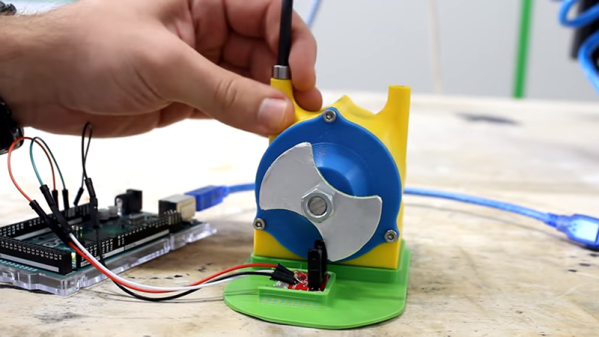
Normally when you think of a V8 engine you think of pistons driven by exploding fuel, pushing a crankshaft. [Miller’s Planet’s] version doesn’t use pistons, instead it uses solenoids along with a 3D printed crankshaft. The finished product would make a great science project or classroom demonstration of how a crankshaft converts a reciprocal linear motion into a rotary motion.

There are a lot of 3D printed parts and the links are in the post. A lot of the video (see below) is filmed in the wordless-workshop style with just a few text overlays to explain what is happening. But towards the middle, you’ll hear an explanation of how a solenoid produces force. The real payoff though is at the end, when you get to watch the contraption in motion.

Continue reading “3D Printed V8 Engine Uses Solenoids”

Mug-O-Matic Plots On Coffee Mugs

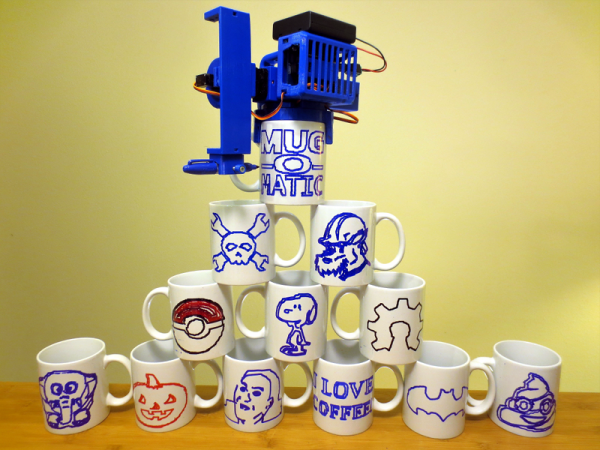
There is something fascinating about watching an autonomous machine. An automatic car wash, a soda vending machine that picks up the product behind a window, a plotter, or a robot like a CNC or 3D printer are all interesting to watch. Although [EngineerDog] bills Mug-O-Matic as a tiny CNC, we think it is more of a plotter for coffee mugs. It’s still fun to watch though, as you can see in the video below.

The design has about 60 printed parts and uses a Sharpie at the business end. It accepts gcode and can even emblazon your favorite mug with our own Jolly Wrencher, so you know we like it.

Continue reading “Mug-O-Matic Plots On Coffee Mugs”

Electrolysis Tank Removes Rust

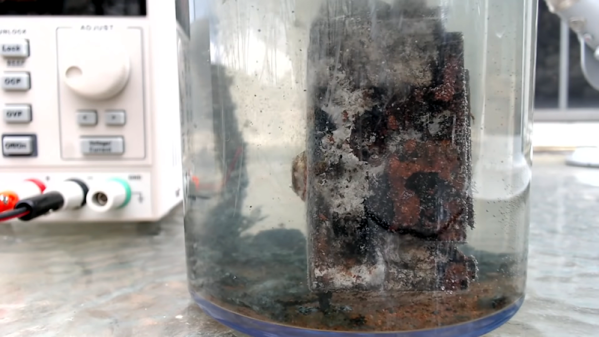
If you have something rusty, you can get a wire brush and a lot of elbow grease. Or you can let electricity do the work for you in an electrolysis tank. [Miller’s Planet] shows you how to build such a tank, but even better, he explains why it works in a very detailed way.

The tank uses a sodium carbonate electrolyte — just water and washing powder. In the reaction, free electrons from the electrolyte displace the oxygen from the rusted metal piece. A glass container, a steel rod, and a power supply make up the rest.

Continue reading “Electrolysis Tank Removes Rust”

Look Like A Movie Hacker

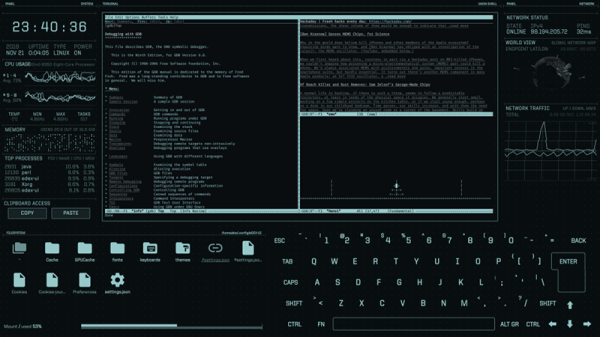
On the old original Star Trek series, they bought some futuristic salt and pepper shakers to use on an episode. The problem is they didn’t look like salt and pepper shakers, so they used normal ones instead and turned the strange-looking ones into Dr. McCoy’s medical instruments. This demonstrates the value of looking like what you claim to be. So sure, you are a super skillful hacker, but if you are sitting in front of a normal looking computer desktop, how can anyone tell? After all, in the movies, hackers use exotic flashy user interfaces, right? Now thanks to eDEX-UI, you can look like a movie hacker if you use Windows, Linux, or the Mac.

As you might expect, the program isn’t very efficient or practical, but it does actually do something. In addition to a load of system information about the CPU and network, there’s a shell, a file manager, and an onscreen keyboard, too. The app uses Electron and — on Linux — AppImage, but for a toy program like this, that may not be a problem.

Continue reading “Look Like A Movie Hacker”

Bar Code Adds A Third Dimension

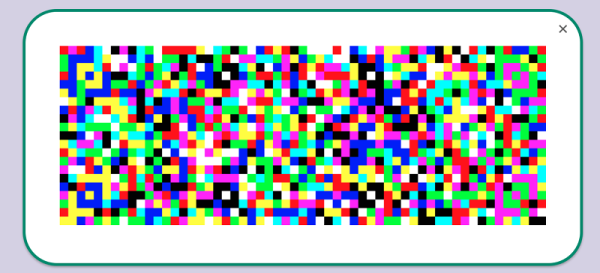
We never really thought about it before, but a traditional barcode or QR code is pretty two dimensional. A 3D barcode sounds like marketing hype but the JAB (Just Another Barcode) system adds a third dimension in the form of color.

Traditional barcodes assume you have a pretty crude sensor, but a color camera now days is no big deal, so why not take advantage? The JAB system specifies two types of symbols: a master symbol and a slave symbol. A master symbol has four finder patterns at the corner. Slave symbols dock to a master or another docked slave.

If you want to create some JABs, there’s a web interface. If you check advanced, you can change the number of colors used, the size of each “module” (colored box), and the width and height of the master symbol. You can also arrange for error correction. The grid that shows the master and slave symbols will allow you to click on any dockable slave location to create more symbols with different attributes.

You can then save the JAB image and use the scan menu item (at the top) to read the code back. It will also read from a camera.

If you are using a color camera and a computer or phone to read barcodes, this probably is something to check out. After all, you are acquiring color data, why not use it?

You might think of the barcode as something modern, but it has a long strange history going back to the 1930s. Early barcodes looked like bullseyes and were actually inspired by Morse code. We wonder how one of these would look on someone’s arm in ink?

PLA Foils Homemade Tachometer

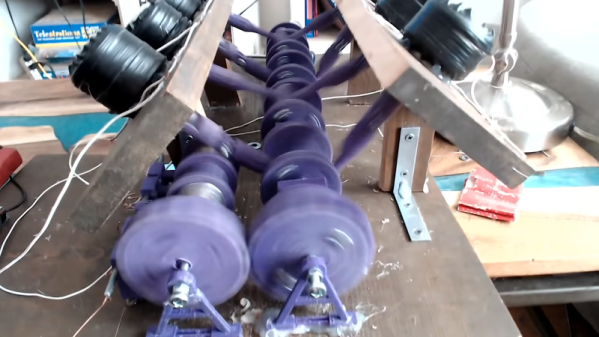
[Integza] built a Tesla turbine and wanted to know how fast it was spinning. However, he didn’t have a tachometer, and didn’t want to buy one. After a false start of trying to analyze the audio to measure the speed, he decided to use a tried-and-true method. Let the wheel break an infrared (IR) optointerruptor and count the spokes of the wheel as they go by. If you know the spacing between the spokes, you can compute the speed. There was only one problem: it didn’t work.

Turns out, PLA is at least somewhat transparent to IR. Knowing that it was a simple matter to fix some tape to the wheel that would block IR and that made things work much better. If you missed the video where he built the turbine, you might want to watch it first.

Continue reading “PLA Foils Homemade Tachometer”

Tiny Ray Tracer Fits In 64 Bytes

Throughout human history, people try to make the biggest, the fastest, and — sometimes — the smallest. [Hellmood] falls into the latter category and proves it with a 64 byte interactive 3D raycasting application for MSDOS.

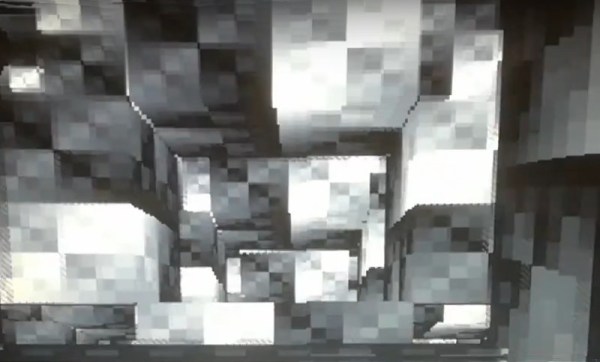
Why MSDOS? We suppose why not? The .COM file format is lean, and you can take over everything without a lot of work. If the program were huge, it wouldn’t be very impressive. There are 64 shades of gray which is odd looking these days, however there are versions that use various color palettes and each one fits in 64 bytes or less. There’s even mouse control and you can see the results in the video below.

Continue reading “Tiny Ray Tracer Fits In 64 Bytes”