Make Your Own Arduino Header Pins

There are two kinds of people in the world (and, no, this isn’t a binary joke). People who love the Arduino, and people who hate it. If you’ve ever tried to use a standard prototype board to mount on an Arduino, you’ll know what kind of person you are. When you notice the pins aren’t on 0.1 inch centers, you might think, “What the heck were those idiots thinking!” Or, you might say, “How clever! This way the connectors are keyed to prevent mistakes.” From your choice of statement, we can deduce your feelings on the subject.

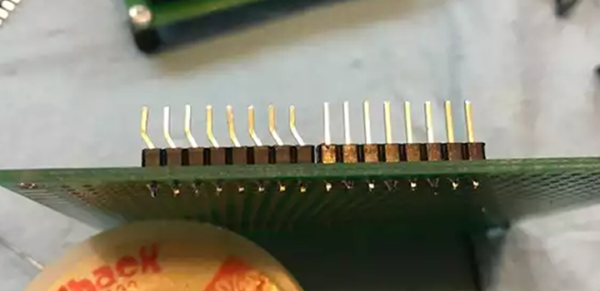
[Rssalnero] clearly said something different. We weren’t there, but we suspect it was: “Gee. I should 3D print a jig to bend headers to fit.” Actually, he apparently tried to do it by hand (we’ve tried it, too). The results are not usually very good.

He created two simple 3D printed jigs that let you bend an 8-pin header. The first jig bends the correct offset and the second helps you straighten out the ends again. You can see the result in the picture above.

Continue reading “Make Your Own Arduino Header Pins” →

Be Your Own Google Mapper

Google Maps is one of the modern wonders of the world. It is hard to remember how expensive it used to be to get high-quality aerial  images. Of course, you don’t get to pick when they fly over a particular piece of the planet. If you are like [Dennis Baldwin] that’s not good enough. He’s been using his drone to document the construction of a high school stadium.

[Dennis] uses the open-source GDAL tools to create Google Map tiles from drone imagery. Even better, he’s documented the process in the video you can find below. Once you can make your own map tiles, you can control when you take the images — important if you are documenting construction like [Dennis] did.

Continue reading “Be Your Own Google Mapper” →

Make Use Of Your Drone Video With WebODM

If you ever watch the original Star Trek, Captain Kirk and crew spend a lot of time mapping new parts of the galaxy. In fact, at least one episode centered on them taking images of some new part of space. It might not be new, but if you have a drone, you probably have accumulated a lot of frames of aerial imagery from around your house (or wherever you fly).

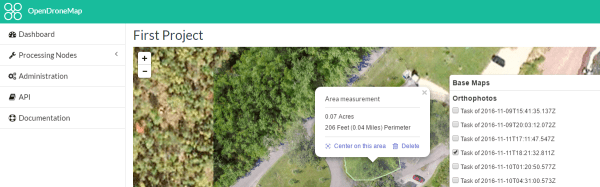
WebODM allows you to create georeferenced maps, point clouds and textured 3D models from your drone footage. The software is really an integration and workflow manager for Open Drone Map, which does most of the heavy lifting.

Continue reading “Make Use Of Your Drone Video With WebODM” →

Arduino Clock Is HAL 1000

In the movie 2001: A Space Odyssey, HAL 9000 — the neurotic computer — had a birthday in 1992 (for some reason, in the book it is 1997). In the late 1960s, that date sounded impossibly far away, but now it seems like a distant memory. The only thing is, we are only now starting to get computers with voice I/O that are practical and even they are a far cry from HAL.

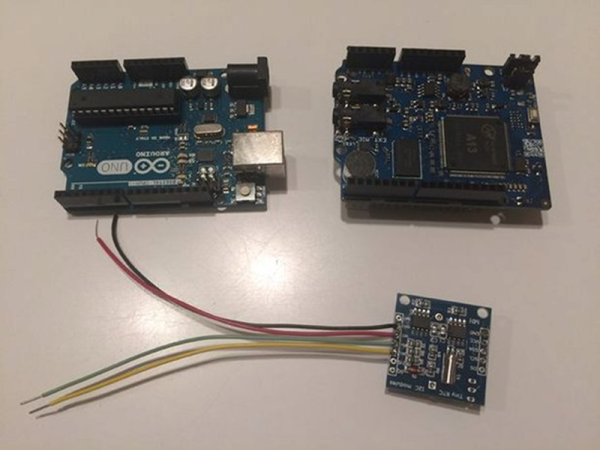
[GeraldF6] built an Arduino-based clock. That’s nothing new but thanks to a MOVI board (ok, shield), this clock has voice input and output as you can see in the video below. Unlike most modern speech-enabled devices, the MOVI board (and, thus, the clock) does not use an external server in the cloud or any remote processing at all. On the other hand, the speech quality isn’t what you might expect from any of the modern smartphone assistants that talk. We estimate it might be about 1/9 the power of the HAL 9000.

Continue reading “Arduino Clock Is HAL 1000” →

Thirty Days Of 3D Printing Filament

Our first 3D printers only printed ABS and PLA plastic. Yeah, we heard about PVA for support structures, but no one could get them to stick. There was also polycarbonate, but you had to have an all metal hot end with a fan to print that stuff. Now there’s a lot of variety out there: flexible, wood and stone, nylon, PETG, and more.

If you are still printing with just the old standards, you might enjoy [all3dp’s] comparison chart of 30 different filament types–that’s enough for one day a month–well at least for four months. It is too many for February, and a day short for the rest of the months. In addition to a table, there’s a short write-up about each type of plastic, its characteristics, and its technical data. There’s even magnetic PLA (see video below) which, in addition to being magnetic, will actually rust in water which might be good for some artistic prints.

Continue reading “Thirty Days Of 3D Printing Filament” →

Maybe You Can Print In Metal

Let’s face it. Printing in plastic is old hat. It is fun. It is useful. But it isn’t really all that exotic anymore. The real dream is to print using metal. There are printers that handle metal in different ways, but they aren’t usually practical for the conventional hacker. Even a “cheap” metal printer costs over $100,000. But there are ways you can almost get there with a pretty garden-variety printer.

There’s no shortage of people mixing things into PLA filament. If you have a metal hot end and don’t mind wearing out nozzles, you can get PLA filament with various percentages of metal powder in it. You can get filament that is 50% to 85% metal and produce things that almost seem like they are made from metals.

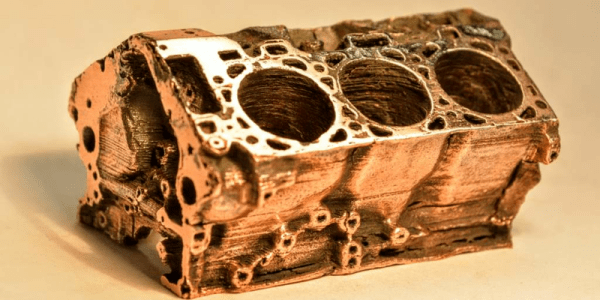
[Beau Jackson] recently had a chance to experiment with a metal-bearing filament that has a unique twist. Virtual Foundry’s Filamet has about 10% PLA. The remaining material is copper. Not only do you have to print the material hot, but you have to print it slow (it is much denser than standard PLA). If it were just nearly 90% metal, that would be impressive, but nothing too exciting.  The real interesting part is what you can do after the print is complete. (If you don’t want to read, you can always skip to the videos, below.)

Continue reading “Maybe You Can Print In Metal” →

VGA Monitor Becomes Drawing Toy

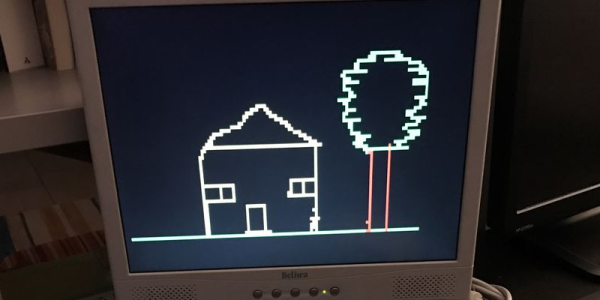
We hate to break it to [Rob Cai], but he’s built a VGA drawing toy, not an Etch-a-Sketch. How do we know? Simple, Etch-a-Sketch is a registered trademark. Regardless, his project shows how an Arduino can drive a VGA monitor using the VGAx library. Sure, you can only do four colors with a 120×60 resolution, but on the other hand, it requires almost no hardware other than the Arduino (you do need four resistors).

The hardware includes two pots and with the right firmware, it can also play pong, if you don’t want to give bent your artistic side. You can see videos of both the art toy and the pong game, below.

Continue reading “VGA Monitor Becomes Drawing Toy” →