Would You Like A Satellite Dish?

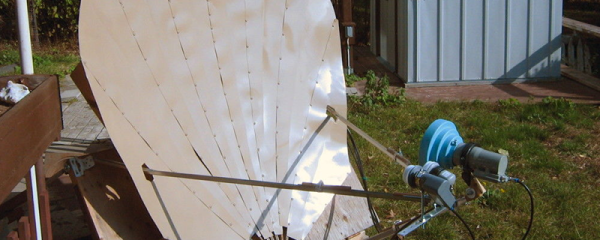
Satellite dishes are a common site these days, although admittedly most of them are Ku- and Ka-band dishes. The older C-band dishes are still around, though, just less frequently in people’s yards. [Greenish Apple] decide to cut the cable and start watching free TV so he built a C-band dish. The trick is, he made the dish out of wood.

The design is the offset type, not a prime focus dish–that is, the electronics are not in the center of the dish but on the side. Wood isn’t particularly good at reflecting RF, of course, so over the wooden skeleton, he used flashing.
Continue reading “Would You Like A Satellite Dish?”

Retrotechtacular: Home Video Recording

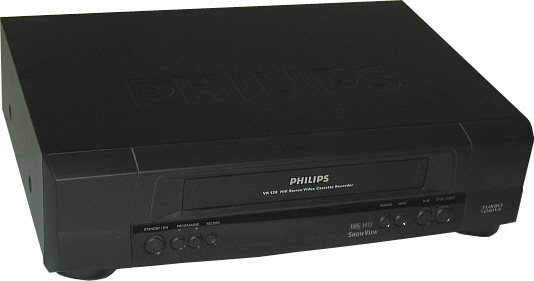
The news has been full of reports that the last company manufacturing consumer VCRs will cease making them this year. I think most of us are surprised that the event is only happening now. After all, these days, video recording is likely to be on a hard drive, a USB stick, or on a server somewhere. Even recording to DVDs seems a bit quaint these days.

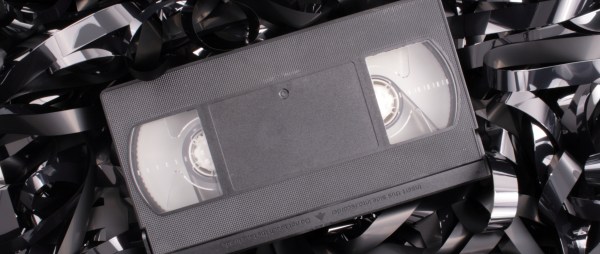
VCR-03Back before there were web sites, people had to get information from magazines like Popular Electronics, Radio Electronics, and a few others. In the late 1960s and early 1970s, it was common to see these magazines predict that this would be the year of the home video recording system. For example, in 1971, [Lou Garner] wrote: “…they [Sony] hope will put home videotape playing in the same living room as conventional high-fidelity sound systems.” You should know that the video cassette he was talking about was 8 inches wide by 5 inches deep (a big larger than a VHS tape) and contained 3/4 inch magnetic tape (VHS used 1/2 inch tape). The 32-pound player had a retail price of about $350 (about $2,000 in today’s dollars; remember gas was $0.36 a gallon and eggs were $0.53 a dozen). It would be several years before VHS and Betamax would duke it out for home supremacy.

Continue reading “Retrotechtacular: Home Video Recording”

Hand Waving Unlocks Door

Who doesn’t like the user interface in the movie Minority Report where [Tom Cruise] manipulates a giant computer screen by just waving his hands in front of it? [AdhamN] wanted to unlock his door with hand gestures. While it isn’t as seamless as [Tom’s] Hollywood interface, it manages to do the job. You just have to hold on to your smartphone while you gesture.

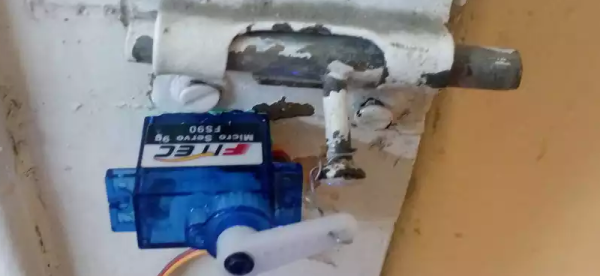
The project uses an Arduino and a servo motor to move a bolt back and forth. The gesture part requires a 1sheeld board. This is a board that interfaces to a phone and allows you to use its capabilities (in this case, the accelerometer) from your Arduino program.

The rest should be obvious. The 1sheeld reads the accelerometer data and when it sees the right gesture, it operates the servo. It would be interesting to do this with a smart watch, which would perhaps look a little less obvious.

We covered the 1sheeld board awhile back. Of course, you could also use NFC or some other sensor technology to trigger the mechanism. You can find a video that describes the 1sheeld below.

Continue reading “Hand Waving Unlocks Door”

Convert Any USB Keyboard To Bluetooth

[DastardlyLabs] saw a video about converting a PS/2 keyboard to Bluetooth and realized he didn’t have any PS/2 keyboards anymore. So he pulled the same trick with a USB keyboard. Along the way, he made three videos explaining how it all works.

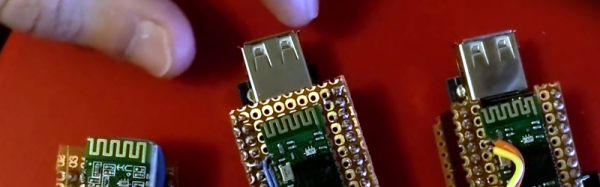
The project uses a stock DuinoFun USB mini host shield with a modification to allow it to work on 5V. An Arduino mini pro provides the brains. A FT-232 USB to serial board is used to program the Arduino. A standard Bluetooth module has to have HID firmware installed. [Dastardly] makes a homemade daughterboard–er, shield–to connect it to the Arduino.

The result is a nice little sandwich with a USB plug, a Bluetooth antenna, and some pins for reprogramming if necessary. Resist the urge to solder the Bluetooth board in–since it talks on the same port as the Arduino uses for programming, you’ll have to remove it before uploading new code.

If you need help reprogramming the HC-05 Bluetooth module, we’ve covered that before. This project drew inspiration from [Evan’s] similar project for PS/2 keyboards.

Continue reading “Convert Any USB Keyboard To Bluetooth”

Talking DIY Z-80 Retrocomputer Complete With Dev Tools

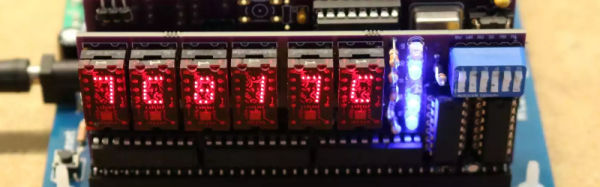
[Scott Baker] wanted to take on a new retrocomputing project. He decided to build an RC2104. Lucky for us, he documented everything along the way. In addition to the main board, [Scott] built bus monitoring and debugging tools, a front panel, a real time clock, an analog to digital converter, and a speech synthesizer.

You can follow along in the 8-part post that includes videos. He started with the basic kit:

  • CPU – The Z80
  • ROM – 27C512 64 KB ROM, selectable in 8KB banks
  • RAM – 62256 32 KB RAM
  • Clock – 7.3728 Mhz crystal that drives a 74HC04 hex inverter (for the CPU and the UART)
  • Serial I/O – MC68B50 UART

In addition, he picked up a digital I/O board.

Continue reading “Talking DIY Z-80 Retrocomputer Complete With Dev Tools”

Mini Plasma Cutter

What do you get when you combine an arc cigarette lighter and some scrap glass and metal? [NightHawkInLight] created a simple plasma cutter project along with some hot glue and a few simple tools.

If you aren’t a smoker, an arc lighter uses a high voltage spark to light the cigarette. He essentially cannibalizes it for use as a power supply. Any similar high-voltage power supply should work just as well. He also uses the same cigarette lighter power supply for an arc pen, that we covered earlier.

Continue reading “Mini Plasma Cutter”

High-Voltage Fractals

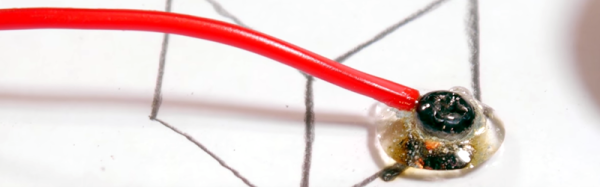
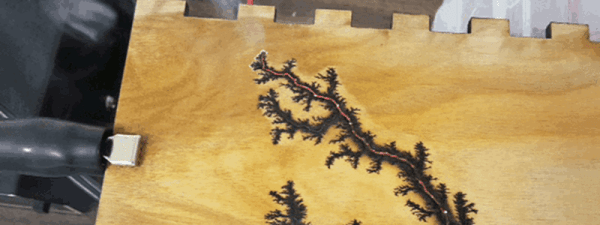
Int 1777, Georg Lichtenberg found that discharging high voltage on an insulating surface covered with a powder, a fractal-like image appears, sometimes known as a lightning tree. Incidentally, this is a crude form of xerography, the principle that lets copiers and laser printers operate.

[PaulGetson] had a high voltage power source from his Jacob’s ladder experiments and decide to see if he could create Lichtenberg figures. Turns out, he could.

Continue reading “High-Voltage Fractals”