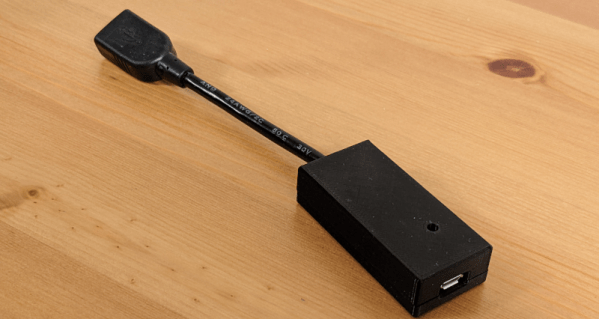
If you want to remap some mouse or keyboard keys, and you use Linux, it is easy. If you use Windows or another operating system, you can probably do that without too much trouble. But what if you use all of them? Or what if you don’t have access to the computer in question? Thanks to [jfedor2], you can reach for a Raspberry Pi Pico and make this handy key-and-mouse remapping hardware dongle.
In 1962, unlike today, most things didn’t have computers in them. After all, the typical computer of the day was a fragile room-sized box that required a gaggle of high priests to service it. But the Minuteman I nuclear missile was stuffed full of pre-GPS navigation equipment and a computer. In a few years, by 1970, the Minuteman III could deliver a warhead 13,000 km with an accuracy of 200 meters. Each one cost about a half million dollars, but that’s almost five million in today’s money. [Ken] takes on a very detailed tour of the computers and avionics that were nothing short of a miracle — and a highly classified miracle — in the 1960s.
The inertial navigation relied on a gyroscope, which in those days, were large and expensive. The Minuteman I required alignment with a precise angle relative to the North Star which naturally wasn’t visible from inside the silo. By the time Minuteman II arrived, they’d figured out an easier way to orient the missiles.
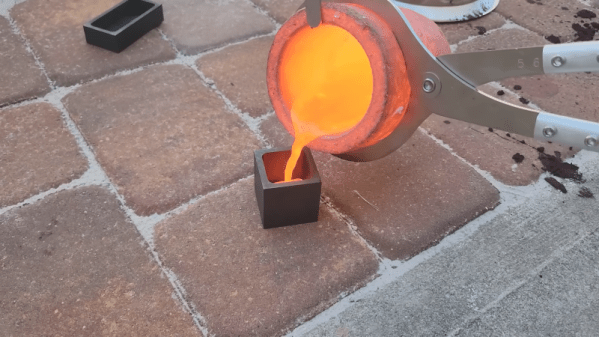
We love it when we find someone on the Internet who has the exact same problem we do and then solves it. [Hyperspace Pirate] starts a recent video by saying, “Oh no! I need to get rid of the algae in my pond, but I bought too much algaecide. If only there were a way to turn all this excess into CNC machined parts.” OK, we’ll admit that we don’t actually have this problem, but maybe you do?
Algaecide is typically made with copper sulfate. There are several ways to extract the copper, and while it is a little more expensive than buying copper, it is cost-competitive. Electrolysis works, but it takes a lot of power and time. Instead, he puts a more reactive metal in the liquid to generate a different sulfate, and the copper should precipitate out.
Diamonds are nearly perfect crystals, but not totally perfect. The defects in these crystals give the stones their characteristic colors. But one type of defect, the NV — nitrogen-vacancy — center, can hold a particular spin, and you can change that spin with the correct application of energy. [Asianometry] explains why this is important in the video below.
Interestingly, even at room temperature, an NV center stays stable for a long time. Even more importantly, you can measure the spin nondestructively by detecting light emissions from the center.
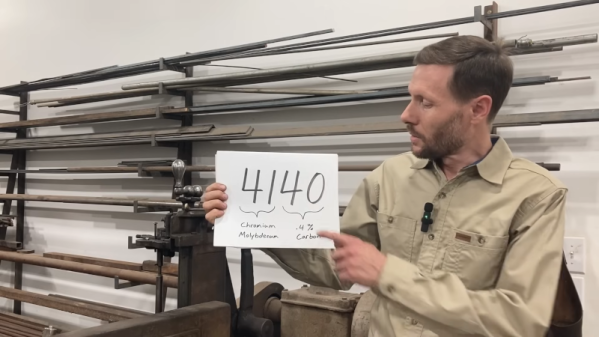
In the movie Conan the Barbarian, we hear a great deal about “the riddle of steel.” We are never told exactly what that riddle is, but in modern times, it might be: What’s the difference between 4150 and 1020 steel? If you’ve been around a machine shop, you’ve probably heard the AISI/SAE numbers, but if you didn’t know what they mean, [Jason Lonon] can help. The video below covers what the grade numbers mean in detail.
The four digits are actually two separate two-digit numbers. Sometimes, there will be five digits, in which case it is a two-digit number followed by a three-digit number. The first two digits tell you the actual type of steel. For example, 10 is ordinary steel, while 41 is chromium molybdenum steel. The last two or three digits indicate how much carbon is in the steel. If that number is, say, 40, then the steel contains approximately 0.40% carbon.
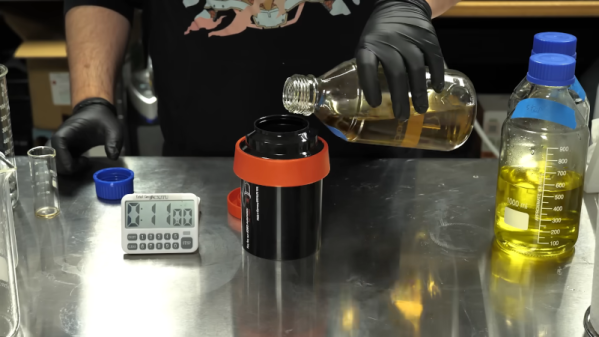
It isn’t just a spy movie trope: secret messages often show up as microdots. [The Thought Emporium] explores the history of microdots and even made a few, which turned out to be — to quote the video you can see below — “both easier than you might think, and yet also harder in other ways.”
If you want to hide a secret message, you really have two problems. The first is actually encoding the message so only the recipient can read it. However, in many cases, you also want the existence of the message to be secret. After all, if an enemy spy sees you with a folder of encrypted documents, your cover is blown even if they don’t know what the documents say.
Today, steganography techniques let you hide messages in innocent-looking images or data files. However, for many years, microdots were the gold standard for hiding secret messages and clandestine photographs. The microdots are typically no bigger than a millimeter to make them easy to hide in plain sight.
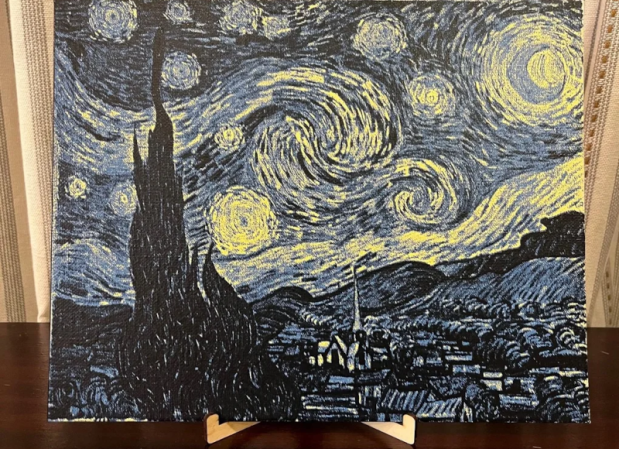
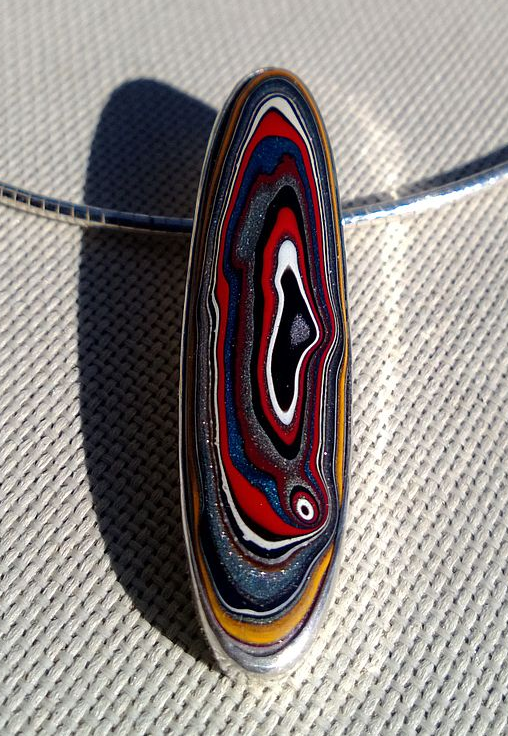
Have you ever heard of Fordite? It was a man-made agate-like stone that originated from the Ford auto factories in the 1920s. Multiple layers of paint would build up as cars were painted different colors, and when it was thick enough, workers would cut it, polish it, and use it in jewelry. [SheltonMaker] uses a similar technique to create artwork using a laser engraver and shares how it works by showing off a replica of [Van Gogh’s] “Starry Night.”
A piece of Fordite on a pendant
The technique does have some random variation, so the result isn’t a perfect copy but, hey, it is art, after all. While true Fordite has random color layers, this technique uses specific colors layered from the lightest to the darkest. Each layer of paint is applied to a canvas. Only after all the layers are in place does the canvas go under the laser.
The first few layers of paint are white and serve as a backer. Each subsequent layer is darker until the final black layer. The idea is that the laser will cut at different depths depending on the desired lightness. A program called ImagR prepared the image as a negative image. Adjustments to the brightness, contrast, and gamma will impact the final result.
Of course, getting the exact power settings is tricky. The best result was to start at a relatively low power and then make more passes at an even lower power until things looked right. In between, compressed air cleared the print, although you have to be careful not to move the piece, of course.
There are pictures of each pass, and the final product looks great. If art’s not your thing, you can also do chip logos. While the laser used in this project is a 40-watt unit, we’ve noted before that wattage isn’t everything. You could do this—probably slower—with a lower-powered engraver.