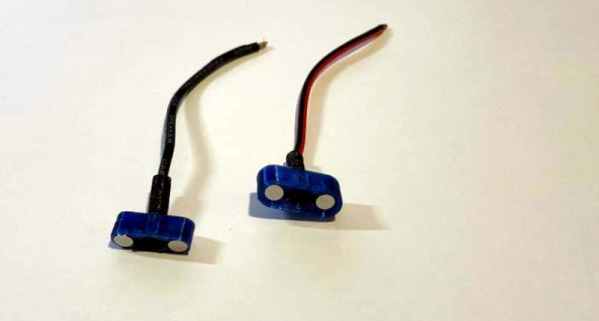
If you have a late-model laptop, you’ve probably seen how the chargers magnetically snap into place. In theory, this should be easy to recreate for your own purposes. But why reinvent the wheel when [DarthKaker] has already done the work for you — assuming you only need two conductors.
The 3D-printed shells take the usual round magnets. Obviously, the north pole on one part should point to the south pole on the other part. In addition, if polarity matters, you should also have each housing contain one north-facing and one south-facing magnet so that the connectors will only mate one way.
It appears the project uses wires soldered or spot welded to the magnets. Heating magnets sometimes has bad effects, so we might try something different. For example, you could solder the wires to thin washers affixed to the magnets with epoxy, perhaps. Or use the magnets for alignment and make a different arrangement for the contacts, although that would take a different shell design.
We have talked about magnet soldering for connectors before. Don’t forget that you can build magnets into your prints, too.
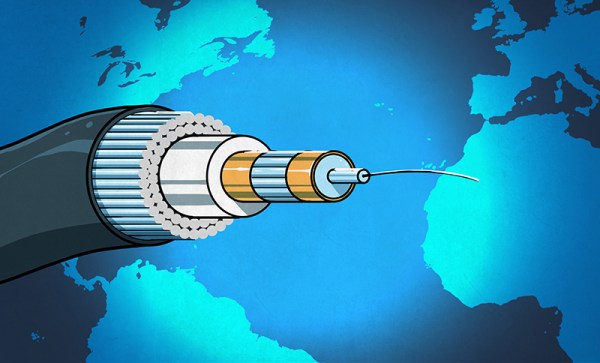
We heard a story that after the recent hurricane, a man noted that while the house was sweltering hot because the power was still out, his kids were more anxious for the internet to come back online. The Internet is practically a basic necessity for most people, but as you may have noticed with the recent CrowdStrike debacle, the Internet isn’t always reliable. Granted, the problem in that case wasn’t the Internet per se, but a problem with many critical hosts that provide services. [Thomas Germain] from the BBC took the opportunity to recall some of the more bizarre reasons we’ve had massive Internet outages in the past.
While teens after a hurricane might miss social media, global outages can be serious business. With 8.5 million computers dead, 911 services went down, medical surgeries were canceled, and — of course — around 46,000 flights were canceled in a single day. We have short memories for these outages, but as [Thomas] points out, this was far from the first massive outage, and many of them have very strange backstories.
A QSL Card from Radio Moscow probably got many 14-year-olds on government watch lists. (Public domain)
Between World War II and Y2K, shortwave listening was quite an education. With a simple receiver, you could listen to the world. Some of it, of course, was entertainment, and much of it was propaganda of one sort or another. But you could learn a lot. Kids with shortwave radios always did great in geography. Getting the news from a different perspective is often illuminating, too. Learning about other cultures and people in such a direct way is priceless. Getting a QSL card in the mail from a faraway land seemed very exciting back then.
Today, the shortwave landscape is a mere shadow of itself. According to a Wikipedia page, there are 235 active shortwave broadcasters from a list of 414, so nearly half are defunct. Not only are there many “dead” shortwave outlets, but many of the ones that are left are either not aimed at the world market or serve a niche group of listeners.
You can argue that with the Internet, you don’t need radio, and that’s probably correct in some ways but misses a few important points. Indeed, many broadcasters still exist as streaming stations or a mix of radio and streaming. I have to admit I listen to the BBC often but rarely on the air. My computer or phone plays it in crystal clarity 24 hours a day.
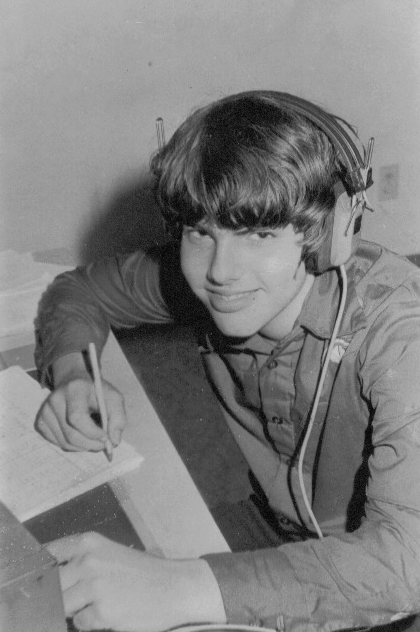
A future Hackaday author in front of an Eico shortwave radio
So, while a 14-year-old in 1975 might be hunched over a radio wearing headphones, straining to hear NHK World Radio, these days, they are likely surfing the popular social media site of the week. You could easily argue that content on YouTube, Instagram, and the like can come from all over the world, so what’s the problem?
The problem is information overload. Faced with a shortwave radio, there were a limited number of options available. What’s more, only a small part of the band might be “open” at any given time. It isn’t like the radio could play games or — unless you were a ham — allow you to chat with your friends. So you found radio stations from Germany to South Africa. From China and Russia, to Canada and Mexico. You knew the capital of Albania. You learned a little Dutch from Radio Nederlands.
Bash is great for automating little tasks, but sometimes a little script you think will take a minute to write turns into a half hour or more. This is the story of one of those half-hour scripts.
I have too many 3D printers. In particular, I have three that are almost — but not exactly — the same, so each one has a slightly different build process when I want to update their firmware. In all fairness, one of those printers is heading out the door soon, but I’ll probably still wind up building firmware images for it.
My initial process was painful. I have a special directory with the four files needed to configure Marlin for each machine. I copy all four files and ask PlatformIO to perform the build. Usually, it succeeds and gives me a file that looks like firmware-yyyyddmmhhmm.bin or something like that.
The problem is that the build process doesn’t know which of the three machines is the target: Sulu, Checkov, or Fraiser. (Long story.) So, I manually look at the file name, copy it, and rename it. Of course, this is an error-prone process, and I’m basically lazy, so I decided to write a script to do it. I figured it would take just a minute to bundle up all the steps. I was wrong.
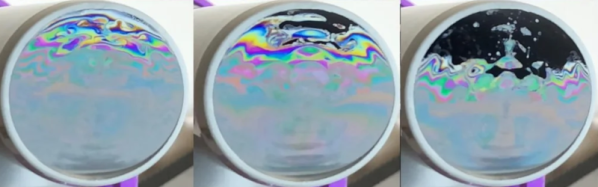
While fluid dynamics sounds like a dull topic, SoapFilmScope promises to make it fun by using your cell phone to observe the interactions between sound waves and liquid membranes. You can make your own with some PVC pipe, some 3D-printed attachments, a speaker, and a few other odds and ends.
If your PVC pipe doesn’t match [DaniloR29’s] exactly, no problem. The files are in OpenSCAD so you can easily change them to suit your needs. One end of the PVC tee dips into soap solution to form a film — think like a soap bubble before you blow it out of the bubble wand. The other ends have the speaker and the cell phone camera.
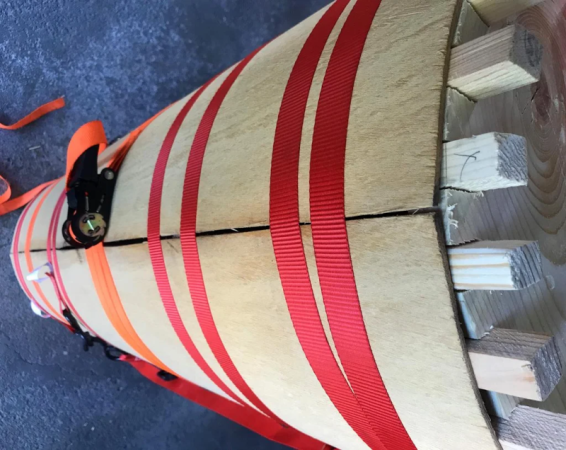
To be clear, when we are talking about tubes, we mean ordinary cylinders, not vacuum-amplifying elements. With that out of the way, when we need a tube like that, we usually think of PVC or some other kind of pipe product. Or maybe we’ll 3D print what we need. But not [GregO29]. He made his tubes from plywood.
You can make tubes as small as 12 inches in diameter, and [GregO29] made some that were 16 inches. The first step was to make a mold or form. In this case, he elected to make a form that the tube-to-be wraps around. The plywood is thin 2-ply white birch. This makes it easy to shape.
The basic idea is to wrap the wood around the form and glue it. You hold it together with a strap until it dries. Then, you can add more layers until it is the thickness you need.
The real problem turned out to be removing the form once it was done. Why make a tube like this? In [Greg]’s case, he’s building a telescope, which is as good a reason as any to have a tube, we suppose.
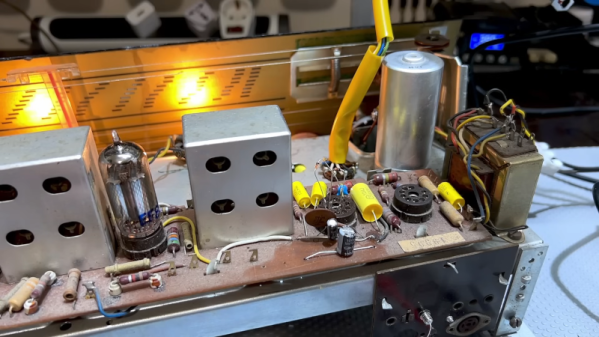
[M Caldeira] had a project in mind: replacing a common vacuum tube with a solid-state equivalent. The tube in question was an EABC80 or 6AK8 triple diode triode. The key was identifying a high-voltage FET and building it, along with some other components, into a tube base to make a plug-in replacement for the tube. You can see a video about the project below.
These tubes are often used as a detector and preamplifier. Removing the detector tube from a working radio, of course, kills the audio. Replacing the tube with a single diode restores the operation of the radio, although at a disadvantage.
From there, he adds more diodes directly into the socket. Of course, diodes don’t amplify, so he had to break out a LND150 MOSFET with a limit of 500 volts across the device. It takes some additional components, and the whole thing fits in a tube base ready for the socket.
Usually, we see people go the other way using tubes instead of transistors in, say, a computer. If you want real hacking, why not make your own tubes?